VEILTA
03/16/2026
Walk into any beauty retailer and you'll find pimple patches making extraordinary claims: “dissolves deep acne”, “clinically proven”, “clears pimples overnight.”
For consumers, ingredient literacy is helpful.
For private label skincare brands, it’s essential.
The ingredient list on a pimple patch determines:
This guide breaks down the most common acne patch ingredients, explains what they actually do, and gives brand owners a framework for evaluating patch formulations when working with an OEM manufacturer.
Unlike creams or serums, pimple patches have almost no sensory experience.
Consumers don't feel texture, fragrance, or absorption — they simply apply the patch and wait.
That means ingredients carry the entire product story.
A patch’s formula determines:
Brands that don't fully understand their ingredient list struggle to differentiate in today's ingredient-aware skincare market.
Every acne patch starts with a base material that determines its core function.
Hydrocolloid is the original pimple patch technology, adapted from wound care dressings.
It forms a gel when it absorbs fluid from the blemish.
What hydrocolloid actually does
The white spot that appears after wearing a patch is absorbed fluid — visible proof that the patch is working.
| Ingredient | Function |
|---|---|
| Carboxymethylcellulose (CMC) | Primary absorbent |
| Pectin | Improves gel formation |
| Polyisobutylene | Elasticity and adhesion |
| Styrene copolymers | Adhesive stability |
Medical-grade hydrocolloid generally delivers better absorption and stronger performance.
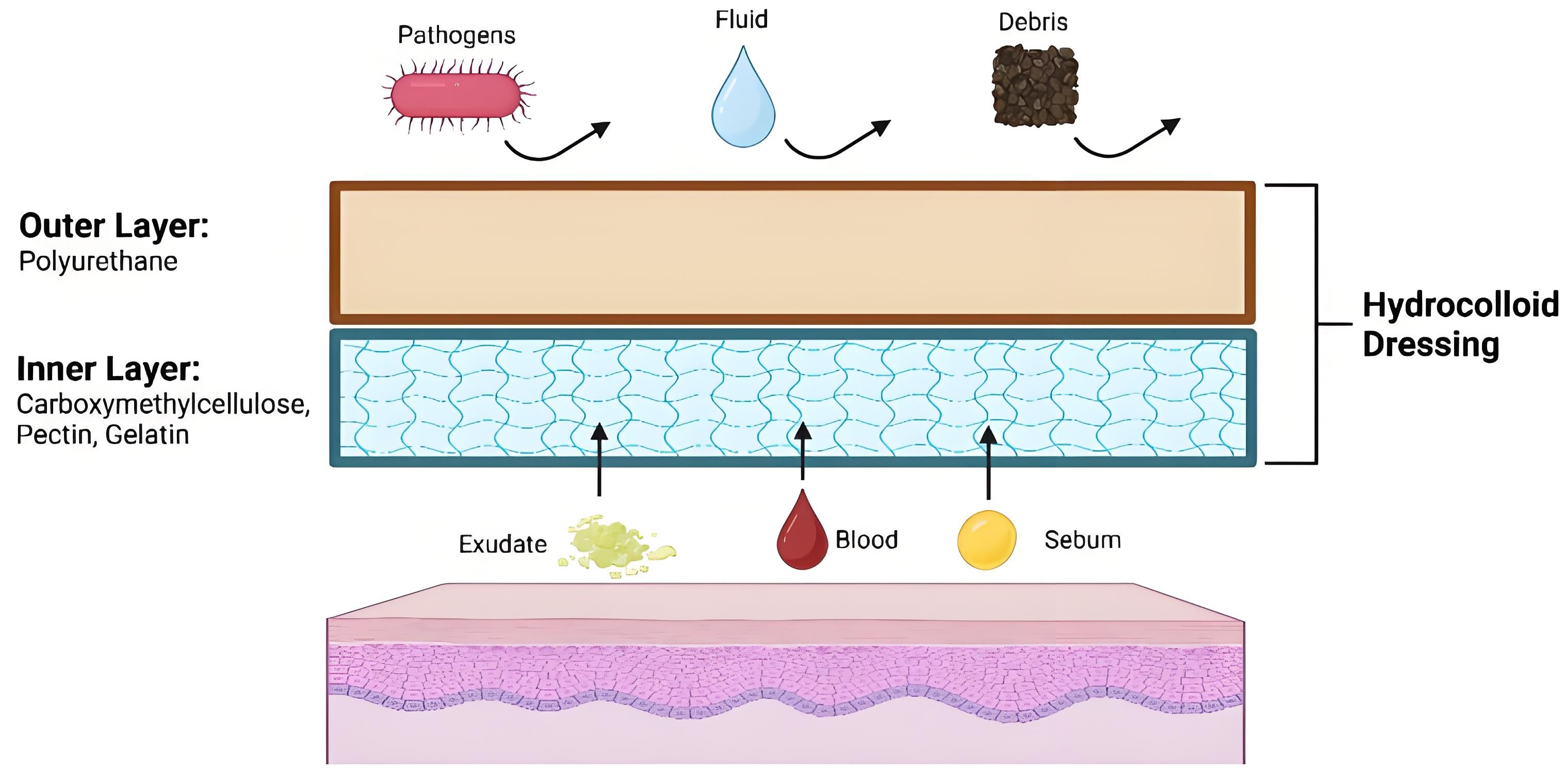
Hydrocolloid technology absorbs pimple fluid while protecting the blemish.
Ultra-thin PU film patches are designed for daytime wear.
What they do
However, they do not absorb fluid, making them less effective for mature pimples.
Active ingredients transform a basic patch into a treatment product.
The most clinically proven acne treatment ingredient.
Benefits
Typical concentrations
| Level | Effect |
|---|---|
| 0.5% | Gentle exfoliation |
| 1-2% | Standard acne treatment |
| >2% | OTC drug classification (US) |
⚠ In the United States, salicylic acid can trigger OTC drug regulations if acne treatment claims are made.
One of the most versatile skincare actives.
Benefits
Typical concentrations
| Level | Effect |
|---|---|
| 2-4% | Mild brightening |
| 4-10% | Oil control & PIH reduction |
Niacinamide is cosmetic-grade globally, making it one of the safest actives for international markets.
A moisture-binding ingredient that supports skin healing.
Benefits in patches
HA also has strong consumer recognition, making it valuable for marketing.
A botanical ingredient widely used in K-beauty acne products.
Key benefits
Ideal for sensitive-skin positioning.
A natural antibacterial essential oil.
Benefits
Best suited for clean beauty or botanical brands.
However, high concentrations can cause irritation.
A premium ingredient derived from salmon DNA.
Originally used in medical aesthetic treatments.
Benefits
PDRN has strong K-beauty innovation positioning and supports premium pricing.
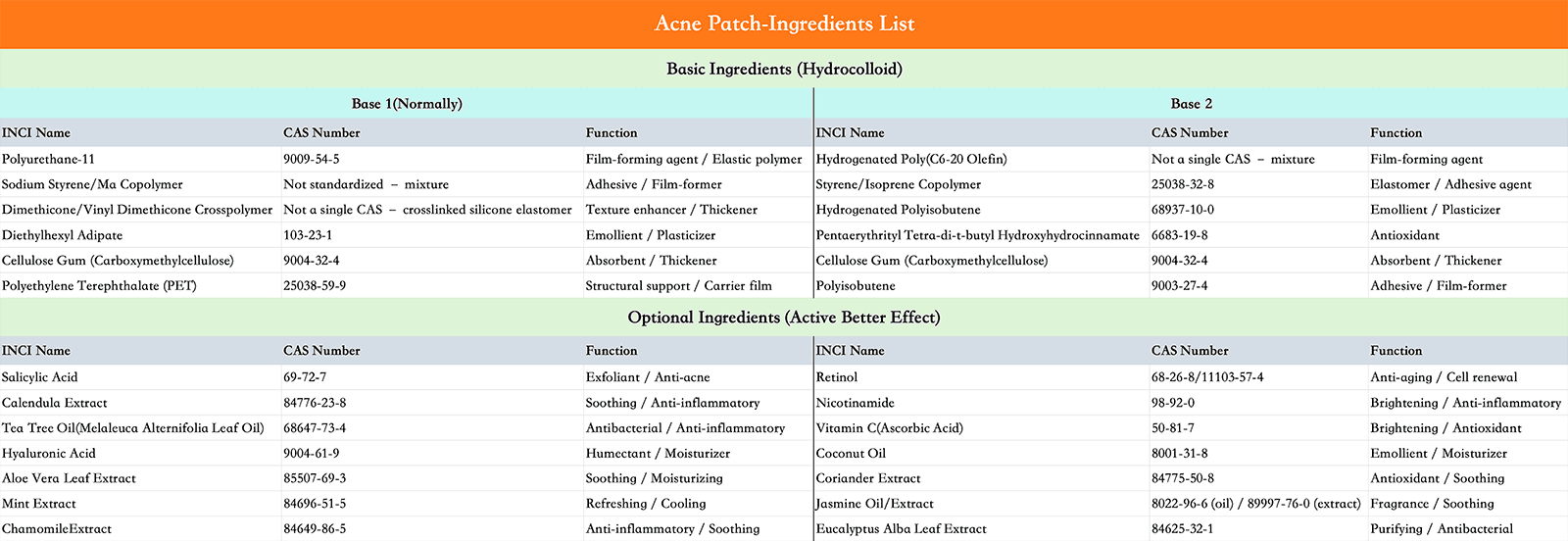
Active ingredients determine the treatment mechanism of acne patches.
Peptides are small signaling molecules that trigger skin repair.
Common peptides used in acne patches:
| Peptide | Function |
|---|---|
| Oligopeptide-76 | Antimicrobial |
| Copper Peptide | Wound healing |
| Palmitoyl Tripeptide-1 | Collagen stimulation |
Peptides are often used in premium clinical skincare products.
Supporting ingredients improve product stability and skin compatibility.
Common examples include:
Preservatives
Colorants
Used for skin-tone invisible patches or decorative patches.
Aloe Vera
Provides soothing and hydration benefits.
Fragrance
Usually avoided in acne patches due to irritation risk.
When reviewing a patch formula, ask these five questions.
Every component should support performance or stability.
Trace levels may only exist for marketing claims.
Example:
Regulations vary between:
Examples:
All require supporting data.
Successful acne patches usually combine multiple complementary ingredients.
Hydrocolloid + Salicylic Acid + Niacinamide
Treats active pimples and reduces marks.
Hydrocolloid + Centella + Hyaluronic Acid
Gentle and calming.
Microneedle + PDRN + Centella
Advanced delivery with strong marketing story.
Hydrocolloid + 2% Salicylic Acid + Niacinamide + Peptides
Maximum acne treatment performance.
Strong formulations include:
Weak formulas rely on trending ingredients at ineffective levels and unsupported claims.
For brands launching new acne patches, ingredient strategy is the foundation of product credibility.
VEILTA works with skincare brands worldwide to develop OEM and private label acne patches, including hydrocolloid patches, invisible patches, microneedle patches, and active-ingredient formulations.
Our R&D team provides:
Hydrocolloid is the key ingredient because it absorbs fluid from pimples and creates a protective healing environment.
In the United States, salicylic acid may be regulated as an OTC drug if acne treatment claims are made.
Yes. Tea tree oil has antimicrobial and anti-inflammatory properties, though it is generally milder than salicylic acid.
Yes. Many effective formulas combine ingredients such as salicylic acid, niacinamide, and centella asiatica.