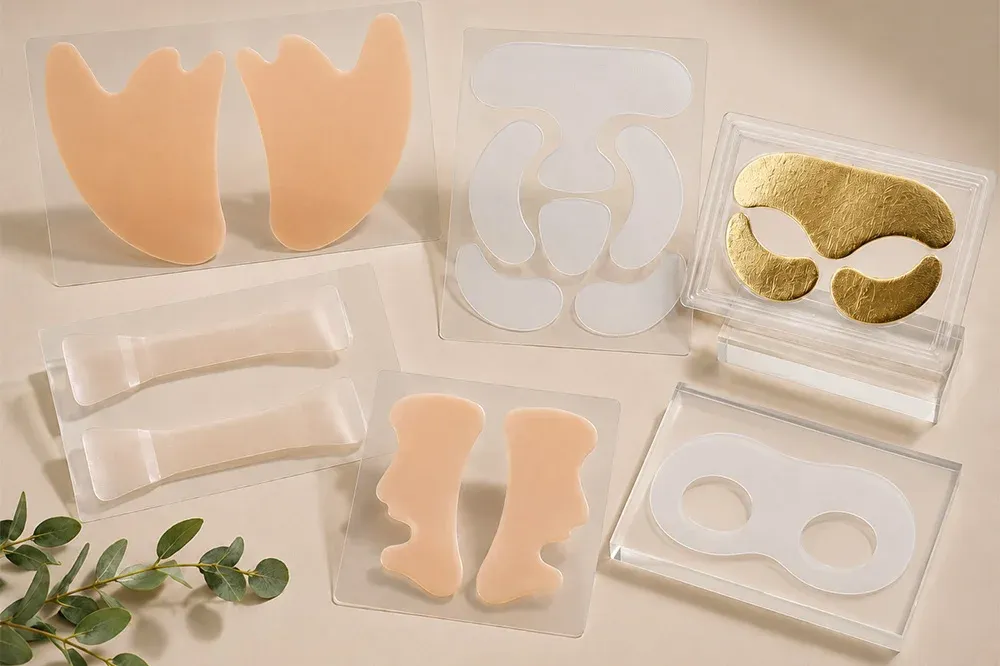
Reusable silicone and single-use hydrogel patches die-cut for forehead, eye, smile line and neck — from 10,000 pairs, with adhesion tested over the claimed reuse count.
Product fundamentals
Wrinkle patches work by two mechanisms — occlusion and mechanical splinting — and neither involves delivering an active ingredient. Understanding that is what separates a credible product from an overstated one.
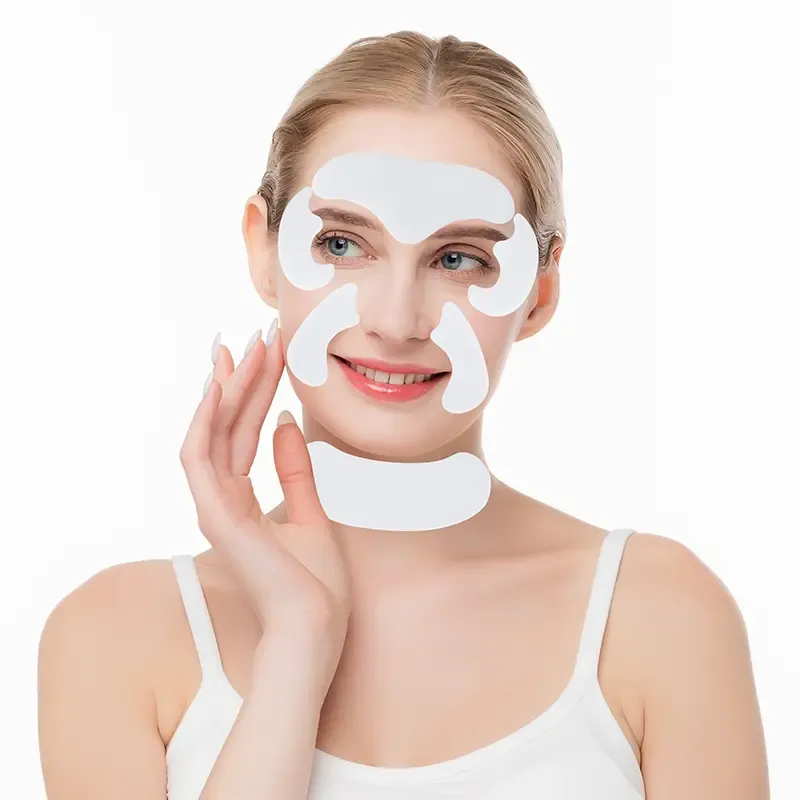
Occlusion. A silicone or hydrogel patch traps moisture against the skin, which plumps the stratum corneum and makes fine lines look softer for a few hours. This is a temporary, cosmetic effect and it is genuinely visible.
Mechanical splinting. A patch holds the skin flat while it is worn, limiting the repeated folding that creates expression lines. Reusable silicone patches are typically worn overnight for this reason. The effect is cumulative only in the sense that habit matters — the patch is not repairing anything while it sits in a drawer.
What a wrinkle patch does not do is deliver a meaningful dose of an active through intact skin. A hydrogel patch can carry peptides or niacinamide, and it will hydrate, but a claim of structural change is not supportable on the mechanism.
That distinction matters commercially. Brands that position honestly — "smooths the look of fine lines while you sleep" — build repeat purchase. Brands that promise to remove wrinkles generate a return rate that no margin survives.
Swipe the table →
| Parameter | Typical range |
|---|---|
| Minimum order | 10,000 pairs for silicone, 5,000 for hydrogel |
| Silicone thickness | 0.3–0.8 mm |
| Claimed reuse | 15–30 applications, tested not assumed |
| Areas | Forehead, eye, smile line (nasolabial), neck, chest |
| Materials | Medical-grade silicone, hydrogel, collagen gel |
| Finishes | Clear, skin tone, gold foil, matte, printed |
| Packaging | Tin, pouch with backing card, rigid case, multi-piece set |
| Sample lead time | 7–10 working days |
| Bulk lead time | 20–25 working days after artwork approval |
A 0.3 mm silicone patch drapes closely and feels nearly invisible, but it tears at the edge after a dozen handling cycles. A 0.6–0.8 mm patch survives 25–30 washes, feels more substantial, and is easier to reposition — which is why most reusable products sit in that range.
The thickness also determines the packaging. A thin patch can ship flat in a pouch with a card; a thicker one needs a rigid tin or case to avoid permanent creasing, and a crease in a reusable patch is a defect the customer sees on the first use.
Material selection
The three materials produce three different products with different price points, different claim sets and different packaging. Confusing them is the most common positioning error in this category.
Swipe the table →
| Material | Mechanism | Reuse | Relative cost | Best suited to |
|---|---|---|---|---|
| Medical-grade silicone | Occlusion plus mechanical splinting | 15–30 uses | Medium | Reusable overnight patches in tins, anti-wrinkle positioning |
| Hydrogel | Cooling, hydration, serum delivery | Single use | Low–medium | Single-use treatment patches, cooling and de-puffing claims |
| Collagen gel | Hydration with a collagen matrix | Single use | Medium | Single-use patches with a collagen story, gift sets |
Medical-grade silicone is the format that justifies a higher price because it is reusable. It carries no serum, so the value proposition is entirely about the physical mechanism and the durability. This makes adhesion testing critical — the product is bought once and evaluated over 20-plus uses, so the first failure defines the review.
Hydrogel is single-use and cheaper, with a stronger immediate sensory payoff: it is cool, wet and visibly hydrating. It suits a "treatment" positioning and pairs well with serum-based claims. It cannot be reused, so the price per use is far higher — which caps the retail price unless the pack contains several pieces.
Collagen gel sits between the two. It carries a collagen matrix that supports a hydration story and photographs as a substantial, premium product. It is single-use, and the collagen is a marketing asset more than a functional one at typical inclusion levels.
If your goal is a reusable product at a premium price point, silicone is the only option. If your goal is a low-price, high-volume single-use product with strong sensory appeal, hydrogel is correct. Collagen gel occupies a narrow middle that works best in gift and set formats where the visual presentation carries the sale.
Customisation scope
Shape does the functional work in this category — a forehead patch and an eye patch are different products, not different sizes — and set composition drives the price point.
Swipe the table →
| Element | Options | Effect on minimum order |
|---|---|---|
| Shape | Forehead, eye pair, smile line, neck, chest, full-face set | Standard dies at base MOQ; new die +10,000 pairs |
| Thickness | 0.3–0.8 mm silicone | Included |
| Finish | Clear, skin tone, gold foil, matte, printed | +10,000 pairs for gold foil or print |
| Set composition | Single area, 2-piece, 3-piece, full-face kit | Included if same die family |
| Packaging | Tin, pouch with card, rigid case, box set | Structure-dependent |
| Logo on case, printed backing card, instruction leaflet | +10,000 pairs per design |
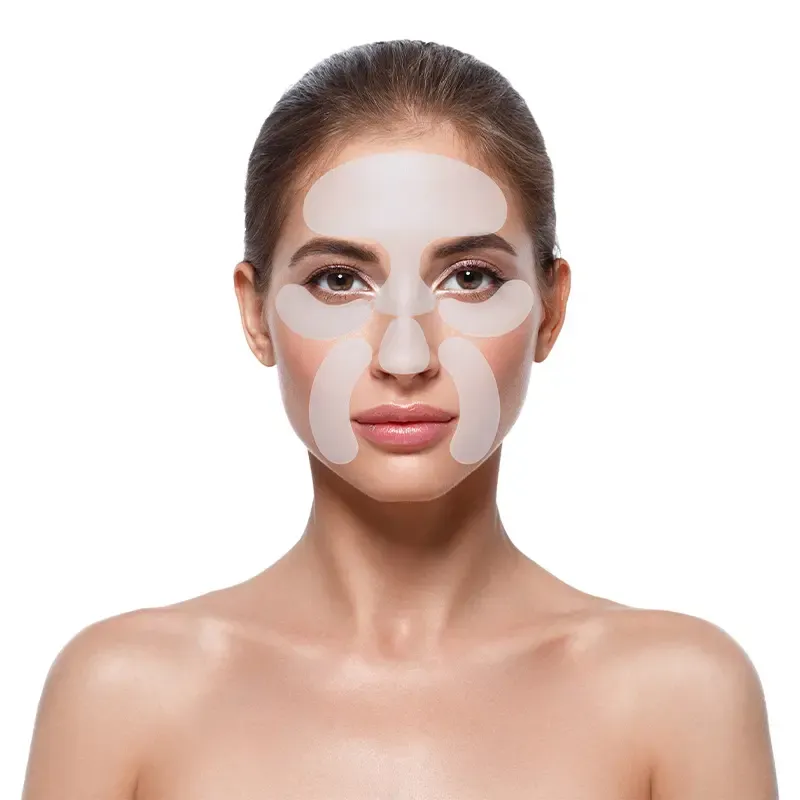
A forehead patch is a wide horizontal strip that resists the frontalis muscle folding vertically. A smile-line patch is a narrow curved strip along the nasolabial fold. A neck patch is a broad panel that has to stay in place while the wearer sleeps. The three are not interchangeable and a single "universal" shape serves none of them well.
This is why set composition is such a strong commercial lever: a three-piece kit covering forehead, eye and smile line addresses the concerns a buyer actually has, and it justifies a higher price than three separate single-area products.
Gold-foil lamination is the most requested finish and the one that most reliably signals a premium price point. It costs 10,000 pairs of minimum order and adds a step to the process, but in this category the visual difference between a clear patch and a gold one is worth more at retail than the cost difference.
Printed backing cards and instruction leaflets are frequently overlooked and matter more than brands expect. A reusable patch needs cleaning instructions, and a set needs a diagram showing where each piece goes. Without them, the customer guesses, and guessing produces poor results and poor reviews.
01
Brief and claim review
Area, mechanism and claim wording. Anti-ageing language is restricted in several markets, so the claim set is checked against the destination before design begins.
02
Material and thickness selection
Silicone for reusable, hydrogel or collagen gel for single use. Thickness follows from the claimed reuse count, not from a preference.
03
Shape and set design
Dies for the target areas, plus set composition if the product is a kit. Fit is checked on a face form rather than judged from a drawing.
04
Reuse and adhesion testing
The patch is washed and reapplied the claimed number of times, with adhesion measured at intervals. This is the test the product will be judged on in use.
05
Die-cutting and finishing
Silicone is cast to thickness, die-cut and finished. Thickness uniformity is gauged across the sheet, because a thin spot tears first.
06
Packing and release
Packed into tins, cases or pouches with backing card and leaflet. Appearance, dimensions and adhesion checked before release, with retained samples kept.
Commercials
Reusable silicone patches carry a higher unit cost than single-use hydrogel but a far higher price ceiling, because the customer is buying 20-plus uses rather than one.
Swipe the table →
| Order quantity | Relative unit cost | Production window |
|---|---|---|
| 10,000–24,999 pairs | Highest | 20–23 working days |
| 25,000–99,999 pairs | Mid | 20–25 working days |
| 100,000–499,999 pairs | Lower | 25–30 working days |
| 500,000+ pairs | Lowest | Scheduled per project |
A tinned reusable silicone patch breaks down roughly as: silicone material 25–35%, tin or case 25–35%, printing and leaflet 10–15%, die-cutting and QC 10–15%, export packing and freight 5–10%. Two consequences follow.
The tin is a positioning decision. A rigid tin signals a reusable product and justifies a price several times that of a pouch. The same patch in a printed pouch reads as a disposable and sells at a fraction of the price. This is the single largest commercial lever in the category.
Set composition multiplies revenue at modest cost. A three-piece set uses three dies from the same family, a slightly larger case and one extra leaflet. The retail price moves by far more than the cost does.
Samples are charged at cost and credited against the bulk order. Reuse testing is included in standard sampling for silicone products, because the adhesion claim cannot be verified any other way.
20–25 working days from signed artwork and received deposit. Two things add time: new dies, and rigid cases or tins, which are frequently 4–6 weeks lead-time items. If launch is fixed and the case is bespoke, order the case first.
Quality and compliance
A reusable patch is evaluated over 20-plus uses, so the quality programme has to test the product the way the customer will experience it — repeatedly, and after washing.
Swipe the table →
| Document | What it covers | When issued |
|---|---|---|
| COA | Batch-specific thickness, dimensions and adhesion results | With shipment |
| Material declaration | Silicone grade and biocompatibility summary | With quotation |
| SDS / MSDS | Handling and transport classification | With quotation |
| Reuse test report | Adhesion measured across the claimed number of washes | On request |
| Cleaning instructions | Text and diagram for the backing card or leaflet | With artwork |
| CPSR support | Safety assessment inputs for EU placement | On request |
Wording restrictions on anti-ageing claims vary by market and are enforced more actively than most brands expect. "Reduces the appearance of fine lines" is generally defensible for an occlusive patch; "removes wrinkles" is not, and "anti-wrinkle" itself is treated as a claim in some jurisdictions rather than a product name.
We check the wording against the destination market before artwork, because a claim that cannot be printed changes the product name, the carton and sometimes the positioning.
Buyer's checklist
This is a category where the honest answer and the marketable answer are often different. These questions identify suppliers who know the difference.
This page covers one category only. Brands assembling a complete line usually pair it with Eye Patch OEM and Face Cream OEM. MOQ, lead times and material options for every category we run sit on the OEM/ODM service page.
What brands ask when sourcing wrinkle patches, answered with the specifications we work to.
10,000 pairs for reusable silicone and 5,000 pieces for single-use hydrogel. Gold foil, printing or a new die adds 10,000 pairs per design. Rigid tins and cases are quoted separately because they are frequently the longer lead-time item.
By occlusion and mechanical splinting. The patch traps moisture against the skin, which temporarily plumps fine lines, and holds the skin flat to limit repeated folding while worn. Neither mechanism involves delivering an active ingredient through intact skin, so claims of structural change are not supportable.
15–30 applications depending on thickness and how it is handled. A 0.3 mm patch drapes more closely but tears at the edge sooner; 0.6–0.8 mm survives 25–30 washes. The claimed number should be backed by adhesion data measured after that many washes, not assumed.
0.3–0.4 mm for a nearly invisible patch where discretion matters more than longevity, and 0.6–0.8 mm for a reusable product where the customer expects 20-plus uses. Thickness also determines packaging: thin patches ship flat in a pouch, thicker ones need a tin or case to avoid permanent creasing.
Forehead, eye pair, smile line, neck and chest, plus full-face sets. These are genuinely different products rather than different sizes — a forehead strip resists vertical folding, a smile-line strip follows the nasolabial curve, and a neck panel has to stay in place overnight.
Yes. Gold-foil lamination, matte finishes, skin-tone tinting and surface printing are all available, each adding 10,000 pairs to the minimum per design. Gold foil is the finish most reliably associated with a premium price point in this category.
They work differently. Hydrogel gives a stronger immediate sensory effect — cool, wet, visibly hydrating — but it is single-use, so the cost per use is far higher. Silicone is reusable and relies on the physical mechanism. Most successful ranges carry both rather than choosing one.
Hydrogel and collagen gel patches can carry peptides, niacinamide or hyaluronic acid, and they will hydrate. Silicone patches cannot deliver actives — silicone occludes, it does not release. Marketing a silicone patch as delivering ingredients is a claim that will not survive scrutiny.
Wording restrictions vary by market, and 'anti-wrinkle' is itself treated as a claim in some jurisdictions rather than a product name. A defensible structure is a descriptive product name plus an appearance-based claim, for example 'Forehead Smoothing Patch' with 'helps smooth the look of fine lines'. We review the wording against your destination market before artwork.
A rigid tin or case signals a reusable product and supports a price several times that of a pouch; the same patch in a printed pouch reads as disposable. Include a printed cleaning instruction and, for sets, a placement diagram — they materially affect how the product performs over 20 uses.
Send us your brief and we will come back with a formulation direction, a realistic MOQ and a production schedule.