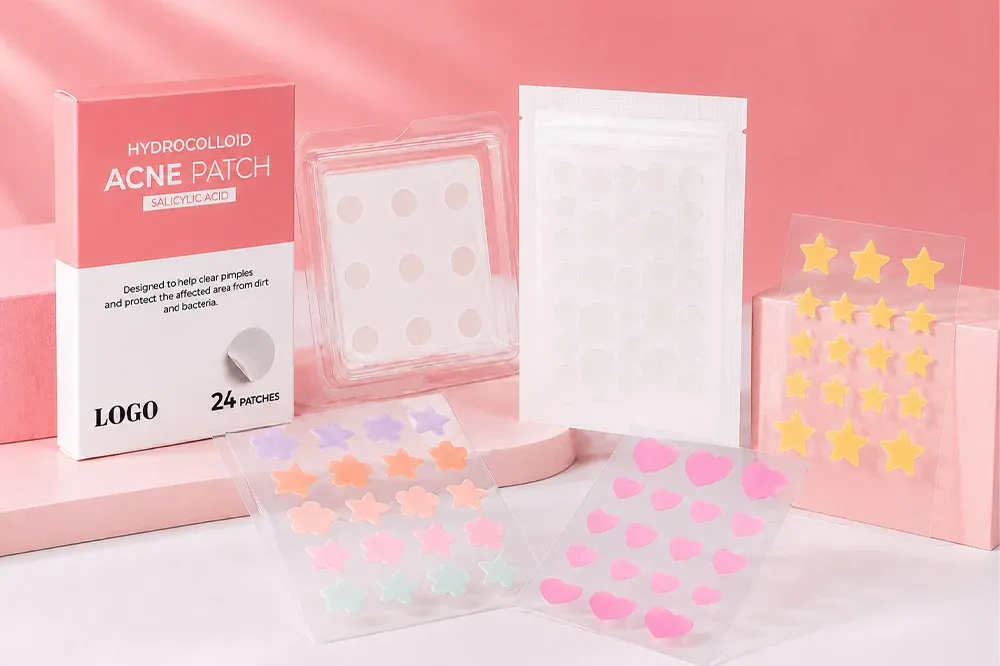
Hydrocolloid, microneedle and invisible patches die-cut, backed and pouched in-house — from 10,000 pieces, with the adhesive and edge profile matched to how the patch is worn.
Product fundamentals
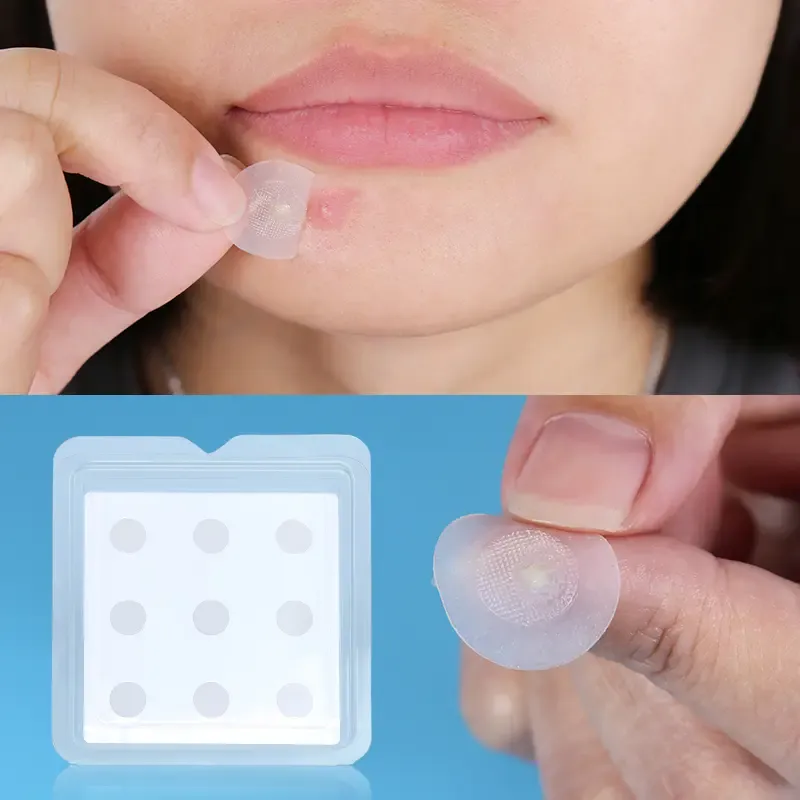
A hydrocolloid acne patch is a thin absorbent dressing with a tapered adhesive edge. It works by absorbing fluid and shielding the blemish, not by delivering an active. Thickness and edge profile decide whether it stays on and whether it stays invisible.
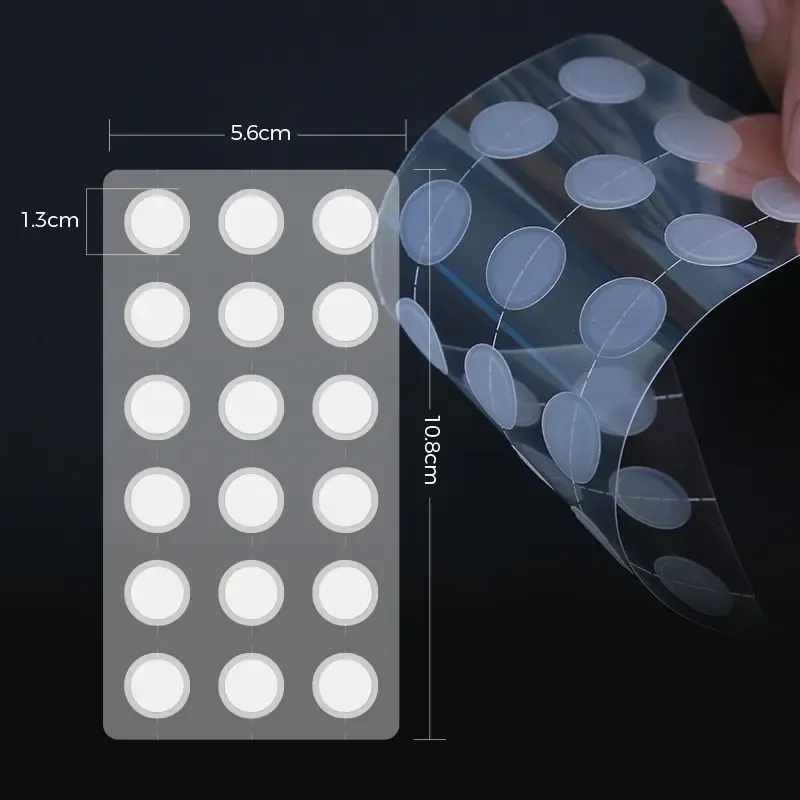
A standard hydrocolloid patch has four layers:
The performance difference between a patch that works and one that falls off is almost entirely in the edge. A straight die cut has a hard border that lifts within hours on a curved jawline; a tapered, bevelled edge feathers into the skin and holds overnight.
Swipe the table →
| Parameter | Typical range |
|---|---|
| Minimum order | 10,000 pcs per size and SKU, 20,000 per printed pouch |
| Thickness | 0.2–0.45 mm (invisible), 0.4–0.8 mm (standard) |
| Absorbency | 150–400% of dry weight |
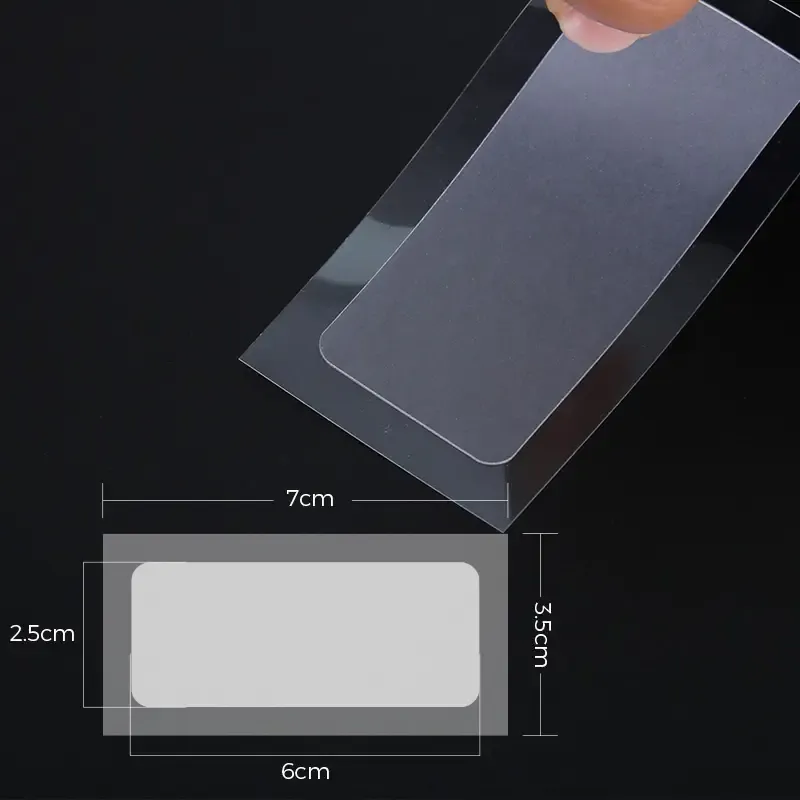
| Sizes | 8 / 10 / 12 / 14 mm round; 20 × 30 mm oval; custom dies |
| Edge profile | Straight cut or tapered (bevelled) edge |
| Materials | Hydrocolloid, microneedle, thin-film silicone |
| Effects | Clear, opaque, holographic, printed, UV colour-change |
| Pack formats | Single pouch, 12/24/36-count card, jar, bulk poly bag |
| Sample lead time | 7–10 working days |
| Bulk lead time | 20–25 working days after artwork approval |
Invisible patches are thin — 0.2 to 0.45 mm — so they disappear under makeup and in daylight. The cost of thinness is absorbency: a 0.25 mm patch holds roughly half what a 0.6 mm patch holds, which suits a daytime patch on a small blemish and disappoints on a larger one.
Standard patches run 0.4–0.8 mm and visibly swell as they absorb, which is satisfying for the wearer and reads well in short-form video. They are less discreet.
Material selection
These are three genuinely different products, not three grades of one. They differ in mechanism, manufacturing process, cost and — in several markets — regulatory classification.
Swipe the table →
| Type | Mechanism | Absorbency | Relative cost | Regulatory note |
|---|---|---|---|---|
| Hydrocolloid | Absorbs exudate, shields from picking | 150–400% of dry weight | Low | Cosmetic in most markets; medical device in some |
| Microneedle | Dissolving micro-structures deliver actives into the upper epidermis | Low — not an absorbent | High | Frequently regulated as a medical device or borderline product |
| Thin-film silicone | Occludes and protects without absorbing | None | Low | Cosmetic in most markets |
| Hydrocolloid with active | Absorbs plus a salicylic acid or tea tree layer | 150–300% | Medium | Claim set narrows; check market rules |
Hydrocolloid is the volume product and the easiest to launch. Tooling is modest, lead times are short, and the claim set is straightforward ("absorbs", "helps protect"). It is also the most competitive segment, so differentiation has to come from shape, colour and packaging rather than performance.
Microneedle is the premium play. A microneedle patch carries dissolving structures — usually hyaluronic acid or a sugar matrix loaded with actives — that penetrate the stratum corneum. It costs several times more to produce, requires tighter process control, and in many markets moves the product into medical device territory. It also generates the strongest marketing story in the category.
Thin-film silicone is the cheapest option and the weakest story. It protects and occludes but does not absorb, so it suits spot-prone skin without active blemishes and pairs badly with a claim built around absorption.
Whether an acne patch is a cosmetic or a medical device depends on the market and on the claims printed on the pack. A hydrocolloid patch sold as "helps protect blemishes" is cosmetic in most jurisdictions; the same patch described as "treats acne" may not be. Adding a microneedle or an active ingredient usually narrows the options further.
Customisation scope
Acne patches are the most visually merchandised product in the category. Shape and effect carry more commercial weight than absorbency, because they are what appears in user content.
Swipe the table →
| Element | Options | Effect on minimum order |
|---|---|---|
| Shape / die | Round 8–14 mm, oval, heart, star, rectangle, large-coverage, custom | Standard dies at base MOQ; new die +10,000 pcs |
| Thickness | 0.2–0.8 mm | Included |
| Colour | Clear, opaque skin tone, black, holographic, printed pattern | +10,000 pcs per additional colour |
| Effect | UV colour-change, glitter, glow-in-dark | +20,000 pcs |
| Printing | Logo on patch surface, printed backing card | +10,000 pcs |
| Packaging | Single pouch, 12/24/36-count card, jar, tin, bulk | Structure-dependent |
| Format mix | Multi-size sheet, mixed-shape sheet | Included if same die family |
Shape is the cheapest differentiator and the most photographed. Heart and star dies cost a one-off tooling charge and instantly differentiate a listing in a category where every competitor shows a beige circle.
UV colour-change patches shift colour on exposure to sunlight, which is a genuine novelty and performs strongly in short-form video. It adds 20,000 pieces to the minimum and requires a UV-sensitive pigment that must be stability-checked, because the effect degrades with shelf time.
Multi-size sheets solve a real consumer problem — one blemish is not the same size as another — and cost nothing extra if the dies fall within the same family. This is the highest-value, lowest-risk customisation on the list.
Bespoke dies on a first order under 30,000 pieces. Tooling is real money, and a new shape that has not been market-tested rarely reorders. Launch on the closest standard die, validate the concept through reviews and returns data, then invest in tooling for the second production run.
01
Brief and classification review
Product type, target claim and market. We confirm which claims keep the product in cosmetic classification for your destination, before any tooling or artwork begins.
02
Material and adhesive selection
Backing film, hydrocolloid thickness and adhesive are fixed here. These three decide wear time and whether the patch reads as invisible.
03
Sampling and wear testing
7–10 working days. Samples are supplied on the specified backing so you can test adhesion on oily skin rather than judging from a photograph.
04
Die, artwork and pouch proofing
Die line, patch print and pouch artwork cleared as one set. We release against a signed physical proof — colour on screen is not a proof.
05
Coating, die-cutting and pouching
Hydrocolloid is coated to thickness, laminated to backing, die-cut and pouched. Adhesive peel strength is checked per lot; thickness is gauged across the web.
06
Release and export packing
Appearance, adhesion and dimensional checks before release, with retained samples kept past shipment so a later complaint can be investigated against the batch.
Commercials
Acne patch pricing is dominated by packaging and die-cutting rather than material. The bands below assume a 12 mm round hydrocolloid patch in a single foil pouch.
Swipe the table →
| Order quantity | Relative unit cost | Production window |
|---|---|---|
| 10,000–24,999 pcs | Highest | 20–23 working days |
| 25,000–99,999 pcs | Mid | 20–25 working days |
| 100,000–499,999 pcs | Lower | 25–30 working days |
| 500,000+ pcs | Lowest | Scheduled per project |
A pouched acne patch breaks down roughly as: pouch and backing card 30–40%, hydrocolloid material 20–30%, die-cutting and conversion 15–20%, pouching and QC 10–15%, export packing and freight 5–10%. The formula is almost irrelevant because there usually is not one.
This has a counter-intuitive consequence: the pack is the product. Moving from a single foil pouch to a 24-count printed card changes unit cost more than switching backing film, and it changes retail positioning more too. The 24-count card at a low price point is the format that sells in drugstore channels; the single pouch sells in beauty retail and subscription boxes.
Samples are charged at cost and credited against the bulk order. Custom die tooling is quoted separately and is a one-off charge that belongs to the buyer — it is not amortised into unit price, because doing so hides a real cost in the quotation.
20–25 working days starts from signed artwork and received deposit. Two things routinely add a week: new die fabrication, and UV or holographic effects that need a pigment stability pre-check. If your launch date is fixed and the effect is novel, order samples earlier than feels necessary.
Quality and compliance
An acne patch fails in one of two ways: it falls off, or it does nothing. Both are measurable before shipment, and neither is caught by visual inspection alone.
Swipe the table →
| Document | What it covers | When issued |
|---|---|---|
| COA | Batch-specific thickness, peel strength and absorbency results | With shipment |
| SDS / MSDS | Handling and transport classification | With quotation |
| Material declaration | Backing, adhesive and hydrocolloid composition | With quotation |
| Biocompatibility summary | Cytotoxicity and irritation data where available | On request |
| Stability data | Adhesive and absorbency retention over shelf life | After stability run |
| Export documentation | Commercial invoice, packing list, origin | Per shipment |
Claims and classification are linked. "Helps protect blemishes" and "absorbs exudate" are cosmetic language in most markets. "Treats acne" is a medicinal claim in many, and moves the product into a different regulatory category with different testing requirements.
Buyer's checklist
Acne patch is the most crowded segment in private label skincare. These questions surface the difference between a converter with a coating line and a trader with a catalogue.
This page covers one category only. Brands assembling a complete line usually pair it with Serum OEM and Eye Patch OEM. MOQ, lead times and material options for every category we run sit on the OEM/ODM service page.
What brands and distributors ask during evaluation, answered with the specifications we work to.
Four layers: a polyurethane or PET backing film, a hydrocolloid matrix of carboxymethyl cellulose dispersed in an elastomer, a skin-contact adhesive, and a release liner. The hydrocolloid layer absorbs fluid; the backing keeps it in place and shields the blemish from picking. There is usually no active ingredient.
10,000 pieces per size and SKU. A printed pouch or backing card raises the minimum to 20,000 pieces per design. Custom dies add a one-off tooling charge rather than raising the unit minimum, and tools are quoted separately so the cost is visible.
Hydrocolloid patches absorb exudate and shield the blemish — a physical mechanism with no active delivery. Microneedle patches carry dissolving micro-structures that penetrate the upper epidermis and deliver actives. Microneedle costs several times more to produce and in many markets is regulated as a medical device rather than a cosmetic.
0.2–0.45 mm for an invisible daytime patch, and 0.4–0.8 mm for a standard patch. Thinner patches are more discreet but hold roughly half the fluid, so they suit small blemishes. Thicker patches visibly swell as they absorb, which customers find satisfying and which photographs well.
Backing film matters more than thickness. A matte polyurethane backing at 0.3 mm reads as more invisible than a glossy film at 0.45 mm, because glossy film catches light and creates a visible sheen. Always compare samples photographed under the same lighting rather than judging from a catalogue image.
Yes. Heart, star, oval, rectangle and large-coverage dies are all available, with a one-off tooling charge and a 10,000-piece minimum per shape. Shape is the cheapest visual differentiator in this category and the one most likely to appear in user-generated content.
A patch containing a UV-sensitive pigment that shifts colour on exposure to sunlight. It adds 20,000 pieces to the minimum and requires a pigment stability check, because the effect degrades over shelf life. It performs strongly in short-form video and is usually a marketing-led rather than performance-led purchase.
Standard hydrocolloid cosmetic patches are not sterile and do not need to be. If your market or your claim requires sterility, that changes the manufacturing process, the pouch specification and usually the regulatory classification. Tell us at brief stage — retrofitting sterility after artwork is expensive.
Single foil pouches, 12/24/36-count printed cards, jars, metal tins and bulk poly bags. Pouch and card account for 30–40% of unit cost, so the format decision is commercial rather than cosmetic. Multi-count cards suit drugstore and gifting; single pouches suit beauty retail and subscription.
Typically 24–36 months unopened, limited by adhesive ageing rather than by the hydrocolloid itself. Adhesive that has passed its window still absorbs but no longer holds, which is why we run stability on peel strength over time, not only on appearance.
Send us your brief and we will come back with a formulation direction, a realistic MOQ and a production schedule.