
Fabric, essence and sachet engineered together — from 5,000 pieces, with the die line and essence load matched to the retail price you need to hit.
Product fundamentals
A sheet mask is a fabric or gel substrate saturated with essence and sealed in a single-use sachet. Three variables decide whether it feels premium: fabric weight, essence load and how closely the die follows the face.
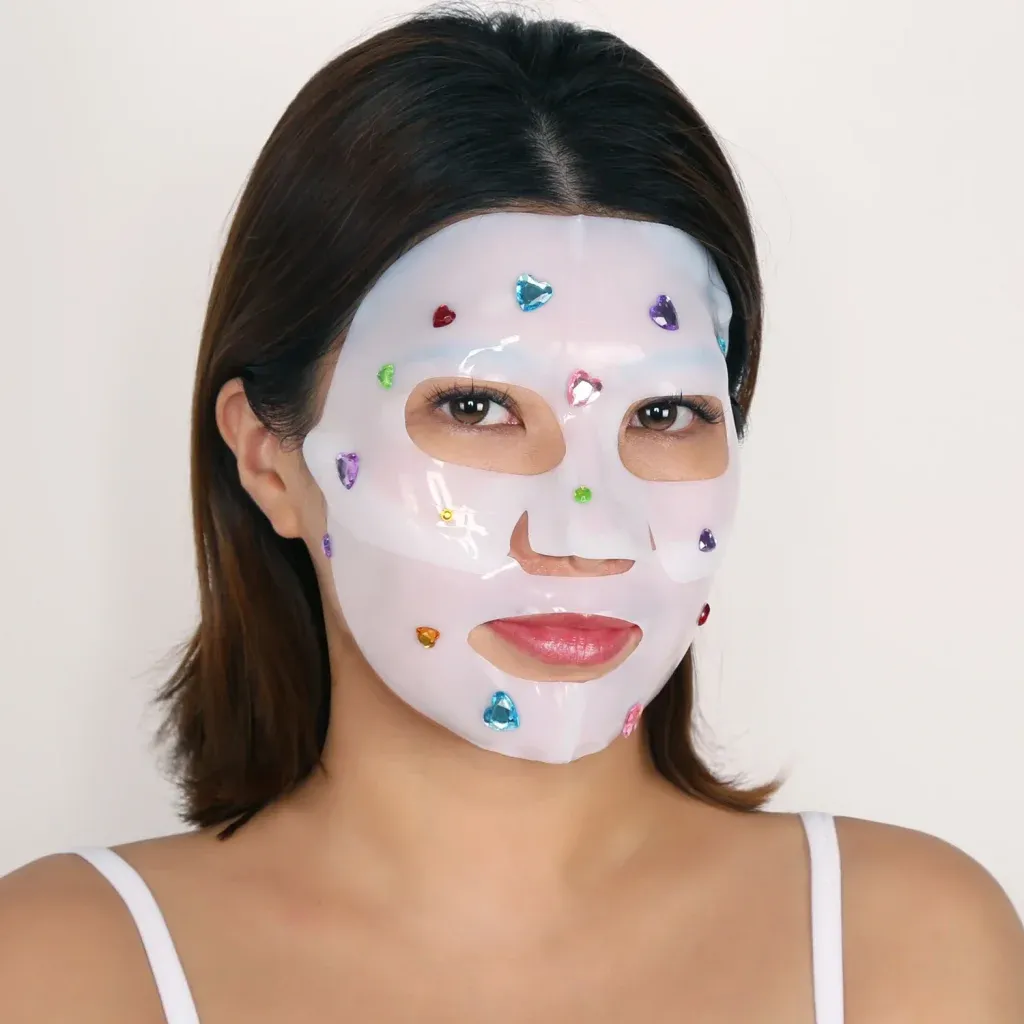
Buyers tend to evaluate sheet masks by the ingredient list on the front of the pack. In production, quality is decided by three figures that rarely appear on packaging:
A 40 gsm spunlace sheet carrying 25 g of essence is the workhorse specification for mid-market private label. It is forgiving to run, holds essence without dripping, and lands at a retail price that supports repeat purchase.
Swipe the table →
| Parameter | Typical range |
|---|---|
| Minimum order | 5,000 pieces per formula, 10,000 per printed sachet |
| Fabric weight | 30–80 gsm |
| Essence load | 20–35 g per sheet |
| Standard die | 190 × 210 mm face die; custom die available |
| Substrates | Spunlace non-woven, cupro, Tencel, bio-cellulose, hydrogel, cotton |
| Sachet | Three-side seal, four-side seal, aluminium laminate |
| Sample lead time | 5–7 working days |
| Bulk lead time | 20–25 working days after artwork approval |
Essence is the cheapest part of a sheet mask by weight and the most expensive by perception. Moving from 20 g to 30 g adds roughly 8–12% to unit cost but changes how the product reads in a review: buyers describe a well-loaded sheet as "wet" and a light one as "dry", and that single adjective drives repeat purchase more than any ingredient claim.
Material selection
The substrate sets the sensory story and most of the material cost. Each option below is a real production choice we run, not a catalogue range.
Swipe the table →
| Substrate | Essence retention | Fit and drape | Relative cost | Best suited to |
|---|---|---|---|---|
| Spunlace non-woven (30–50 gsm) | Moderate | Good, slightly stiff | Low | Volume lines, multi-pack and sachet-only products |
| Cupro / Tencel | High | Excellent, soft and clingy | Medium | Premium daily masks, sensitive-skin positioning |
| Cotton | Moderate | Good, less stretch | Medium | Natural and organic claims |
| Bio-cellulose | Very high | Conforms closely, no lifting | High | Premium "second skin", gift and spa channels |
| Hydrogel | High (holds its own body) | Firm, does not drape | High | Cooling and de-puffing products, visible effects |
Spunlace to cupro is the most common upgrade and the one with the best cost-to-perception ratio. Cupro fibres are finer, so the sheet clings to the face without a second layer and holds essence closer to the skin. Expect a 20–30% material increase and a noticeably better review score.
Spunlace to bio-cellulose roughly doubles substrate cost and adds a constraint: bio-cellulose is grown, not woven, so sheet dimensions come in fixed formats and custom dies are limited. It is the right choice when the retail price supports it and wrong when volume is the priority.
Hydrogel sheet masks sit between a mask and an eye patch. They carry less essence but stay put, do not drip, and photograph well — which is why they dominate short-form video. They are also the substrate most sensitive to ambient humidity during packing.
Customisation scope
Sheet masks are highly customisable, but three elements carry setup costs that have to be amortised: a new die, a new print run and a bespoke formula.

Swipe the table →
| Element | Options | Effect on minimum order |
|---|---|---|
| Die / cut | Standard face die, custom die, eye and mouth opening adjustment | Standard die at base MOQ; new die +5,000 pcs |
| Fabric | Spunlace, cupro, Tencel, cotton, bio-cellulose, hydrogel | No change for stock fabrics; specialty weaves +3,000 pcs |
| Essence load | 20–35 g per sheet | Included |
| Formula | Ready-made library or bespoke development | Library at base MOQ; bespoke +5,000 pcs |
| Fragrance | Fragrance-free or specified fragrance | Included |
| Sachet print | Up to 8 colours, matte or gloss, metallised | +5,000 pcs per design |
| Pack format | Single sachet, 5/7/10-piece box, jar, bulk | Structure-dependent |
| Claims | Hydrating, soothing, brightening, firming | Depends on actives and market |
Die geometry is worth investing in only after the concept is proven. A custom die that follows the jaw better than the standard cut is a genuine differentiator in reviews, but tooling is real money and most first orders never repeat the shape. Launch on the standard die, measure returns and reviews, then invest.
Sachet print is where most brands under-invest. The sachet is the entire brand experience for a single-serve product — there is no carton in the bathroom. Eight-colour rotogravure with a matte varnish reads as premium at a modest unit cost increase, and it is the first thing photographed in unboxing content.
Fragrance is the fastest way to move perceived quality and the fastest way to trigger complaints. Fragrance-free is the safer default for sensitive-skin positioning; a light, well-chosen fragrance scores better in markets where sheet masks are a leisure purchase rather than a treatment.
Bespoke essence development on a first order below 10,000 pieces. Formulation, stability and micro testing are fixed costs regardless of volume, and a brand still validating its positioning rarely reorders the same formula. Start from the library, learn what sells, then formulate.
01
Brief and price-point check
Share your target retail price, market and channel. We confirm within two working days whether the fabric, essence load and sachet you want can be delivered at that price — before any sampling cost is incurred.
02
Fabric and essence selection
Fabric weight, substrate and essence load are fixed here, because all three change the sachet format and the freight calculation.
03
Sampling
5–7 working days from the library. Samples ship with the matching INCI list so your regulatory reviewer can work in parallel rather than after approval.
04
Die line and sachet artwork
Die line, sachet artwork and carton dieline are approved as one set. We release production only against a signed physical proof — screen colour is not a proof.
05
Filling, sealing and in-process QC
Essence is prepared in batches, sheets are saturated and sealed on a three- or four-side line. Fill weight is checked hourly; seal integrity is pull-tested every shift.
06
Micro testing and export packing
Every batch is held for microbial release before it is packed. Retained samples and the batch record stay on file so a later claim can be investigated, not guessed at.
Commercials
Four variables drive sheet mask pricing: fabric, essence load, sachet structure and quantity. The bands below reflect a 40 gsm spunlace mask at 25 g essence load in a printed three-side-seal sachet.
Swipe the table →
| Order quantity | Relative unit cost | Production window |
|---|---|---|
| 5,000–9,999 pcs | Highest | 20–23 working days |
| 10,000–49,999 pcs | Mid | 22–25 working days |
| 50,000–199,999 pcs | Lower | 25–30 working days |
| 200,000+ pcs | Lowest | Scheduled per project |
A finished sheet mask breaks down roughly as: fabric 20–30%, essence 20–30%, sachet and carton 25–35%, filling and QC 10–15%, export packing and freight 5–10%. Two consequences follow.
First, essence is the wrong place to cut. Dropping from 25 g to 20 g saves single-digit percentages and is immediately noticeable to the buyer. Second, sachet structure is the right place to negotiate: moving from a four-side-seal aluminium sachet to a three-side-seal structure can reduce cost by more than any formula change, at the price of a shorter shelf life.
Library-formula samples are charged at cost and credited against the bulk order. Bespoke formulation carries a separate fee, credited once production passes 20,000 pieces. Samples typically ship within five to seven working days, with the INCI list attached.
The 20–25 day production window starts from signed artwork and received deposit, not from the purchase order. Projects that miss their launch date almost always lost two to three weeks in artwork rounds — usually because the sachet dieline and the carton dieline were approved separately and then found to disagree.
Quality and compliance
A sheet mask is a water-based product in a sealed pack, so the risks are microbial rather than mechanical. Control points concentrate around essence preparation and seal integrity.
Swipe the table →
| Document | What it covers | When issued |
|---|---|---|
| INCI list | Full declaration in your market's required order | With quotation |
| COA | Batch-specific results against specification | With shipment |
| SDS / MSDS | Handling and transport classification | With quotation |
| Stability report | Accelerated and real-time data for the chosen formula | After stability run |
| Micro report | TPC, yeast and mould, pathogens to your market's limits | With shipment |
| CPSR support | Safety assessment inputs for EU placement | On request |
"Hydrating" is safe and supportable. "Brightening" and "anti-ageing" require either a defensible active level or a substantiation file, and the requirement varies by market. Tell us the wording you intend to print at brief stage — retrofitting a claim after artwork approval is the single most common cause of a delayed first shipment in this category.
Buyer's checklist
Every sheet mask supplier claims low MOQ and custom formulation. These seven questions get at the things that differ, and the answers are difficult to fake.
This page covers one category only. Brands assembling a complete line usually pair it with Eye Patch OEM and Body Care OEM. MOQ, lead times and material options for every category we run sit on the OEM/ODM service page.
What buyers ask during evaluation, answered with the figures we actually quote.
5,000 pieces per formula. A printed sachet raises the minimum to 10,000 pieces, because each print run carries its own setup. The minimum applies to total pieces across the order, so a mixed pack of two formulas is not automatically accepted at 5,000.
Sampling is 5–7 working days from our formula library and around 10–12 working days for a bespoke formula, which needs a stability pre-check before release. Bulk production is 20–25 working days after signed artwork and deposit.
30–50 gsm spunlace is the standard range for mid-market private label: it holds essence without dripping and does not tear on application. Below 30 gsm the sheet becomes fragile; above 80 gsm it feels heavy and costs more per unit without a proportional gain in perceived quality. Cupro at 30–40 gsm is the most common premium upgrade.
20–35 g per sheet, with 25 g the most common specification. Essence load is the number behind the declared net content, and it is checked hourly during filling. Above 35 g the sachet needs a wider seal and the sheet begins to slide during wear.
Yes. Bespoke development starts from a brief covering target skin concern, texture, fragrance direction, claim set and retail price. It carries a formulation fee and a minimum of 10,000 pieces, and requires a stability run before commercial production. Most first-time brands do better starting from the library and reformulating after first sales data.
Yes, both. Bio-cellulose is grown in fixed sheet formats, so custom dies are limited and material cost is roughly double spunlace. Hydrogel masks carry less essence but stay in place and photograph well. Both are stocked substrates rather than special orders, so the minimum stays at 5,000 pieces.
Up to eight colours by rotogravure, with matte or gloss varnish and metallised options. Sachet print adds 5,000 pieces to the minimum per design. For a single-serve product the sachet is the entire brand experience in the bathroom, so this is rarely the right place to economise.
24–36 months unopened for an aluminium-laminate four-side-seal sachet, and typically 18–24 months for a three-side-seal structure. The declaration must be backed by stability data at the timepoint reached, which we supply. Once opened, a sheet mask should be used immediately.
Yes. Fragrance-free is a standard configuration and does not affect the minimum order. Vegan formulations use no animal-derived collagen; where a formula calls for collagen, we substitute a plant-derived or synthetic alternative and declare it accordingly in the INCI list.
We supply full INCI, batch COA, SDS/MSDS, stability data, microbial reports and the inputs a safety assessor needs for an EU CPSR. The CPSR itself is issued by a qualified assessor, and we can introduce one if you do not already work with one. For other markets we provide the standard export documentation set.
Send us your brief and we will come back with a formulation direction, a realistic MOQ and a production schedule.