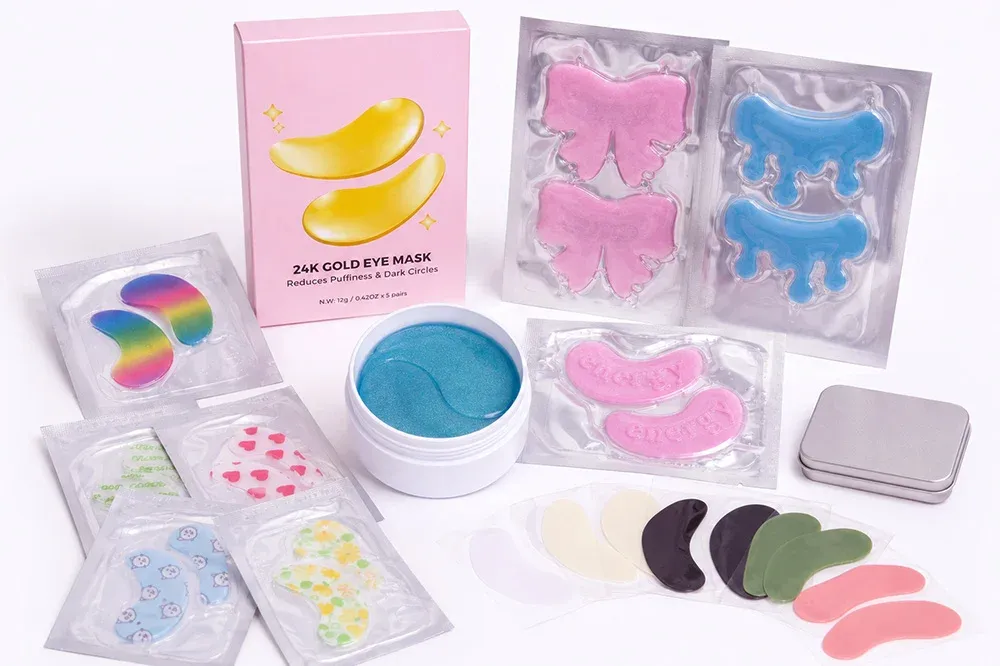
Under-eye patches developed, filled and packed in our own plant in Zhongshan, Guangdong — from 3,000 pairs, with the die, formula and packaging built around your brand.
Product fundamentals
An under-eye patch is a cross-linked hydrogel or bio-cellulose pad loaded with a water-based serum, worn for 15–30 minutes. Veilta Bio manufactures them for private label brands from 3,000 pairs per formula, with 5–7 working days for samples and 22–28 working days for bulk production after approval.
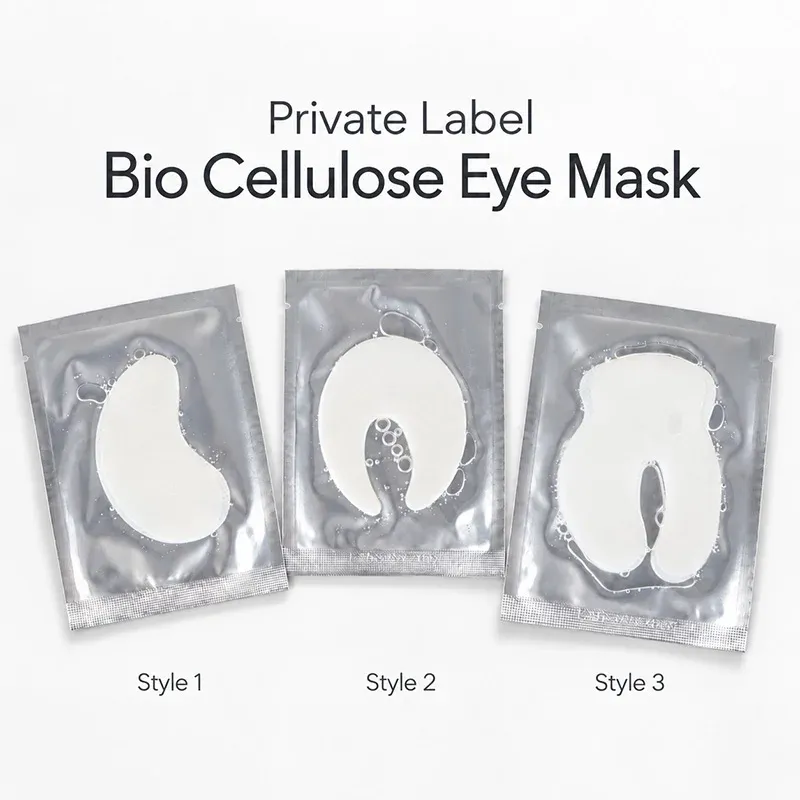
The single most useful question to ask any eye patch supplier is whether the patch is cast or cut. A hydrogel patch starts as a liquid — water, glycerin and a gelling agent such as carrageenan, sodium polyacrylate or PVA — poured into a tray, gelled, partially dried, then die-cut into a crescent or full-eye shape. The dried sheet is what gives the product its body: it holds its own weight on a vertical face, does not drip, and releases serum slowly over 20–30 minutes.
A supplier who buys ready-made sheets and only fills sachets will describe the product in terms of ingredients and packaging. A supplier who casts in-house will talk about gel strength, drying loss and die tolerance — because those are the variables that decide whether batch 3 looks like batch 1.
Swipe the table →
| Parameter | Typical production range |
|---|---|
| Minimum order | 3,000 pairs per formula, 5,000 pairs per printed design |
| Patch thickness | 0.6–1.2 mm |
| Serum load | 1.8–2.6 g per pair |
| Standard die size | 60 × 25 mm crescent; up to 90 × 40 mm |
| Substrate options | Hydrogel, bio-cellulose, collagen-stamped gel, silicone (reusable) |
| Colour / effect | Clear, gold, pearl, black, glitter, Pantone match |
| Sachet format | Single pair, 3/5/7-pair box, jar, tin, bulk poly bag |
| Sample lead time | 5–7 working days (10–12 for a new formula) |
| Bulk lead time | 22–28 working days after sample approval |
Thickness and serum load are the two numbers worth negotiating hardest. A 0.6 mm sheet at 1.8 g reads as a "daily" product and ships cheaply; a 1.2 mm sheet at 2.6 g feels clinical and photographs better for premium listings, but adds roughly 18–25% to unit cost once you account for gel solids, sachet foil and carton weight.
Brands often assume the serum is the expensive part. In practice a hydrogel eye patch breaks down roughly as: gel sheet 20–30%, serum 15–25%, primary packaging 25–35%, labour and QC 10–15%, export packing and freight 5–10%. That is why switching from a printed folding carton to a plain sachet can move the landed price more than downgrading an active ingredient — and why we quote packaging and formula together rather than separately.
Material selection
Four substrates cover almost every private label eye patch on the market. They differ in serum capacity, skin feel and cost, and the choice constrains your retail price point more than the formula does.
Swipe the table →
| Substrate | Skin feel | Serum capacity | Relative cost | Best suited to |
|---|---|---|---|---|
| Hydrogel (carrageenan / PVA) | Cool, slippy, substantial | High — holds 2–3× its dry weight | Low | Mass and mid-market eye masks, gold and pearl effects, multi-pair boxes |
| Bio-cellulose | Fibrous, breathable, conforms closely | Moderate | High | Premium "second skin" positioning, sensitive-skin claims |
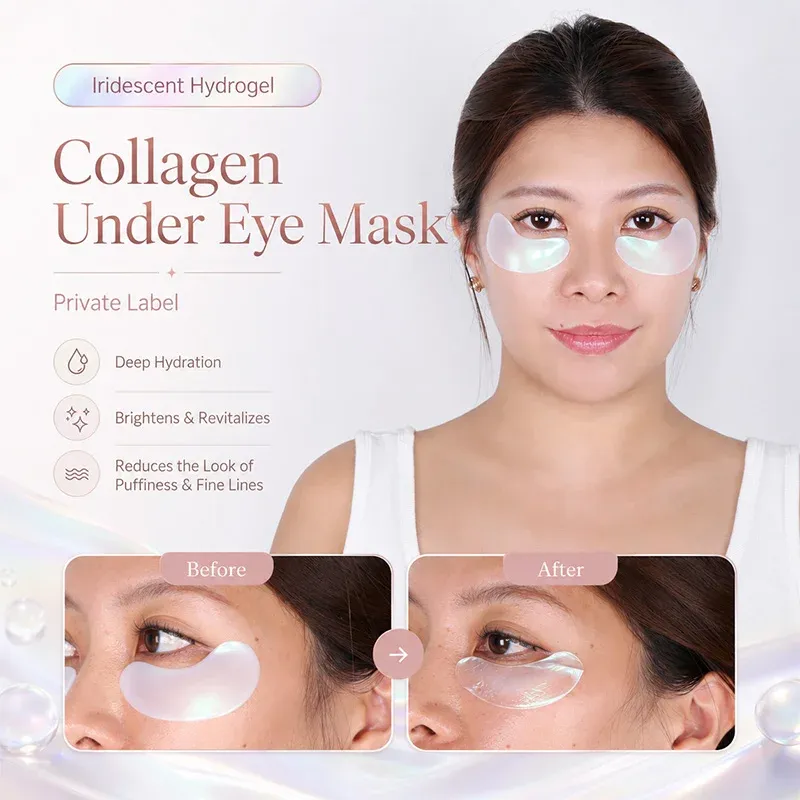
| Collagen-stamped gel | Firm, holds an embossed logo | Moderate | Medium | Logo embossing, gift sets, travel retail |
| Silicone (reusable) | Occlusive, no serum | None — occludes natural moisture | Low | Reusable anti-wrinkle patches, tin and pouch formats |
Hydrogel to bio-cellulose roughly doubles material cost and shortens practical shelf life, because the fibre mat is thicker and harder to seal without trapping air. In exchange you get the drape that premium brands photograph. Plan for a stability run before committing — bio-cellulose is the substrate most likely to show edge lift at month 18.
Hydrogel to silicone removes the serum entirely, which changes the regulatory story as well as the cost. A reusable silicone patch is closer to an accessory than a cosmetic in several markets, and the claim set shifts from "hydrating" to "helps smooth the look of fine lines while you sleep".
Collagen-stamped gel is the only substrate that takes an embossed logo without printing. If your launch plan depends on the patch being recognisable in an unboxing video, this is usually worth the medium-tier cost.
Customisation scope
Almost every element of an eye patch is customisable. The practical constraint is not capability but minimum order: each new die, colour or print run adds a setup that has to be amortised across units.
Swipe the table →
| Element | Options | Effect on minimum order |
|---|---|---|
| Shape / die | Crescent, full-eye, butterfly, extended-coverage, fully bespoke | Standard dies at base MOQ; new die +2,000 pairs |
| Colour and effect | Clear, gold, pearl white, black, glitter, Pantone match | +1,000 pairs per additional colour |
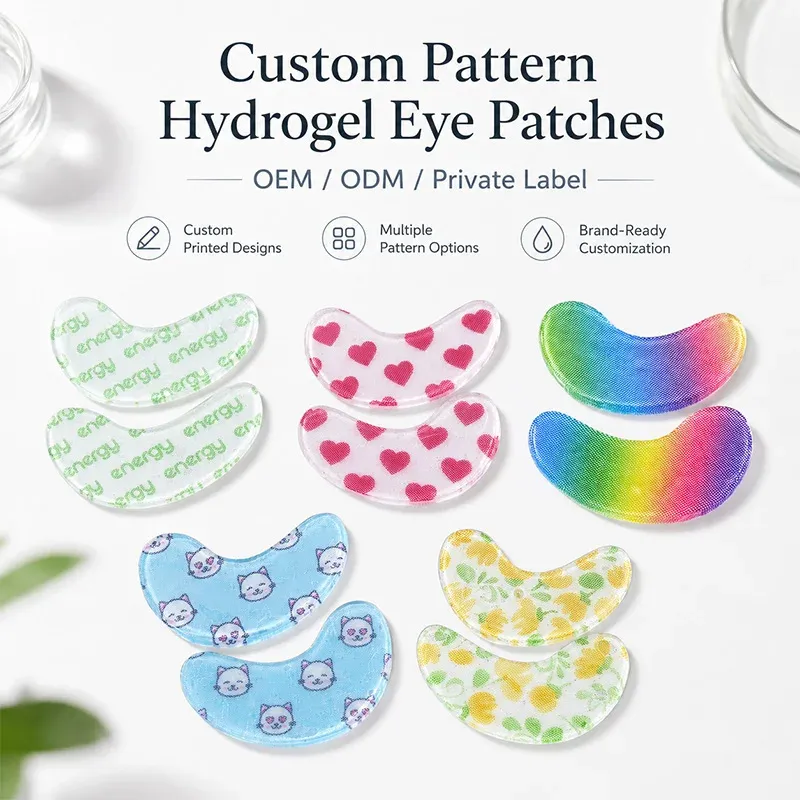
| Logo | Surface print, embossed logo, brand-element pattern | +2,000 pairs for embossing |
| Formula | Ready-made library or bespoke development | Ready-made at base MOQ; bespoke +5,000 pairs |
| Serum load | 1.8–2.6 g per pair | Included |
| Fragrance | Fragrance-free, or a specified fragrance | Included |
| Packaging | Sachet, folding carton, jar, tin, multi-pack, bulk | Driven by structure, not volume |
| Claim direction | Hydrating, cooling, depuffing look, brightening | Depends on actives and target market |
Shape is the cheapest differentiator and the one buyers notice first. A butterfly or extended-coverage die reads as a different product on a shelf even at the same formula cost.
Colour carries more weight online than in store. Gold and pearl effects photograph well under ring lighting; black hydrogel signals "clinical" and tends to convert better in markets where the category is already crowded.
Embossed logo is the only element that survives a repost. Printed logos sit on the sachet and disappear once the buyer unboxes; an embossed patch appears in every user photo.
We push back on bespoke dies for first orders under 10,000 pairs. The tooling is real money, and a brand testing a new shape rarely repeats it. Start from the closest standard die, validate the concept, then invest in tooling once the reorder is confirmed.
01
Brief and feasibility check
Send the target retail price, market and claim direction. We confirm within two working days whether the brief is achievable at your target cost, and flag any claim that needs substantiation before sampling.
02
Formula and substrate selection
Choose from our hydrogel library or start a bespoke formula. Substrate, thickness and serum load are fixed here, because they determine the sachet and carton spec.
03
Sampling and stability
5–7 working days for a library formula, 10–12 for bespoke. Samples ship with the matching INCI list so your regulatory consultant can review in parallel.
04
Artwork, die and packaging proofing
Die line, print proof and carton dieline are approved together. We do not release production until the physical proof is signed — colour on screen is not a proof.
05
Bulk production and in-process QC
Gel casting, drying, die-cutting, serum filling and sachet sealing on one line. Fill weight is checked hourly; seal integrity is pull-tested each shift.
06
Finished-goods release and export packing
Micro testing, retained samples and a batch record before release. Export cartons, pallet configuration and shipping documents prepared against your forwarder's spec.
Commercials
Eye patch pricing is driven by four variables: substrate, serum load, packaging structure and order quantity. The bands below are what we typically quote for a single-sachet hydrogel patch in a printed carton.
Swipe the table →
| Order quantity | Relative unit cost | Production window |
|---|---|---|
| 3,000–4,999 pairs | Highest | 22–25 working days |
| 5,000–19,999 pairs | Mid | 25–28 working days |
| 20,000–49,999 pairs | Lower | 28–35 working days |
| 50,000+ pairs | Lowest | Scheduled per project |
Library-formula samples are charged at cost and credited against the bulk order. Bespoke development carries a separate formulation fee, also credited once production passes 10,000 pairs. We do not refund sampling if the project is cancelled — the cost is real and pretending otherwise only moves it into the unit price.
Quotes take one to two working days when the enquiry includes: quantity, substrate preference, serum load, packaging structure, target market and required ship date. Without packaging structure we can only quote a range, because primary packaging is 25–35% of unit cost.
Standard terms are 30% deposit with balance against bill of lading, or a letter of credit for first orders above USD 50,000. Repeat customers move to net-30 after three completed shipments.
Quality and compliance
Quality control on an eye patch happens at five points, not one. What separates a reliable supplier is whether the checks are recorded per batch and whether you can obtain those records after delivery.
Swipe the table →
| Document | What it covers | When issued |
|---|---|---|
| INCI list | Full ingredient declaration in the order required by your market | With quotation |
| COA | Batch-specific specification results | With shipment |
| SDS / MSDS | Handling and transport classification | With quotation |
| Stability report | Accelerated and real-time data for the chosen formula | After stability run |
| Micro report | TPC, yeast and mould, pathogens per your market's limits | With shipment |
| CPSR support | Safety assessment inputs for EU placement | On request |
We will not print a claim we cannot support. "Depuffing" and "brightening" are consumer-facing narratives that need either an ingredient at a defensible level or a substantiation file. If your market requires clinical data for a specific wording, tell us at brief stage — retrofitting a claim after artwork approval is the most common cause of a delayed first shipment.
Buyer's checklist
Most eye patch suppliers describe the same capabilities. These seven questions get at the things that actually differ, and the answers are hard to fake.
This page covers one category only. Brands assembling a complete line usually pair it with Sheet Mask OEM and Anti-Wrinkle Patch OEM. MOQ, lead times and material options for every category we run sit on the OEM/ODM service page.
The questions buyers actually ask during evaluation, answered with the numbers we work to.
3,000 pairs per formula. If the patch carries a printed or embossed design, the minimum rises to 5,000 pairs because each print run has its own setup. Mixed-pack configurations (for example three pairs per box) do not change the pair count — the minimum applies to total pairs across the order.
5–7 working days for a formula from our existing library, and 10–12 working days for a bespoke formula because it needs a stability pre-check before it can be released. Samples ship with the matching INCI list so your regulatory reviewer can work in parallel.
Yes. Send the full formula with ingredient percentages and we will review it for compatibility with our gel system, run a lab batch, and confirm whether it casts and dries cleanly. Formulas that rely on high alcohol content or oil-heavy phases often need adjustment before they will hold a sheet.
Hydrogel is a cast, cross-linked gel sheet that carries a high serum load and feels cool and slippy. Bio-cellulose is a fermented fibre mat that conforms more closely to the skin and breathes better, but holds less serum and costs roughly twice as much. Hydrogel suits volume and effect-driven products; bio-cellulose suits premium and sensitive-skin positioning.
Between 1.8 g and 2.6 g per pair in our standard range. The load is declared on the sachet and checked hourly during filling. Higher loads feel richer but increase sachet foil cost and carton weight, and above roughly 2.8 g the patch starts to slide during wear.
Yes. Fragrance-free is a standard configuration and does not affect the minimum order. Vegan formulations use no animal-derived collagen; where a formula calls for collagen, we substitute a plant-derived or synthetic alternative and declare it accordingly in the INCI list.
Both are possible. Surface printing sits on the gel and shows clearly in product photography; embossing requires a collagen-stamped or thicker hydrogel substrate and adds 2,000 pairs to the minimum. Most brands combine an embossed patch with a printed sachet.
Single-pair sachets, 3/5/7-pair folding cartons, jars, metal tins and bulk poly bags. Sachet material can be aluminium-laminated for a 24–36 month shelf life or clear film for a lower-cost, shorter-life product. Packaging structure drives 25–35% of unit cost, so it is worth fixing early.
24–36 months unopened for aluminium-laminated sachets, and typically 24 months for clear film. Once opened, use immediately — a hydrogel patch has no preservative system capable of surviving prolonged air exposure. We supply real-time stability data at the timepoint reached so the declaration is supportable.
We supply the inputs a safety assessor needs — full INCI, impurity statements, heavy-metal and microbial results, and packaging migration data where relevant — plus SDS/MSDS and batch COA. The CPSR itself is issued by a qualified safety assessor; we can introduce you to one if you do not already work with one.
Send us your brief and we will come back with a formulation direction, a realistic MOQ and a production schedule.