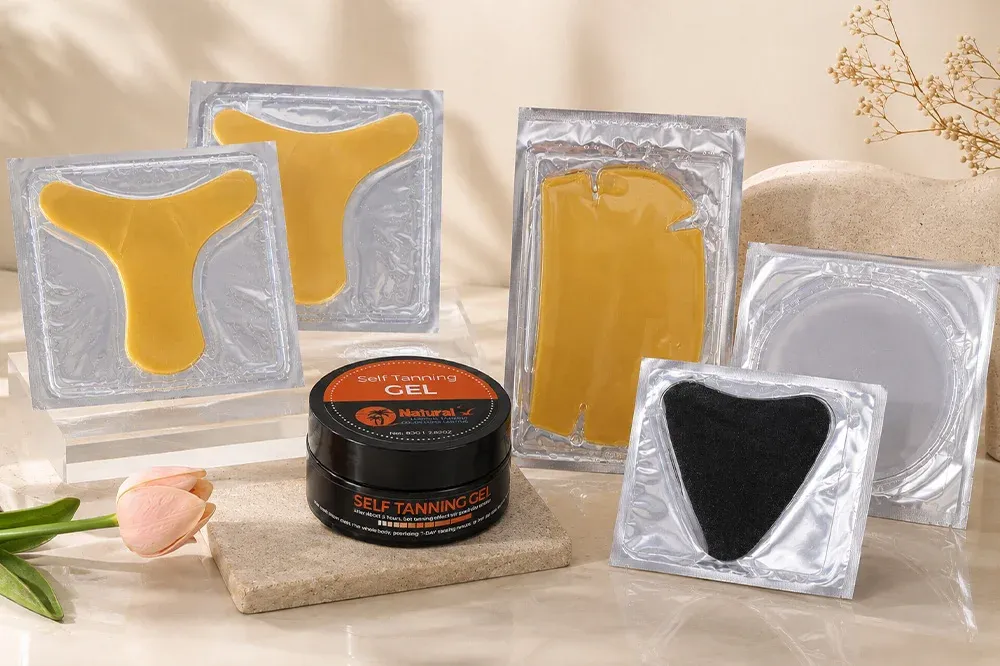
Neck, chest, belly and targeted body masks cut and filled in-house — from 5,000 pieces, with the pattern developed on a body form rather than scaled up from a face mask.
Product fundamentals
A body mask is a large-format patch engineered around a specific body area. The problem it solves is contact: a 40 × 50 cm sheet on a curved, moving surface will lift unless the pattern, material and adhesive are designed together.
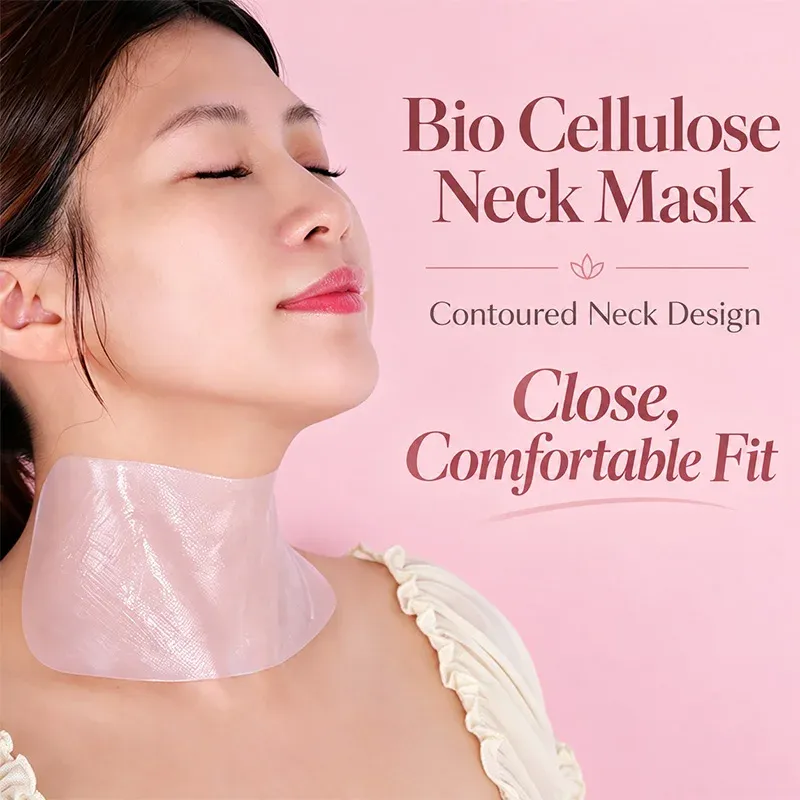
Scaling a face mask up produces a sheet that peels away from the body within minutes. The reasons are physical:
That is why we develop body mask patterns on a body form rather than scaling from a face die, and why we recommend a lightly tacky hydrogel or silicone border for vertical placements.
Swipe the table →
| Parameter | Typical range |
|---|---|
| Minimum order | 5,000 pcs per size and formula, 10,000 per printed pouch |
| Formats | Neck, chest/décolleté, belly, back, arm, hip, targeted patches |
| Typical dimensions | Neck 20 × 30 cm; chest 30 × 40 cm; belly 40 × 50 cm |
| Materials | Hydrogel, bio-cellulose, non-woven, silicone gel |
| Fill weight | 20–60 g depending on format |
| Edge treatment | Plain cut, tapered edge, tacky hydrogel border |
| Packaging | Single folded pouch, roll, jar, box |
| Sample lead time | 7–10 working days after pattern approval |
| Bulk lead time | 22–28 working days after artwork approval |
Neck masks are the highest-volume body format by a wide margin. They address a concern (horizontal neck lines) that consumers already recognise, they are easy to wear while doing something else, and they fold into a pouch without creasing.
Chest and décolleté masks photograph extremely well and suit premium positioning, but they are harder to keep in contact and demand a border treatment.
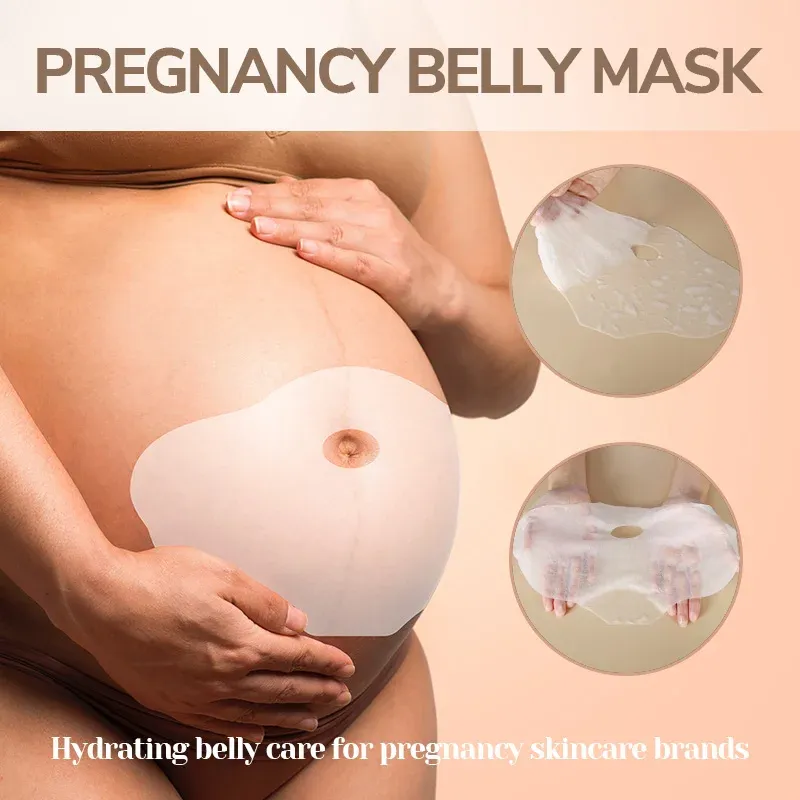
Belly masks are a smaller, higher-empathy market — pregnancy and post-partum care — where the formulation conversation is more sensitive and the claim set needs more care.
Material selection
On a large format, material choice is driven by weight and adhesion more than by serum capacity. A material that performs well on a face can be unusable at 40 × 50 cm.
Swipe the table →
| Material | Weight at large format | Adhesion without adhesive | Relative cost | Best suited to |
|---|---|---|---|---|
| Hydrogel | Heavy when wet | Good on skin, moderate on curves | Medium | Neck, chest, targeted patches |
| Bio-cellulose | Light, strong when wet | Good, conforms closely | High | Premium neck and chest masks |
| Non-woven | Light | Poor — needs a border or straps | Low | Single-use body sheets, sachet products |
| Silicone gel | Moderate | Excellent, reusable | Medium–high | Reusable neck and chest patches, anti-wrinkle positioning |
Hydrogel is the default for neck and chest formats. It has enough body to stay in place on a sloping surface, carries a high serum load, and gives the cooling sensation that body treatments are judged on. Its weakness is weight: a 40 × 50 cm hydrogel sheet is heavy enough that a belly format usually needs a border treatment or a wrap.
Bio-cellulose is the premium choice for neck and chest. It is light, strong when wet, and conforms closely enough that it does not need an adhesive border. It costs roughly twice as much as hydrogel and comes in fixed sheet formats, so very large or unusual patterns are constrained.
Non-woven is the cheapest and the least suitable for vertical placement. It has almost no adhesion of its own and needs straps, a wrap or a border. It works for formats worn lying down and for sheet products sold on price.
Silicone gel is reusable, which changes the value proposition entirely. A reusable neck patch sold in a tin positions as a treatment device rather than a consumable, and it photographs as a durable object rather than a wet sheet.
Customisation scope
On body formats, the pattern is the product. Dimensions, curve allowance and border treatment determine whether the mask stays in contact long enough to matter.
Swipe the table →
| Element | Options | Effect on minimum order |
|---|---|---|
| Size and pattern | Standard neck, chest, belly, back; custom pattern | Standard at base MOQ; new pattern +10,000 pcs |
| Curve allowance | Flat cut, darted, stretch-material | Included |
| Border | Plain cut, tapered edge, tacky hydrogel border | +5,000 pcs for tacky border |
| Material | Hydrogel, bio-cellulose, non-woven, silicone gel | No change for stock materials |
| Fill weight | 20–60 g | Included |
| Fragrance | Fragrance-free or specified | Included |
| Packaging | Single folded pouch, roll, jar, box | Structure-dependent |
| Up to 8 colours on pouch and carton | +10,000 pcs per design |
A neck mask pattern that is 10 mm too narrow will not reach the jawline; one that is too wide bunches under the chin and lifts. Neither failure is visible in a flat drawing. We develop patterns on a body form, then supply a worn sample before artwork is released.
For chest and belly formats, the curve allowance matters more than the outline. A flat pattern on a curved surface has to either stretch or gap. Darts in the cut solve it for non-stretch materials; a stretch non-woven solves it more cheaply but changes the feel.
A tacky hydrogel border costs 5,000 pieces of minimum order and is the difference between a chest mask that stays in contact for 20 minutes and one the wearer holds in place. For vertical formats it is almost always worth it; for formats worn lying down it is not.
01
Brief and format selection
Body area, concern and how the product will be worn. Whether it is worn upright or lying down determines the adhesion strategy before anything else is decided.
02
Pattern development on a body form
Dimensions and curve allowance developed on a form rather than scaled from a face die. This stage prevents the most common body-mask failure.
03
Material and border selection
Hydrogel, bio-cellulose, non-woven or silicone, plus plain, tapered or tacky border. Fill weight follows from the format area.
04
Worn fit sampling
Physical samples worn in the intended posture and photographed. Flat samples hide every meaningful failure in this category.
05
Filling, sealing and QC
Essence is distributed evenly across a large area, which requires a different filling approach from a face mask. Fill weight and distribution are checked per lot.
06
Release and export packing
Micro results and batch documentation before release. Large formats are folded to a specified pattern so the pouch does not crease the product.
Commercials
On a body mask, material area dominates cost. A 30 × 40 cm chest mask uses roughly four times the material of a face mask, and that ratio holds through filling, pouching and freight.
Swipe the table →
| Order quantity | Relative unit cost | Production window |
|---|---|---|
| 5,000–9,999 pcs | Highest | 22–25 working days |
| 10,000–49,999 pcs | Mid | 22–28 working days |
| 50,000–199,999 pcs | Lower | 28–35 working days |
| 200,000+ pcs | Lowest | Scheduled per project |
A pouched neck mask breaks down roughly as: material 30–40%, formula 20–30%, pouch 15–20%, filling and QC 10–15%, freight 5–10%. The material share is higher than on a face mask because area, not count, drives consumption.
Two consequences:
Freight is a real line item. Large formats are light but bulky, so cartons cube out before they weigh out. A 30 × 40 cm mask folded to 15 × 20 cm still fills a carton quickly. Ask for the carton count per pallet before finalising landed cost — this is the number that surprises brands entering body care from face care.
The border is a cost, not an accessory. Adding a tacky hydrogel border raises both material and process cost. For a vertical format it protects the entire value of the product; for a horizontal one it is money spent on nothing.
Pattern development is charged separately from formula sampling, because a new body pattern involves form work and a physical fit sample. The charge is credited against the bulk order once production passes 20,000 pieces.
22–28 working days from signed artwork and received deposit. New patterns add roughly a week for form development and fit sampling. If the format is unusual — a full back mask, for instance — allow two weeks.
Quality and compliance
Large formats fail differently from face masks. Essence distribution and edge adhesion are the two variables that decide whether the product works.
Swipe the table →
| Document | What it covers | When issued |
|---|---|---|
| INCI list | Full declaration in your market's required order | With quotation |
| COA | Batch-specific fill weight, dimensions and micro results | With shipment |
| SDS / MSDS | Handling and transport classification | With quotation |
| Stability data | Material and adhesion retention over shelf life | After stability run |
| Pattern drawing | Approved dimensions and tolerance | With artwork |
| CPSR support | Safety assessment inputs for EU placement | On request |
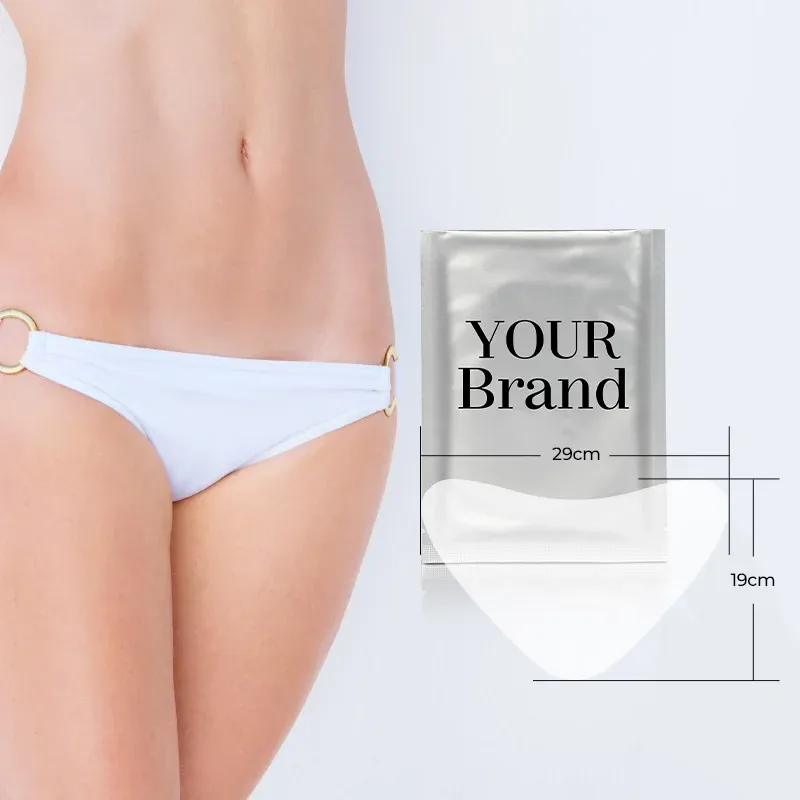
Targeted body formats frequently sit close to sensitive claims. Pregnancy belly masks, intimate-area masks and firming products all carry claim restrictions that vary by market, and some require substantiation or specific wording.
We review the claim set against the destination market at brief stage rather than at artwork stage, because a claim that cannot be printed changes the entire positioning — and sometimes the format.
Buyer's checklist
Body formats are a small, specialised corner of private label. These questions separate a supplier who develops patterns from one who scales up face masks.
This page covers one category only. Brands assembling a complete line usually pair it with Sheet Mask OEM and Hand & Foot Mask OEM. MOQ, lead times and material options for every category we run sit on the OEM/ODM service page.
What brands ask when sourcing targeted body masks, answered with the figures we work to.
5,000 pieces per size and formula. A printed pouch raises the minimum to 10,000 pieces per design, and a new custom pattern adds a 10,000-piece minimum because the pattern has to be developed and fit-tested on a body form.
Because the body is not a flat surface and the wearer moves. A scaled-up flat pattern lifts at the edges, and on a large wet sheet gravity pulls the product down. Body patterns need curve allowance, and vertical placements usually need a tacky border or a tapered edge to stay in contact.
Neck, chest and décolleté, belly, back, arms and targeted patches. Neck masks are the highest-volume format by a wide margin, because they address a concern consumers already recognise and are easy to wear while doing something else.
Hydrogel is the default: it has enough body to stay on a sloping surface and carries a high serum load. Bio-cellulose is the premium alternative — lighter, stronger when wet, and conforming closely enough to avoid needing an adhesive border, at roughly twice the material cost.
20–60 g depending on format area. A neck mask typically sits around 25–35 g, while a belly or back format can reach 60 g. Distribution across the sheet matters as much as total load, since uneven distribution means the top edge dries before the treatment ends.
Yes. Silicone gel patches are reusable and position as a treatment device rather than a consumable, which changes both the retail story and the packaging — typically a tin or a rigid case rather than a pouch. They adhere well without an additional border.
Yes, with additional care on claims. These categories carry wording restrictions that vary by market, and some require substantiation. We review the claim set against your destination market at brief stage, before pattern and artwork are committed.
Single folded pouches, rolls for large formats, jars and boxes. Large formats are folded to a specified pattern so the pouch does not crease the product. Reusable silicone patches usually ship in a tin or rigid case.
Significantly, because large formats cube out before they weigh out. A 30 × 40 cm mask folded to 15 × 20 cm still fills cartons quickly. Ask for the carton count per pallet before finalising landed cost — it is the line item that most often surprises brands moving from face care.
Full INCI, batch COA with fill weight and dimensions, SDS/MSDS, stability data on material and adhesion retention, the approved pattern drawing with tolerances, and the inputs a safety assessor needs for an EU CPSR. The CPSR itself is issued by a qualified assessor.
Send us your brief and we will come back with a formulation direction, a realistic MOQ and a production schedule.