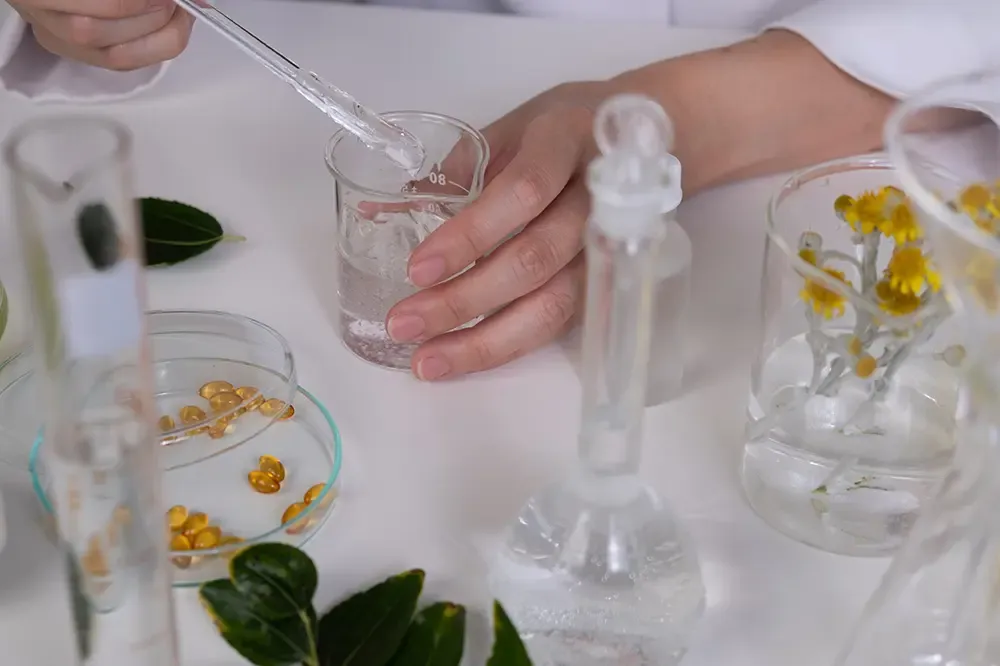
A formula built from scratch for your brand — not an off-the-shelf base relabelled. Actives, texture, fragrance and claims, developed by our in-house R&D team.
Formulation fundamentals
Custom formulation is building a product from a blank sheet, not adjusting an existing base. You control the ingredients, the texture, the fragrance and the claims — and the trade-off is time and development cost, not just MOQ.
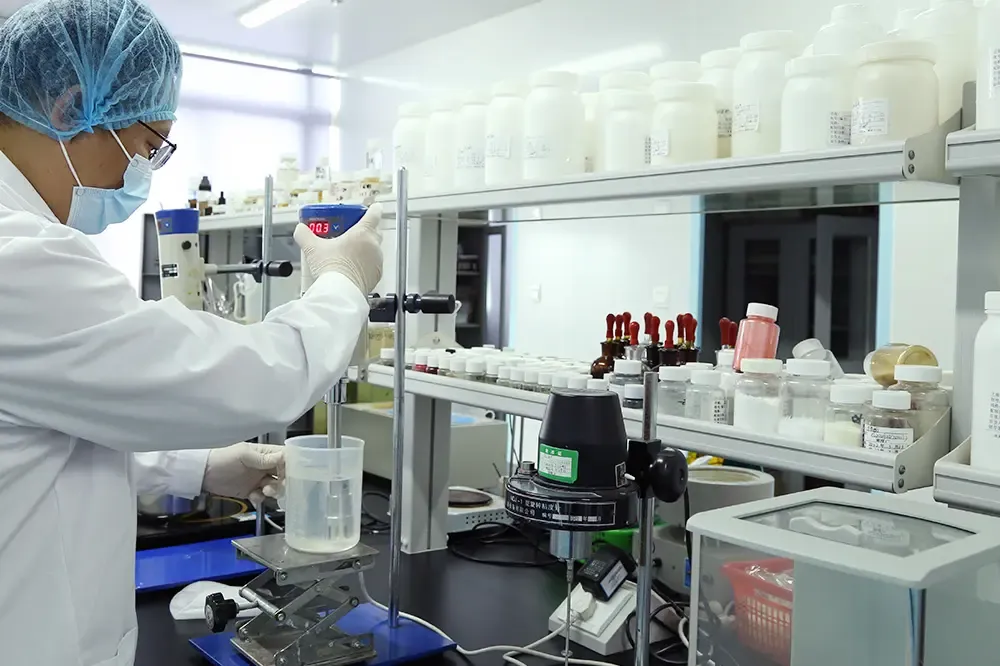
The difference is who owns the starting point. Private label starts from an existing formula you adapt; custom formulation starts from your brief and builds a recipe that is exclusive to your brand.
Swipe the table →
| Custom formulation | Private label | |
|---|---|---|
| Formula source | Built from scratch | Existing library formula |
| Customisation | Full control over ingredients, texture, fragrance, claims | Limited (scent, colour, label) |
| Exclusivity | Formula is yours alone | May be shared across brands |
| Development time | 4–8 weeks for a new formula | 1–2 weeks to sample |
| Cost | Development fee (credited against bulk) | Lower setup cost |
| Best for | Differentiation, premium positioning | Speed to market, new brands |
A custom formula is a recipe plus a stability file plus a regulatory position. The recipe is the easy part; the value is in the stability data, the substantiation and the batch reproducibility that let you launch the product in a real market without a recall risk.
Swipe the table →
| Parameter | Typical development range |
|---|---|
| Concept to first sample | 3–4 weeks |
| First sample to market-ready | 4–8 weeks including stability |
| Development fee | Credited against bulk above 10,000 pieces |
| Stability testing | Accelerated plus real-time, tracked per formula |
| Minimum order | 5,000 pieces per bespoke formula |
Ingredient selection
The ingredient list is the claim. We select actives against the target benefit and the target market, then fix the texture and delivery system so the formula is stable — not just nice in a demo.
Swipe the table →
| Benefit | Typical actives | Notes |
|---|---|---|
| Hydration | Hyaluronic acid, glycerin, panthenol | Multiple molecular weights for layered effect |
| Brightening | Niacinamide, vitamin C derivatives, arbutin | Stability is the main challenge |
| Barrier repair | Ceramides, squalane, fatty acids | Ratio to cholesterol and fatty acids matters |
| Anti-aging | Peptides, retinol derivatives, bakuchiol | Claim substantiation needed |
| Soothing | Centella, allantoin, beta-glucan | Gentle, well-tolerated |
Texture decides repeat purchase more than the active does. A serum that feels heavy on first application gets abandoned regardless of its ingredient story. We fix the delivery system — gel, emulsion, serum, cream, oil phase — against the skin feel you are targeting, then validate that the actives survive in that matrix.
We source actives with a COA and an identity check against retained samples, and we prefer suppliers who can provide the impurity and heavy-metal data a regulatory reviewer will ask for. A cheaper active that cannot produce its COA will cost more downstream when the safety assessor needs documents you cannot obtain.
Customisation scope
You control the direction; we guardrail the chemistry. Nearly everything is customisable, but some requests carry stability or regulatory consequences we will flag before they cost you a batch.
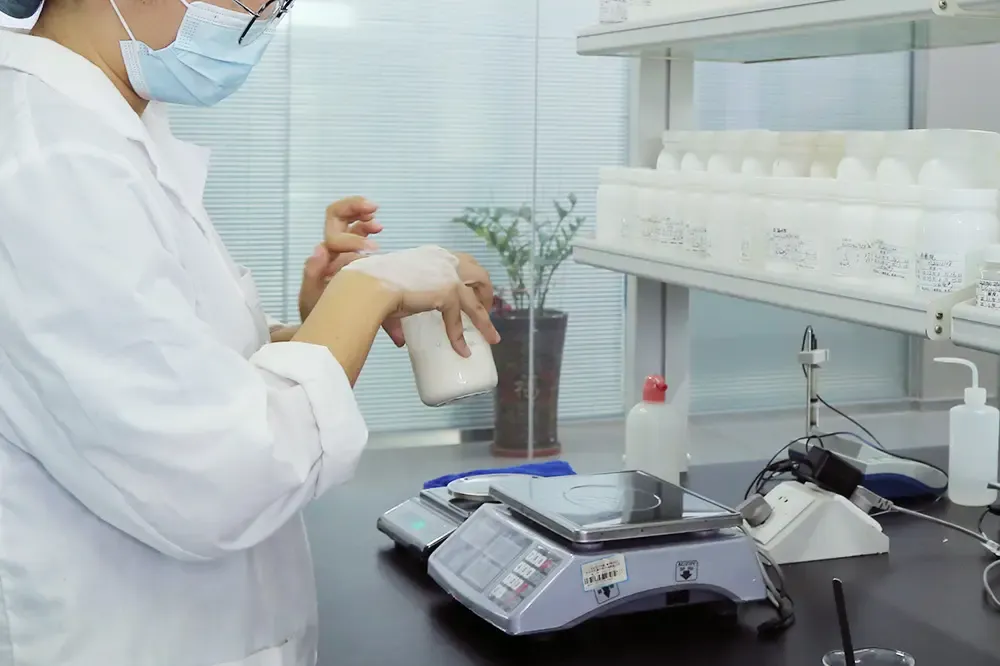
We push back on fully bespoke formulas for first orders under 5,000 pieces. The development cost is real and rarely amortises on a test run. Start from a library base with a bespoke twist, validate the market, then commission a from-scratch formula on reorder.
01
Share your ideas
Tell us the product type, target skin concern, desired texture and any hero ingredient. If you are unsure, our R&D team proposes a direction.
02
Select key ingredients
Pick the actives you want to feature — niacinamide, collagen, hyaluronic acid — or let our R&D team guide the selection against your benefit target.
03
Sample creation
We develop an initial draft formulation and prepare prototype samples with the packaging options under consideration, so you judge the whole product.
04
Review and refinement
You review the samples and request reasonable refinements to formulation and packaging until the product matches your expectation.
05
Safety and stability testing
The revised formula goes through stability, efficacy and safety testing to confirm it holds up for the declared shelf life.
06
Finalisation and production
Once testing passes, we finalise the manufacturing process, confirm packaging and obtain the certifications needed to shift into full-scale production.
Commercials
Custom formulation carries a development fee and a longer timeline than private label. The fee is an investment in exclusivity, and we credit it back once bulk production passes a threshold.
Swipe the table →
| Item | Typical range |
|---|---|
| Formula development fee | Credited against bulk above 10,000 pieces |
| First sample | 3–4 weeks |
| Market-ready (with stability) | 4–8 weeks |
| Stability testing | Included in development fee |
| Minimum order | 5,000 pieces per bespoke formula |
The development fee covers bench work, ingredient sourcing, stability testing and the documentation your regulatory reviewer needs. It is not a markup on the formula — it is the cost of producing a reproducible recipe with a stability file, which is what makes the product launchable.
Briefs move faster when they include: target benefit, texture preference, hero ingredients (or "recommend for me"), target market, order quantity and required ship date. A vague "make something premium" takes three rounds of clarification before we can put it on the bench.
Quality and compliance
A custom formula ships with a documentation pack, not just a jar. The value of bespoke development is that the stability, safety and compliance evidence travels with the product.
Swipe the table →
| Document | What it covers | When issued |
|---|---|---|
| Full formula / INCI | Ingredient declaration in the order your market requires | With quotation |
| COA | Batch-specific specification results | With shipment |
| SDS / MSDS | Handling and transport classification | With quotation |
| Stability report | Accelerated and real-time data | After stability run |
| Micro report | TPC, yeast and mould, pathogens | With shipment |
| CPSR support | Safety assessment inputs for EU placement | On request |
We will not build a formula around a claim we cannot support. "Brightening", "anti-aging" and "soothing" each carry different substantiation burdens in different markets. Tell us the claims at brief stage, and we design the formula and the testing around them — retrofitting a claim after development is the most common cause of a delayed launch.
Buyer's checklist
Many suppliers claim custom formulation. These six questions get at whether they have a real R&D bench, and the answers are hard to fake.

The questions buyers ask when commissioning a bespoke formula, answered with the numbers we work to.
Custom formulation builds a product from scratch for your brand — you control the ingredients, texture, fragrance and claims, and the formula is exclusive to you. Private label starts from an existing formula you adapt, with limited changes like scent and colour. Custom costs more and takes longer, but it is the path to genuine differentiation.
The first sample takes 3–4 weeks. A market-ready formula, including stability testing, takes 4–8 weeks from the first stable prototype. Stability testing runs in parallel with refinement, so the window is realistic but cannot be compressed without cutting corners on data.
The development fee covers bench work, ingredient sourcing, stability testing and documentation. It is credited against bulk production once the order passes 10,000 pieces. It is not refunded if the project is cancelled — the cost is real, and pretending otherwise only moves it into the unit price.
Yes. Send your formula or your hero ingredient and we will evaluate compatibility with our systems, run a lab batch, and confirm stability. Ingredients with poor COA traceability or known incompatibilities will be flagged before sampling.
Yes, under our development agreement the finished formula is assigned to your brand. We retain the technical file for manufacturing continuity, but the formula is yours and is not reused for other clients.
Bench stability, accelerated stability, real-time stability, micro testing and claim substantiation where a claim needs data. The documentation pack — full INCI, COA, SDS, stability and micro reports — ships with the formula so your regulatory reviewer has what they need.
Yes. Fragrance-free is a standard configuration. Vegan formulations use no animal-derived ingredients; where collagen or similar is called for, we substitute a plant-derived or synthetic alternative and declare it in the INCI list.
We can target a texture profile — gel, serum, cream, oil, emulsion — against a reference. We will not copy a competitor's formula, but we can reverse-engineer the skin feel and build your own formula to match it.
5,000 pieces per bespoke formula. The development fee is credited against bulk above 10,000 pieces. If you want to test the market first, we recommend starting from a library base with a bespoke twist at a lower MOQ.
We supply the inputs a safety assessor needs — full INCI, impurity statements, heavy-metal and microbial results — plus SDS/MSDS and batch COA. The CPSR itself is issued by a qualified safety assessor; we can introduce you to one if you do not already work with one.
Send us your brief and we will come back with a formulation direction, a realistic MOQ and a production schedule.