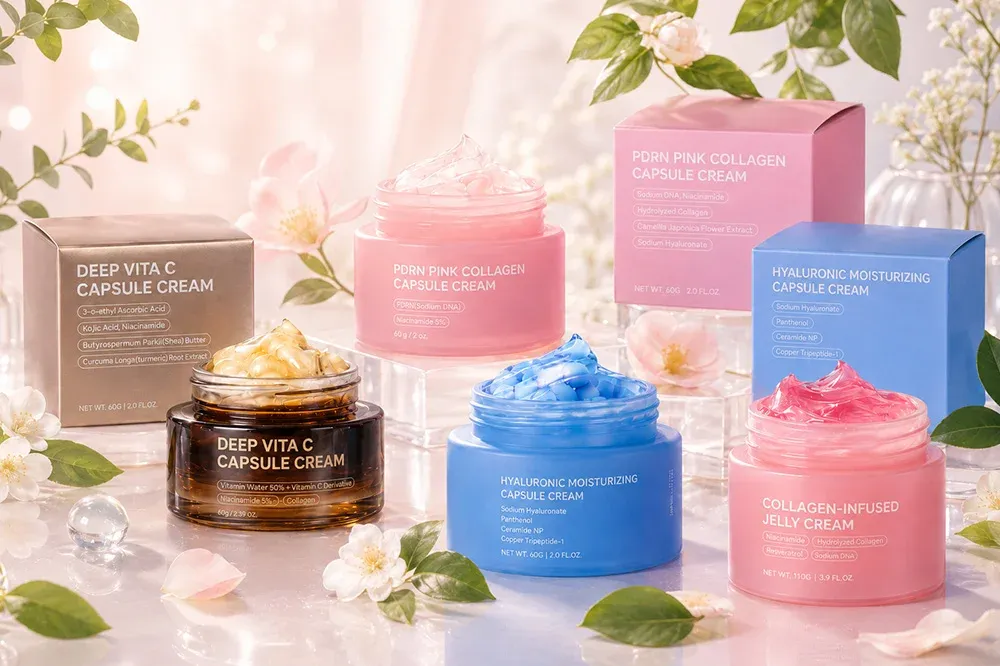
Emulsions developed and filled in-house — from 5,000 pieces, with the emulsifier system and the jar specified together so the cream is still stable at month 24.
Product fundamentals
A face cream is an emulsion — oil dispersed in water, or water dispersed in oil — stabilised by an emulsifier system. Viscosity, pH and the choice of emulsifier predict whether it stays stable; the active ingredients rarely do.
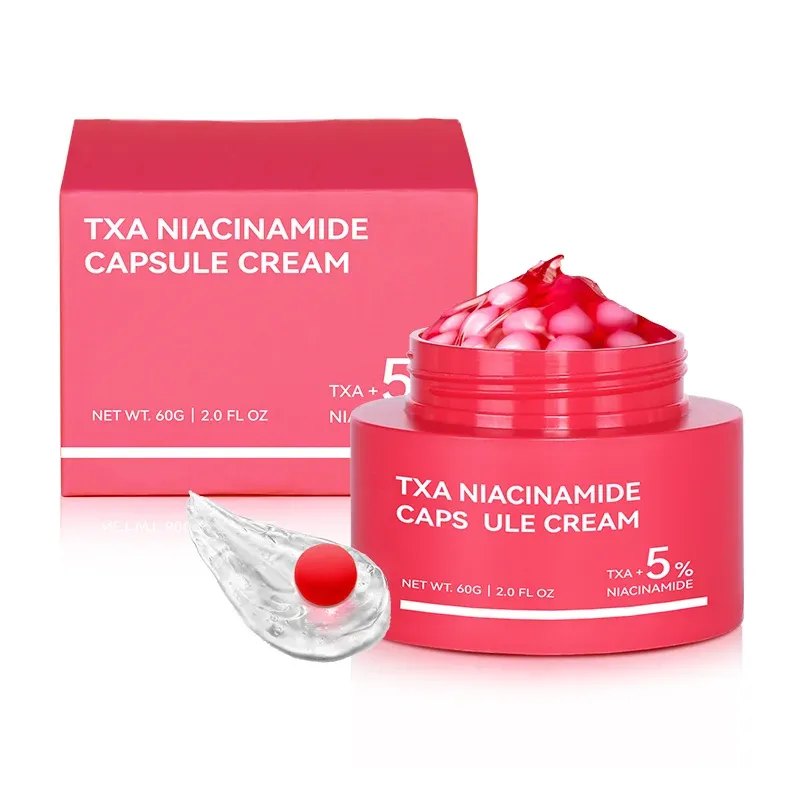
Most cream complaints are not about efficacy. They are about texture and stability: a cream that separates in the jar, weeps water at the surface, or turns gritty at month eight. All three are emulsion failures, and all three are predictable in an accelerated stability run.
The variables that matter:
Swipe the table →
| Parameter | Typical range |
|---|---|
| Minimum order | 5,000 pcs per formula, 10,000 per printed carton |
| Fill volume | 15 / 30 / 50 / 100 / 200 ml |
| Viscosity | 20,000–120,000 cps |
| pH | 4.5–7.0 |
| Emulsion type | O/W, W/O, gel-cream, anhydrous balm |
| Pack formats | Jar, airless jar, tube, airless pump, sachet |
| Sample lead time | 7–10 working days |
| Bulk lead time | 25–30 working days after artwork approval |
A jar is the most demanding pack for a cream, because every opening exposes the whole surface to air and fingers. An airless jar or a tube costs more per unit but reduces preservative demand and extends real-world shelf life after opening.
If the retail concept requires a jar — and for premium positioning it often does — the preservative system has to be specified for that reality, not for an ideal one. A formula that passes challenge testing in a tube can fail the same test in a wide-mouth jar.
Emulsion selection
The emulsion type is the single most consequential decision on a cream project. It sets the skin feel, the preservative burden, the pack options and the cost.
Swipe the table →
| Type | Skin feel | Best suited to | Stability risk | Relative cost |
|---|---|---|---|---|
| Oil-in-water (O/W) | Light, absorbs quickly, non-greasy | Oily and combination skin, day creams, large volumes | Moderate — separation if emulsifier is under-specified | Low |
| Water-in-oil (W/O) | Rich, occlusive, slight residue | Dry skin, night creams, barrier repair | Higher — heat sensitivity, phase inversion risk | Medium |
| Gel-cream | Cooling, watery break, no residue | Humid markets, oily skin, "water cream" positioning | Lower — but prone to syneresis | Medium |
| Anhydrous balm | Heavy, melts on contact | Cleansing balms, occlusive night treatments | Low — no water phase, minimal preservation need | Medium–high |
O/W is the workhorse. It is the cheapest to produce, the easiest to fill, and covers the widest range of textures. Its weakness is that a poorly specified emulsifier system separates under heat — which is exactly the failure mode that shows up after a summer in a warehouse.
W/O delivers the richness that premium night creams are judged on. It is also harder to stabilise: W/O emulsions are sensitive to temperature during filling and to electrolyte levels in the water phase. If your formula includes a high level of a salt-form active, this is the wrong system.
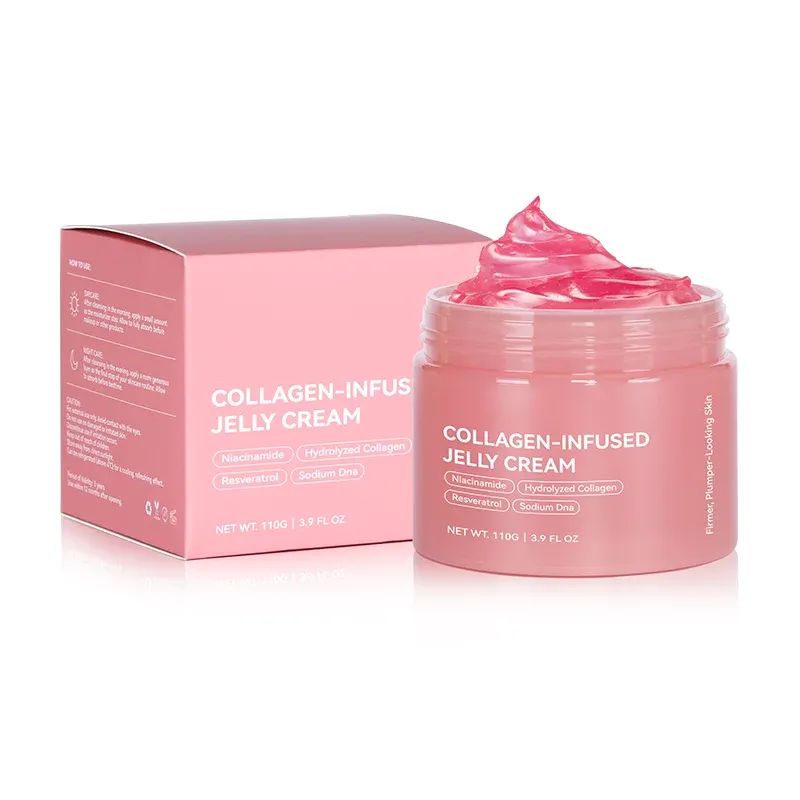
Gel-cream is the format that travels best. It feels light in humid markets, photographs as translucent, and carries a "water cream" story without the cost of a W/O system. It is also the format most prone to syneresis — water weeping from the gel — which is a stability test, not a visual check.
Anhydrous removes the water phase entirely, which removes most of the preservative challenge. Cleansing balms and occlusive night treatments live here. The trade-off is sensory: an anhydrous balm is either loved or rejected, rarely rated neutral.
Customisation scope
Cream is customisable across texture, fragrance, colour, actives and pack. The practical constraint is not the formula but the filling equipment, which is why viscosity is agreed before anything else.
Swipe the table →
| Element | Options | Effect on minimum order |
|---|---|---|
| Texture | Light lotion to rich balm, 20,000–120,000 cps | Included |
| Emulsion type | O/W, W/O, gel-cream, anhydrous | Included |
| Actives | Niacinamide, hyaluronic acid, peptides, ceramides, centella, panthenol | Included at standard levels; +5,000 pcs for high-load formulas |
| Fragrance | Fragrance-free or specified | Included |
| Colour | Untinted, tinted, pearlescent | +2,000 pcs for pearlescent |
| Pack | Jar, airless jar, tube, airless pump | Structure-dependent |
| Carton | Up to 6 colours, spot UV, foil, embossing | +5,000 pcs per design |
| Claim set | Hydrating, barrier support, brightening, firming | Depends on actives and market |
Brands brief texture in adjectives; the factory needs figures. "Rich but not greasy" usually means a W/O emulsion at 60,000–90,000 cps with a fast-absorbing emollient blend. "Lightweight gel" usually means an O/W or gel-cream at 20,000–35,000 cps. "Melts into skin" is a high-oil-phase cream with a low melting-point butter.
The fastest way to converge is to send a competitive product you want to match. We measure viscosity, oil phase and pH, then propose a system that lands in the same sensory territory — which is far more efficient than three rounds of adjective-based sampling.
High-viscosity creams above roughly 90,000 cps need a jar or a specific piston-filling tube. Airless pumps top out lower, because the piston cannot draw a very heavy mass reliably. If your retail concept depends on an airless pump, viscosity is capped — and that caps how rich the cream can feel.
01
Brief and benchmark
Target texture, skin type, claim and retail price. Sending a competitor product you want to match shortens development more than any written brief.
02
Emulsion system and pack selection
O/W, W/O, gel-cream or anhydrous, plus the pack, agreed together. Viscosity and container are fixed here because they constrain each other.
03
Lab batch and sensory approval
A lab batch is made and assessed for texture, absorbency and after-feel. This is the cheapest point in the project to change direction.
04
Stability run in the production pack
Accelerated testing at 40°C/75% RH with the formula in the actual jar or tube. Separation, syneresis and pH drift are logged at each timepoint.
05
Filling and in-process control
Filled by weight to ±1%, with viscosity and pH checked against the approved standard at start, middle and end of run.
06
Release and export packing
Micro results, batch record and COA before release. Retained samples kept past shipment for later comparison against complaints.
Commercials
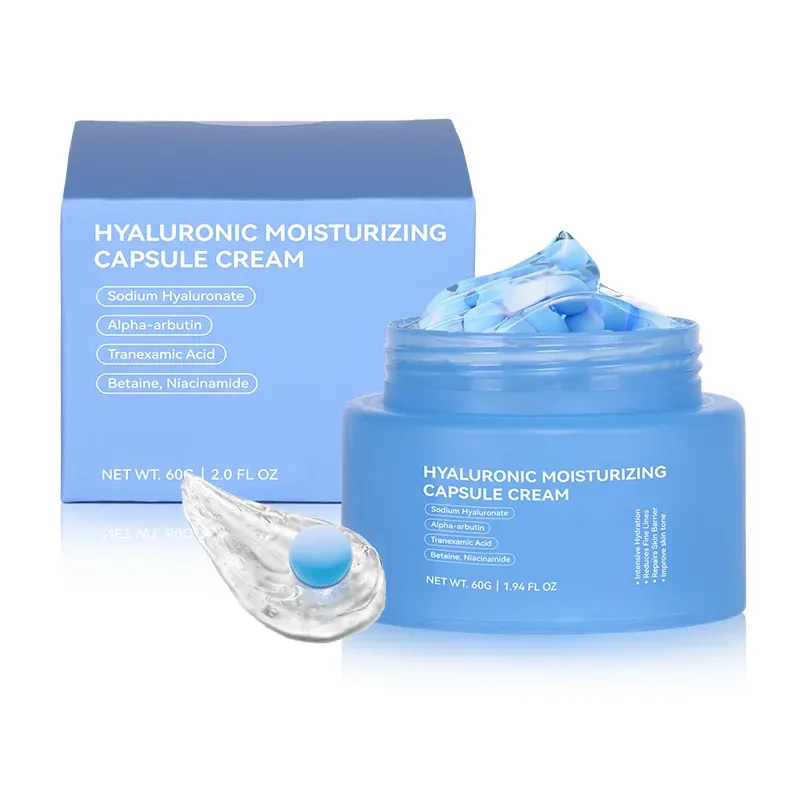
On a jarred cream, the container and the carton together often exceed the cost of what is inside them. The bands below assume a 50 ml jar with a printed carton.
Swipe the table →
| Order quantity | Relative unit cost | Production window |
|---|---|---|
| 5,000–9,999 pcs | Highest | 25–28 working days |
| 10,000–49,999 pcs | Mid | 25–30 working days |
| 50,000–199,999 pcs | Lower | 30–35 working days |
| 200,000+ pcs | Lowest | Scheduled per project |
A 50 ml jarred cream breaks down roughly as: jar and lid 25–40%, formula 20–30%, carton and labelling 10–15%, filling and QC 10–15%, export packing and freight 5–10%. Three consequences follow.
The jar is the negotiation. Moving from a thick-wall acrylic jar with a domed lid to a standard PET jar can cut unit cost by a third — and changes the shelf presence entirely. This is the single largest lever on a cream project.
Fill volume is a pricing decision. A 15 ml jar and a 50 ml jar differ mostly in what goes inside, not in the component. That is why 15 ml exists as a trial size and rarely as a volume product.
Carton is optional and expensive. A printed folding carton adds 10–15% to unit cost. For a premium jar it is often justified; for a tube it usually is not.
Library-formula samples are charged at cost and credited against the bulk order. Bespoke development carries a fee covering lab time and a stability run, credited once production passes 20,000 pieces.
25–30 working days starts from signed artwork and received deposit. The critical path on cream projects is frequently the jar, not the filling line: non-standard jars, airless mechanisms and custom lids are routinely 4–6 weeks lead-time items. Confirm jar stock before approving artwork if the launch date is fixed.
Quality and compliance
Cream fails in three visible ways — it separates, it weeps, or it changes colour. Each has a specific test, and each is far cheaper to run before launch than to discover after.
Swipe the table →
| Document | What it covers | When issued |
|---|---|---|
| INCI list | Full declaration in your market's required order | With quotation |
| COA | Batch-specific viscosity, pH and micro results | With shipment |
| SDS / MSDS | Handling and transport classification | With quotation |
| Stability report | Accelerated and real-time data at the timepoint reached | After stability run |
| Preservative efficacy report | Challenge test results in the production pack | After challenge test |
| CPSR support | Safety assessment inputs for EU placement | On request |
Surface weeping — a thin film of water on top of the cream — is syneresis, and it looks like spoilage even when the product is microbiologically sound. It is caused by an under-specified emulsifier or by temperature cycling during transit. It is fully predictable in a freeze–thaw test.
Grittiness at month eight is usually crystallisation of a butter or fatty alcohol, not contamination. It is a formulation issue that emerges slowly, which is why real-time data at the 12- and 24-month timepoints still matter even when accelerated results pass.
Buyer's checklist
Cream suppliers all claim custom formulation, low MOQ and fast turnaround. These questions reach the part of the process that determines whether the product is still good at month 18.
This page covers one category only. Brands assembling a complete line usually pair it with Serum OEM and Body Care OEM. MOQ, lead times and material options for every category we run sit on the OEM/ODM service page.
What brands ask during evaluation, answered with the specifications we quote against.
5,000 pieces per formula. A printed carton raises the minimum to 10,000 pieces per design. High-load active formulas may carry a 10,000-piece minimum because they require additional stability work before release.
Oil-in-water creams disperse oil droplets in a water phase: they feel light, absorb quickly and suit oily or combination skin and day use. Water-in-oil creams disperse water in oil: they feel richer and more occlusive, suit dry skin and night use, and are harder to stabilise because they are sensitive to temperature and to electrolytes in the water phase.
7–10 working days for samples, plus a stability run before commercial production for a bespoke formula. Bulk production is 25–30 working days after signed artwork and deposit. On jarred products, the jar lead time is frequently longer than the filling lead time and should be confirmed first.
Yes, and it is the most efficient way to brief. Send a sample and we measure viscosity, oil phase and pH, then propose an emulsion system that lands in the same sensory territory. This usually converges faster than three rounds of adjective-based sampling.
20,000–120,000 cps. Above roughly 90,000 cps the pack must be a jar or a piston-filling tube, because airless pumps cannot draw a very heavy mass reliably. If the retail concept depends on an airless pump, viscosity is effectively capped.
Yes. Accelerated stability at 40°C/75% RH is run with the formula in the production pack rather than a generic container, because a wide-mouth jar presents a different preservation and oxidation environment. We also run three freeze–thaw cycles, which catches failures that heat testing alone misses.
Niacinamide, hyaluronic acid, peptides, ceramides, centella asiatica, panthenol, squalane, shea butter and most standard emollients and humectants. High-load formulas may need a different emulsifier system, which is why we ask for the target level at brief stage rather than after sampling.
Yes. Fragrance-free is standard at no MOQ penalty and is the safer default for sensitive-skin positioning. Vegan formulations avoid animal-derived ingredients including lanolin and beeswax, substituting plant-derived equivalents and declaring them in the INCI list.
Syneresis — water separating from the emulsion — caused by an under-specified emulsifier system or by temperature cycling during transit. It looks like spoilage even when the product is microbiologically sound, and it is fully predictable in a freeze–thaw test. It is a formulation and logistics issue, not a contamination issue.
Full INCI, batch COA with viscosity and pH, SDS/MSDS, accelerated and real-time stability data, freeze–thaw results, preservative efficacy in the production pack, and the inputs a safety assessor needs for an EU CPSR. The CPSR itself is issued by a qualified assessor.
Send us your brief and we will come back with a formulation direction, a realistic MOQ and a production schedule.