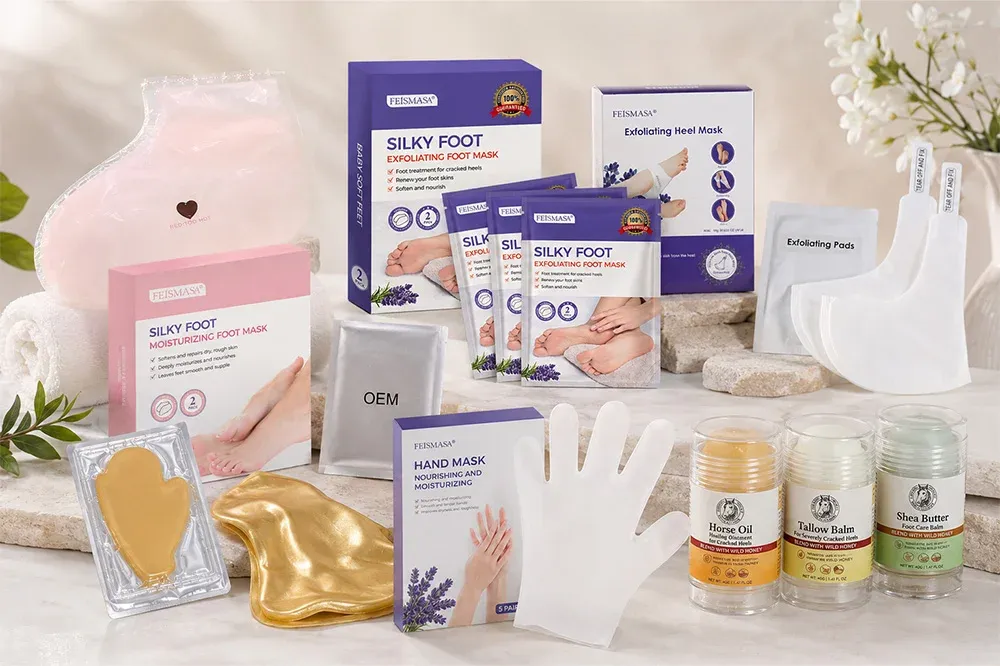
Glove and sock masks, peeling masks and paraffin treatments — from 10,000 pairs, with seal strength tested per lot because a leaking glove is not a cosmetic defect, it is a return.
Product fundamentals
A hand or foot mask is a sealed glove or sock containing serum, or a coated film that delivers an acid or wax treatment. Film structure and seal geometry matter more than the formula, because the product has to survive being worn while the wearer moves.
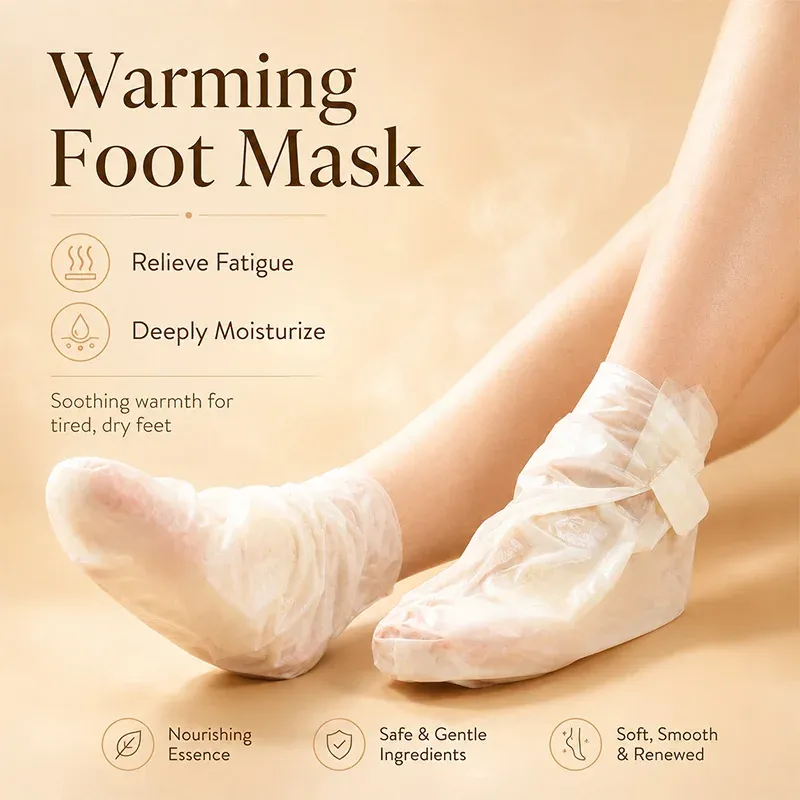
Unlike a sheet mask, a hand or foot mask is worn as a garment. The wearer walks, types, or sits with feet elevated. That changes the engineering priorities completely:
Most complaints in this category are not about efficacy. They are about a glove that split, a sock that slid off, or a product that leaked inside its own carton.
Swipe the table →
| Parameter | Typical range |
|---|---|
| Minimum order | 10,000 pairs per formula, 20,000 per printed carton |
| Glove / sock material | PE film, non-woven laminate, aluminium-laminate |
| Fill weight | 15–30 g per pair |
| Seal type | Three-side, contour seal, gusseted |
| Peeling mask acid level | 8–15% total AHA (glycolic / lactic), pH 3.5–4.0 |
| Paraffin melt point | 45–55°C |
| Formats | Glove, sock, heel patch, paraffin sleeve |
| Sample lead time | 7–10 working days |
| Bulk lead time | 20–25 working days after artwork approval |
PE film is the cheapest and the most common. It is thin, seals reliably, and transmits heat poorly — which is fine for a 15-minute moisturising treatment and wrong for a warming or paraffin product.
Non-woven laminate feels softer against skin, looks less clinical and photographs better. It costs more and requires a different sealing process, because the fibrous layer does not seal to itself the way PE does.
Aluminium laminate holds heat and prevents evaporation, which is what a paraffin or warming foot mask needs. It is the most expensive structure and the only one that reliably keeps a 20-minute treatment warm.
Format selection
These are four different products that share a category shelf. Each carries a different regulatory profile, a different failure mode and a different price point.
Swipe the table →
| Format | Mechanism | Key failure mode | Relative cost | Best suited to |
|---|---|---|---|---|
| Moisturising glove / sock | Occlusion plus humectants | Seal failure at thumb or heel | Low | Volume retail, gifting, spa retail |
| Peeling foot mask | AHA dissolves surface keratin; shedding follows in 5–10 days | pH drift, patchy peeling, irritation | Medium | High-conversion online products |
| Paraffin treatment | Heat plus occlusive wax | Wax solidifies in transit if melt point is wrong | Medium–high | Salon and professional channels |
| Heel patch / heel mask | Localised occlusion on a fitted patch | Adhesive lift on a high-friction area | Low | Add-on and travel formats |
| Warming mask | Exothermic or chemical warming layer | Uneven heat, and a real safety requirement | High | Winter and wellness positioning |
A peeling foot mask is the highest-conversion product in this category and the one with the least margin for error. The acid load is typically 8–15% total AHA at pH 3.5–4.0. Below that range the product does nothing and generates refunds; above it, the risk of irritation and of regulatory problems rises sharply.
Regulatory limits on AHA concentrations differ by market, and some markets treat a peeling foot mask as a cosmetic while others scrutinise it more closely. Fix the destination market before fixing the formula — reformulating after the artwork is printed is the most expensive mistake available here.
Shedding behaviour is also a formulation decision. A mask that produces patchy peeling looks like a defect even when it is functioning as designed. Uniform shedding depends on acid distribution across the film, which is a coating-control issue rather than an ingredient issue.
Customisation scope
Hand and foot masks are customisable in size, film, fill, seal and packaging. Size is the element most often underestimated and the one that generates the most complaints.
Swipe the table →
| Element | Options | Effect on minimum order |
|---|---|---|
| Size | Standard hand and foot, oversized, heel-only, wrist-only | Standard at base MOQ; new die +10,000 pairs |
| Film | PE, non-woven laminate, aluminium laminate | No change for stock films |
| Fill weight | 15–30 g per pair | Included |
| Seal geometry | Three-side, contour, gusseted | Included |
| Opening | Tear notch, zip, adhesive tab | +5,000 pairs for adhesive tab |
| Packaging | Single pair pouch, 2/3/5-pair box, jar, gift set | Structure-dependent |
| Up to 8 colours on pouch and carton | +10,000 pairs per design |
A hand mask that is 10 mm too short splits at the thumb crotch when the wearer flexes. A foot mask that is too narrow will not go over an ankle. Both failures are invisible in a flat photograph and obvious the moment a customer tries the product.
We size from measurements rather than from a competitor sample, and supply a physical fit sample before artwork approval. If you are adapting an existing product, send one — measuring a competitor's glove is faster and more reliable than describing a hand.
A tear notch that works is a small delight; a zip closure that reseals lets a two-treatment product be sold at a higher price. An adhesive tab costs 5,000 pairs of minimum order and is the difference between a glove that stays on during a 20-minute treatment and one that has to be held.
01
Brief and market check
Format, destination market and claim. For peeling masks this is where the acid level is checked against the market's limits — before anything else is designed.
02
Film and seal geometry
Film structure and seal layout agreed against how the product will be worn. PE for volume, non-woven for spa positioning, aluminium for heat retention.
03
Fit sampling
Physical fit samples in the specified size, worn and photographed. This is the cheapest point to discover a glove that splits at the thumb.
04
Fill, seal and leak testing
Filled by weight, sealed, then dye-penetration tested per lot. Seal strength is checked at the highest-stress point rather than on a flat area.
05
Artwork and carton proofing
Pouch and carton proofed together. For multi-pair boxes the dieline and the pouch dimensions must agree, or the carton will not close.
06
Release and export packing
Micro results, seal records and batch documentation before release. Cartons are drop-tested where the product contains liquid-filled film.
Commercials
Film and carton dominate cost in this category, and the multi-pair box is the format that changes both unit economics and retail positioning.
Swipe the table →
| Order quantity | Relative unit cost | Production window |
|---|---|---|
| 10,000–24,999 pairs | Highest | 20–23 working days |
| 25,000–99,999 pairs | Mid | 20–25 working days |
| 100,000–499,999 pairs | Lower | 25–30 working days |
| 500,000+ pairs | Lowest | Scheduled per project |
A pouched hand mask breaks down roughly as: film and pouch 30–40%, formula 20–30%, carton 10–15%, filling and seal QC 10–15%, export packing and freight 5–10%. Two consequences follow.
The box is the positioning. A five-pair printed box sells at a multiple of the unit price of five single pouches, and the incremental cost is carton and labour, not product. This is the highest-return packaging decision in the category.
Film structure is a formula constraint, not just a cost line. Aluminium laminate costs more than PE but is the only structure that keeps a paraffin treatment warm for 20 minutes. Choosing PE to save cost and then claiming a warming effect is a claim problem waiting to happen.
Samples are charged at cost and credited against bulk. Fit samples in the specified size are supplied as part of standard sampling — a flat pouch sample tells you nothing about whether the glove fits.
20–25 working days from signed artwork and received deposit. Two things routinely add a week: new seal tooling for a non-standard contour, and carton production where the box is a non-standard size. If launch date is fixed and the box is bespoke, order the carton earlier than feels necessary.
Quality and compliance
This is a liquid-filled film product that gets worn while moving. The quality programme is built around preventing leaks and preventing pH drift, in that order.
Swipe the table →
| Document | What it covers | When issued |
|---|---|---|
| INCI list | Full declaration in your market's required order | With quotation |
| COA | Batch-specific fill weight, pH and micro results | With shipment |
| SDS / MSDS | Handling and transport classification | With quotation |
| Seal integrity record | Per-lot dye penetration and pull test results | On request |
| Stability data | pH and seal integrity retention over shelf life | After stability run |
| CPSR support | Safety assessment inputs for EU placement | On request |
For peeling masks, the acid concentration and the finished pH must both be within your destination market's limits. Some markets cap total AHA in consumer products; others require specific labelling. We check this against the destination before quoting, because a formula that is compliant in one market may not be shippable to another at the same acid level.
Buyer's checklist
This category looks simple and fails in specific, predictable ways. These questions reach the failure modes before your customers do.
This page covers one category only. Brands assembling a complete line usually pair it with Body Care OEM and Face Cream OEM. MOQ, lead times and material options for every category we run sit on the OEM/ODM service page.
What buyers ask during evaluation, answered with the specifications we work to.
10,000 pairs per formula. A printed carton raises the minimum to 20,000 pairs per design. Multi-pair gift boxes do not change the pair count — the minimum applies to total pairs across the order.
A moisturising foot mask occludes and delivers humectants, with visible softening in 15–20 minutes. A peeling mask contains 8–15% total AHA at pH 3.5–4.0, which dissolves surface keratin so shedding begins 5–10 days later. They are different products with different regulatory profiles, not two strengths of the same thing.
PE film for volume and low price points — it seals reliably and costs least. Non-woven laminate for spa and gifting positioning, because it feels softer and photographs better. Aluminium laminate only where heat retention matters, such as paraffin or warming treatments, since it is the only structure that keeps a treatment warm for 20 minutes.
15–30 g per pair, with 20 g the most common specification. Fill weight is checked hourly. Over-filling is a more serious problem than under-filling in this category, because excess liquid finds its way out through the seal in transit.
Yes, typically 8–15% total AHA (glycolic, lactic or a blend) at pH 3.5–4.0. The exact level depends on your destination market, because AHA limits and labelling requirements differ between jurisdictions. We confirm the compliant range for your market before quoting.
Seal strength is tested at the highest-stress point — the thumb crotch on a glove, the heel on a sock — rather than on a flat area, and dye penetration is run per lot to catch channel leaks. Cartons for liquid-filled film products are drop-tested before shipment.
Yes, and we recommend it. A flat pouch sample tells you nothing about whether a glove splits at the thumb when worn. We supply physical fit samples and worn photographs as part of standard sampling, and size from measurements rather than from a competitor sample alone.
Yes, with a melt point of 45–55°C in an aluminium-laminate sleeve. The melt point has to be matched to your climate and transit conditions: too low and the wax softens in a warm warehouse, too high and it never melts comfortably against skin.
Single foil pouches, 12/24/36-count printed cards, jars, metal tins and bulk poly bags. Pouch and card account for 30–40% of unit cost, so the format decision is commercial rather than cosmetic. Multi-count cards suit drugstore and gifting; single pouches suit beauty retail and subscription.
Typically 24–36 months unopened in an aluminium-laminate structure, and 18–24 months in PE film. Seal integrity is the limiting factor rather than the formula, which is why we run stability on seal strength over time rather than only on appearance and pH.
Send us your brief and we will come back with a formulation direction, a realistic MOQ and a production schedule.