VEILTA
10/12/2025
If you have asked multiple factories for acne patch quotes, you have probably seen it already: two suppliers can quote very different prices for products that seem similar at first glance.
That does not always mean one factory is overpriced and the other is efficient. In many cases, the gap comes from different assumptions. One quote may cover only the patch sheet. Another may include custom pouch, box, insert, testing, or a lower MOQ. A “cheap” quote often stops looking cheap once the details are aligned.
This guide explains what usually affects acne patch OEM price and MOQ, how to read market pricing more carefully, why MOQ is often misunderstood, and how to negotiate a safer first order without turning the discussion into a pure price fight.
In most cases, large quote gaps come from scope differences rather than one simple pricing mistake.
A supplier may quote:
That is why price comparison only works when the scope is aligned.
Basic hydrocolloid patches are usually the lowest-cost category. More complex products usually cost more.
A rough cost ladder often looks like this:
This is one of the main reasons two “acne patch” quotes can be far apart. The product category may sound similar, but the manufacturing difficulty is not.
MOQ has a direct effect on unit price because fixed setup cost has to be spread across the run.
A supplier quoting a larger order volume may look cheaper on paper. A supplier quoting a realistic smaller first order may show a higher unit cost. That does not automatically mean the second supplier is more expensive in practical terms. It may simply mean the quote is based on a lower starting volume.
Customization raises cost in ways that are easy to underestimate.
Common cost drivers include:
The more moving parts the project has, the less likely the cheapest unit quote will stay the cheapest after full scope is added.
Some buyers need more than a production quote. They may also need additional documentation, testing support, or process controls to meet importer, retailer, or brand requirements.
When compliance and paperwork expectations rise, cost usually rises too.
Packaging is one of the biggest reasons two quotes stop matching.
A supplier may quote only the patch and pouch. Another may include retail box, insert, barcode labeling, and outer carton requirements. A standard pouch is not the same project as a fully customized retail-ready SKU.
If packaging is not aligned, the quote comparison is not real.
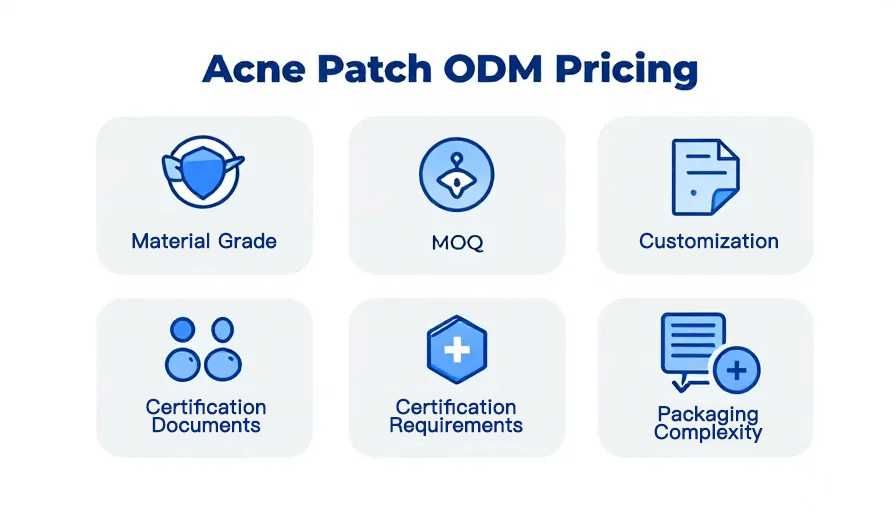
There is no universal market price for acne patch OEM. Final pricing depends on product spec, packaging, quantity, region, and order structure. Still, buyers usually need a rough reference point before they can judge whether a quote is broadly in range.
Public OEM and wholesale listings usually show this pattern:
| Product Type | Typical Price Position | Typical MOQ Position | Why | |---|---|---| | Standard hydrocolloid patch | Lowest | Lowest to moderate | Simpler material and broader supplier availability | | Salicylic acid or medicated patch | Mid | Moderate to higher | Added formula, process, or documentation complexity | | Microneedle acne patch | Highest | Higher | More complex structure, materials, and production process |
A safer way to use this table is directional, not absolute. It helps you judge whether the quote structure is broadly logical before you compare supplier details.
When you review any quote, ask:
Without those answers, price range discussions become misleading very quickly.
MOQ is one of the easiest places for buyers to get confused.
A supplier may quote MOQ by:
That means two suppliers can both say “our MOQ is low” while talking about completely different units.
A brand hears a manageable MOQ number and assumes that applies to the final sellable unit. Later it turns out:
That is how a small launch becomes larger than expected before production even starts.
Instead of asking “What is your MOQ?”, ask this:
“What is the MOQ by patch, sheet, pouch, box, and final sellable unit for this exact project scope?”
That question usually gets much closer to the real commercial requirement.
| Level | Term | Meaning | What it Refers To | Typical Relationship | How MOQ Is Usually Quoted |
|---|---|---|---|---|---|
| 1 | Piece | One individual acne patch | A single patch | Multiple pieces = 1 sheet | MOQ is rarely quoted by piece |
| 2 | Sheet | One patch sheet / liner sheet | A sheet containing multiple patches | 1 sheet = 12 / 24 / 36 / 48 pieces | Often used to show patch count per sheet |
| 3 | Pouch | One individual pouch | A pouch containing one or more sheets | 1 pouch = 1 or more sheets | Many suppliers quote MOQ by pouch |
| 4 | Box | One retail box | An outer retail box containing multiple pouches | 1 box = 6 / 12 / 24 pouches, etc. | Common for retail packaging |
| 5 | Final Sellable Unit | The final unit sold to the customer | Usually 1 box, but sometimes 1 pouch | Depends on the selling format | This is the most important MOQ unit |
The strongest first-order negotiation is usually about reducing exposure, not squeezing every cent out of the quote.
A supplier may not want to cut unit price much, but it may still be willing to improve the deal in ways that matter more.
Ask whether the supplier can support:
These changes often protect the buyer more than a small discount on paper.
If a supplier refuses to lower the unit price, the discussion does not have to stop there.
A better first-order package might be:
That kind of result can be commercially better than winning a lower unit price and losing protection elsewhere.
Be careful if you find yourself:
A cheaper quote is not always a cheaper project.
In many OEM skincare transactions, a 30/70 payment structure is common. That usually means a deposit before production and the balance before shipment.
That does not automatically make the deal safe. Payment terms should still match the level of trust, clarity, and verification already established.
Look more carefully if:
If the supplier wants certainty from the buyer, the buyer should also have certainty on what is being paid for.
For a first order, the right question is usually not “How do I get the cheapest price?”
It is:
“How do I get a quote structure that still makes sense if the first run is not perfect?”
That means reviewing:
A supplier that is slightly more expensive but clearer, more consistent, and easier to manage may still be the better commercial choice.
A useful acne patch OEM quote is not just a low number. It is a quote you can actually compare, understand, and execute without discovering hidden assumptions later.
If you need the broader sourcing framework behind supplier selection, OEM planning, and factory due diligence, read our OEM Pimple Patches Sourcing Guide.
The biggest pricing factors are usually product type, material quality, MOQ scale, customization level, packaging complexity, and any compliance or documentation requirements tied to the project.
Two suppliers may be quoting different assumptions even when the product name sounds similar. Differences in packaging scope, MOQ basis, active ingredients, sample standard, and documentation can all create large quote gaps.
MOQ can refer to piece count, sheet count, pouch count, retail box quantity, or total order quantity. Buyers should always ask which unit the MOQ applies to for the actual project scope.
In most public OEM and wholesale listings, yes. Microneedle acne patches usually cost more than standard hydrocolloid patches because the structure, materials, and production process are more complex.
A better approach is to reduce first-order risk instead of focusing only on unit price. Buyers can often negotiate packaging scope, order structure, defect handling, payment terms, and trial-order arrangements more effectively than asking for a simple discount.
It is a common structure in many OEM transactions, but buyers still need to review what triggers the balance payment, whether specifications are locked, and how quality problems would be handled if they appear.
MOQ is often confusing because suppliers may quote by different units. A number that sounds manageable may apply only to the patch sheet, while the pouch or retail box minimum is much higher.
Check the product type, unit basis, MOQ basis, packaging scope, active ingredients, customization level, payment terms, and defect handling terms. A quote is only useful when those points are clear.