Leakage Is Not a Packaging Problem — It Is a System Failure
In facial mask OEM, leakage is often blamed on pouch quality or sealing machines.
In reality, leakage is the final visible symptom of multiple upstream failures —
formula behavior, material absorption, filling tolerance, seal geometry, and logistics stress.
This page explains facial mask packaging and leakage control from a failure-mechanism perspective, not from packaging marketing claims.
Failure Category 1: Over-Reliance on Seal Strength
Common OEM Misjudgment
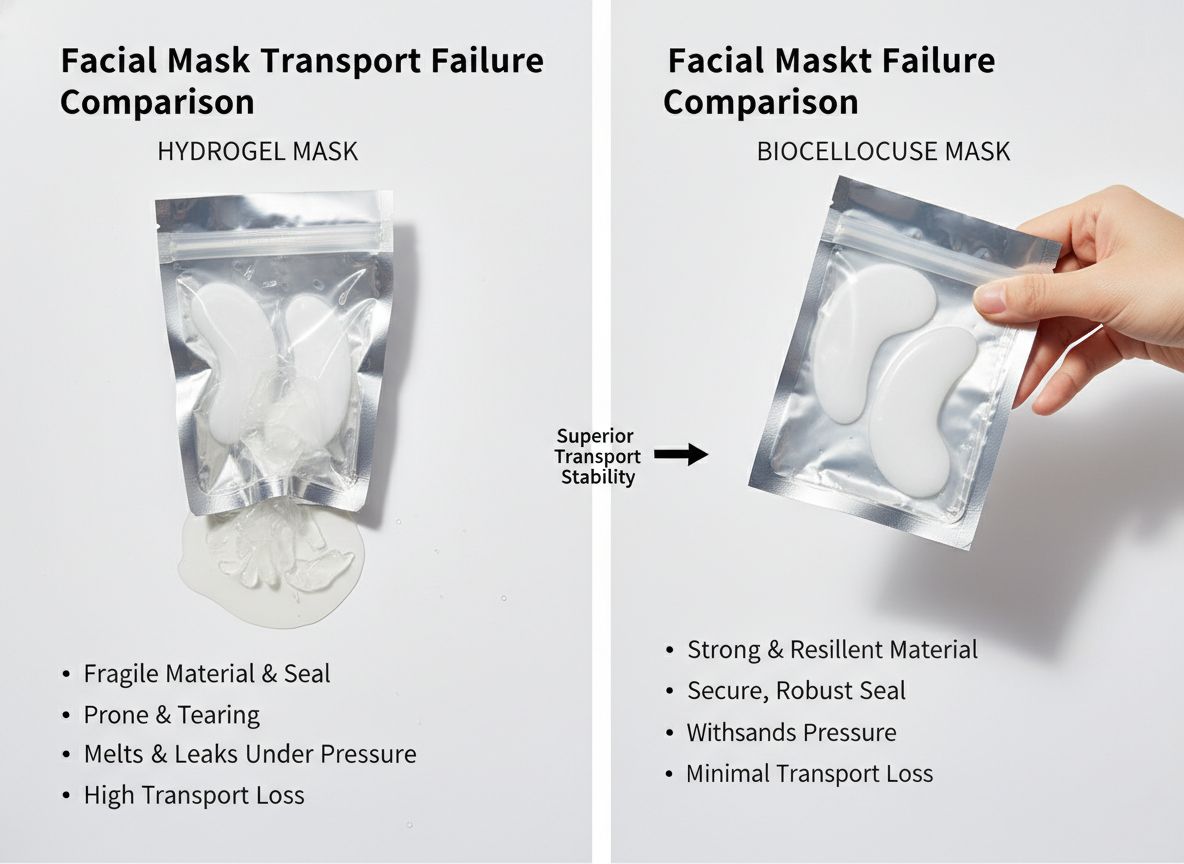
- Increasing sealing temperature or pressure to “prevent leakage”
- Using thicker laminates without revalidating seal geometry
Why This Fails
- Excessive heat weakens inner PE layers
- Micro-channels form along seal edges
- Seal strength increases but seal integrity decreases
Key Insight:
A strong seal is not always a safe seal.
Failure Category 2: Essence Mobility Inside the Pouch
High-Risk Scenarios
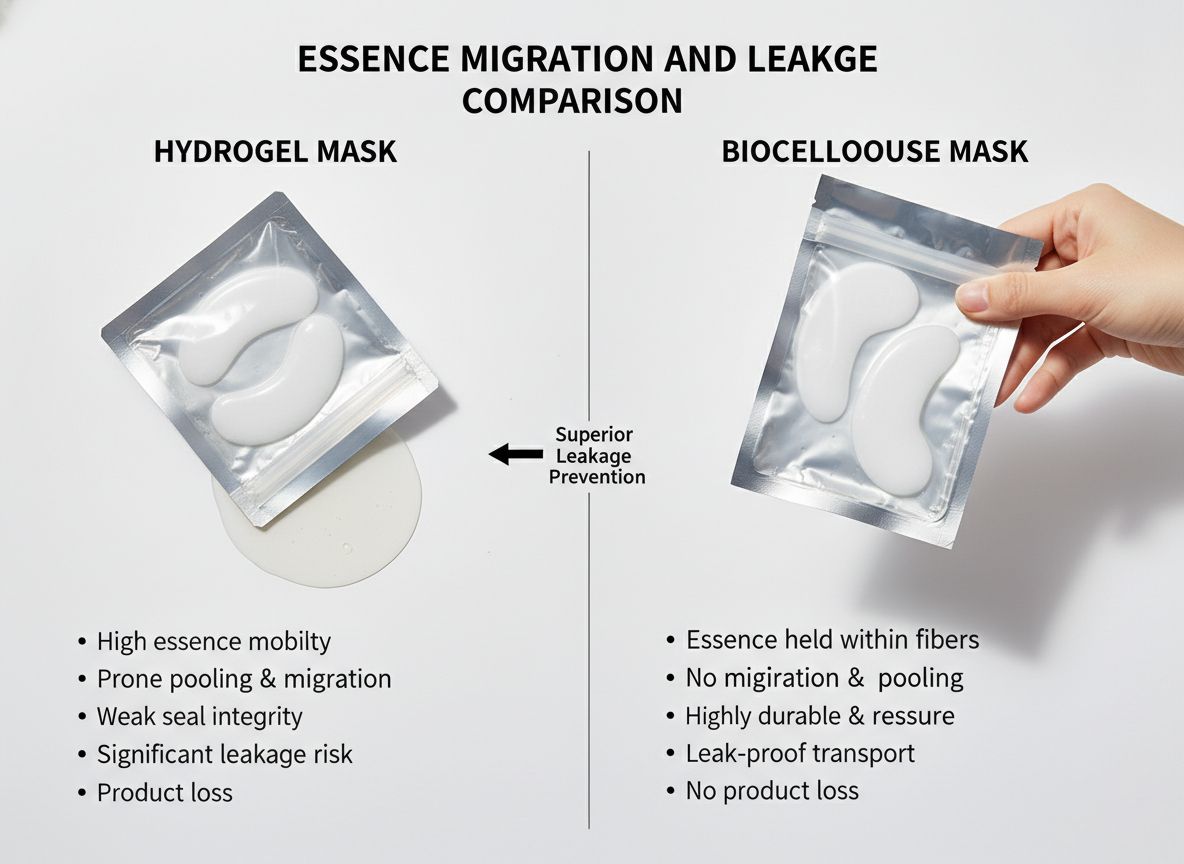
- Low-viscosity essences
- High glycerin or solvent systems
- Masks with low absorption substrates
Failure Mechanism
- Essence migrates under vibration
- Repeated pressure hits seal edge
- Leakage occurs days or weeks after packing, not immediately
OEM Reality:
Leakage that appears in transit cannot be detected by same-day QC.
Failure Category 3: Substrate Absorption Imbalance
Hydrogel & Bio-Cellulose Differences
Hydrogel masks:
- Lower absorption capacity
- More free liquid inside pouch
- Higher hydraulic pressure on seals
Bio-cellulose masks:
- Higher internal liquid retention
- Less mobile essence
- Lower leakage probability
Failure Risk Summary:
Packaging leakage risk is strongly influenced by mask material behavior, not just pouch quality.
Failure Category 4: Headspace Miscalculation
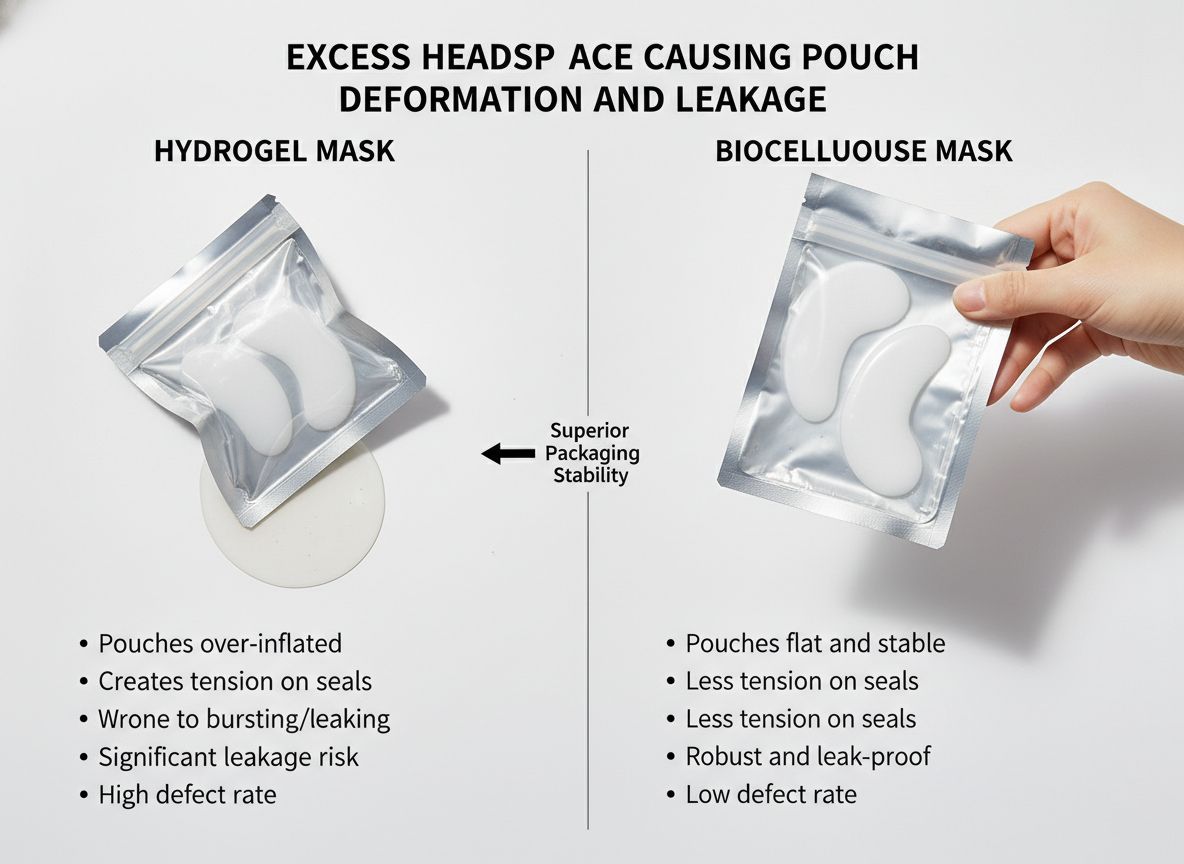
Typical OEM Errors
- Overfilling to enhance “premium feel”
- Ignoring altitude and air pressure changes during export
What Happens
- Excess headspace amplifies internal pressure changes
- Pouch expands and contracts repeatedly
- Seal fatigue occurs over time
Key Insight:
More essence does not equal better safety.
Failure Category 5: Transport-Induced Fatigue
Sea Freight vs Air Freight
Sea freight:
- Long-term vibration
- Temperature cycling
- Humidity fluctuation
Air freight:
- Rapid pressure changes
- Short-term stress spikes
Many facial mask packages survive drop tests but fail under long-duration fatigue, which standard tests often overlook.
Failure Category 6: Secondary Packaging Amplification
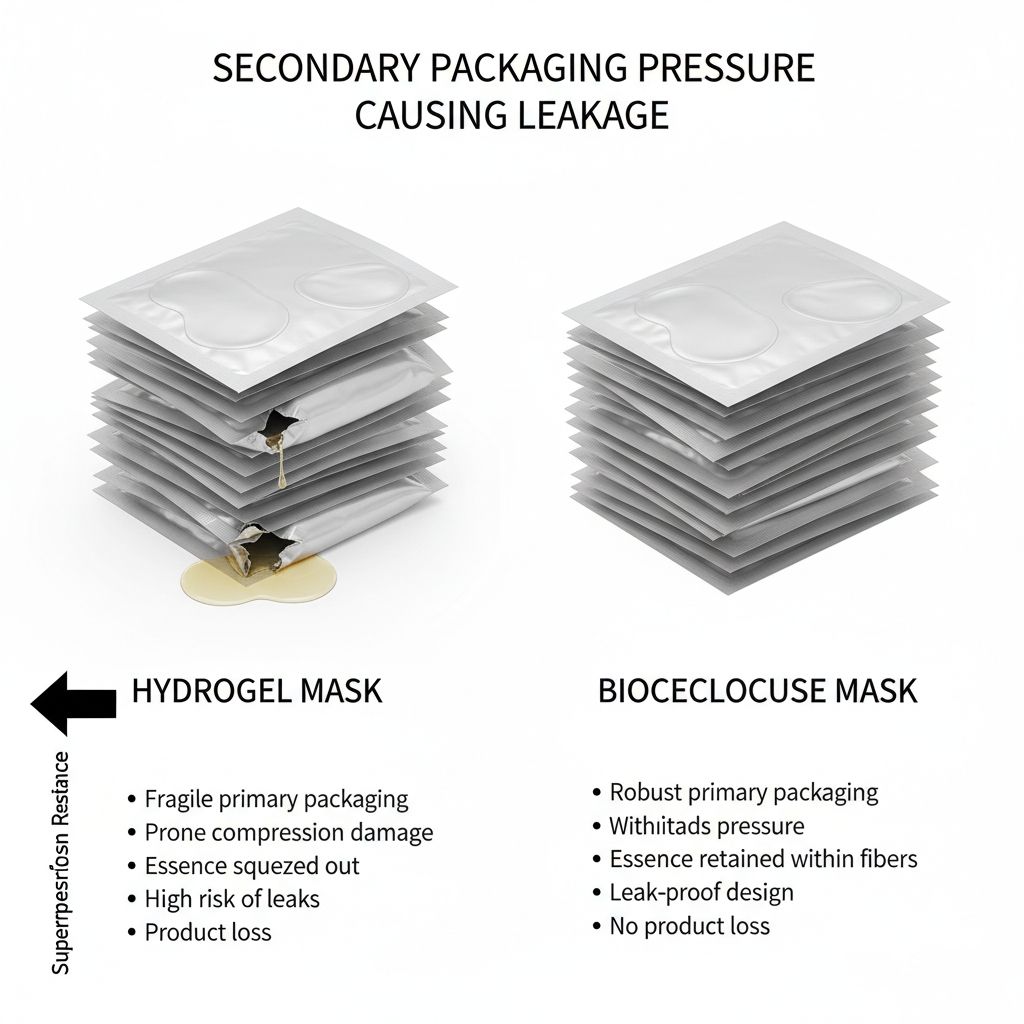
Hidden Risk
- Tight carton packing
- Uneven stacking pressure
- Edge compression during palletization
Primary pouches are often compliant,
but secondary packaging amplifies localized pressure on seals.
Leakage Is Usually a Chain Reaction
Leakage almost never has a single cause.
It typically follows this path:
- Essence mobility exceeds substrate absorption
- Headspace allows pressure fluctuation
- Seal geometry concentrates stress
- Transport fatigue weakens micro-areas
- Leakage becomes visible at destination
Fixing only one step rarely solves the problem.
VEILTA Leakage Control Framework
Our facial mask OEM leakage control focuses on system balance, not single-point optimization.
We evaluate:
- Essence rheology vs substrate absorption
- Fill volume tolerance windows
- Seal geometry and material compatibility
- Transport route simulation
- Secondary packaging pressure mapping
The goal is not zero leakage in factory —
it is zero leakage at the customer’s warehouse.
Packaging Selection Is Market-Dependent
High-risk markets:
- Long sea freight routes
- Tropical or cold-climate fluctuation
- Multi-distributor handling
Lower-risk markets:
- Domestic or short-haul logistics
- Controlled storage environments
Packaging decisions should follow distribution reality, not catalog specifications.
OEM Guidance: Reducing Leakage Risk
Facial mask leakage risk is reduced by:
- Matching essence mobility to substrate absorption
- Designing seals for fatigue resistance, not peak strength
- Controlling headspace scientifically
- Aligning secondary packaging with pouch behavior
These decisions must be made before mass production, not after complaints occur.
Start a Leakage-Controlled Facial Mask OEM Project
If your brand has experienced:
- Leakage during export
- Unstable pouch performance
- Inconsistent customer complaints
VEILTA can support you with:
- Leakage risk assessment
- Packaging-material compatibility testing
- Transport-oriented packaging optimization
Contact VEILTA to build a facial mask OEM system designed to survive real-world logistics.