Facial Mask OEM Stability Testing & Shelf-Life Failure
Shelf Life Is Not a Date — It Is a Failure Boundary
In facial mask OEM, shelf life is often treated as:
- a regulatory checkbox
- a fixed number on the packaging
- a document prepared for compliance
In reality, shelf life is the time window before the first failure mechanism becomes dominant.
This page explains facial mask OEM stability testing from a failure-based engineering perspective, not from marketing claims or accelerated test summaries.
What Changes First
- pH micro-shifts
- Viscosity reduction
- Solubilizer phase imbalance
These changes may not be visible, but they alter interaction with the mask substrate and packaging.
Why This Matters
A formula that passes initial QC can:
- increase essence mobility
- weaken preservative performance
- accelerate packaging stress
Shelf-life failure often begins chemically, not visually.
Failure Category 2: Preservative System Fatigue
Common Misunderstanding
Passing a preservative challenge test ≠ long-term microbial safety.
Failure Mechanism
Over time:
- Preservative efficacy decays
- Active ingredients compete for preservative availability
- Localized microbial risk increases at pouch edges or folds
Critical Insight:
Microbial failure usually occurs after physical instability begins, not before.
Failure Category 3: Substrate–Essence Interaction Aging
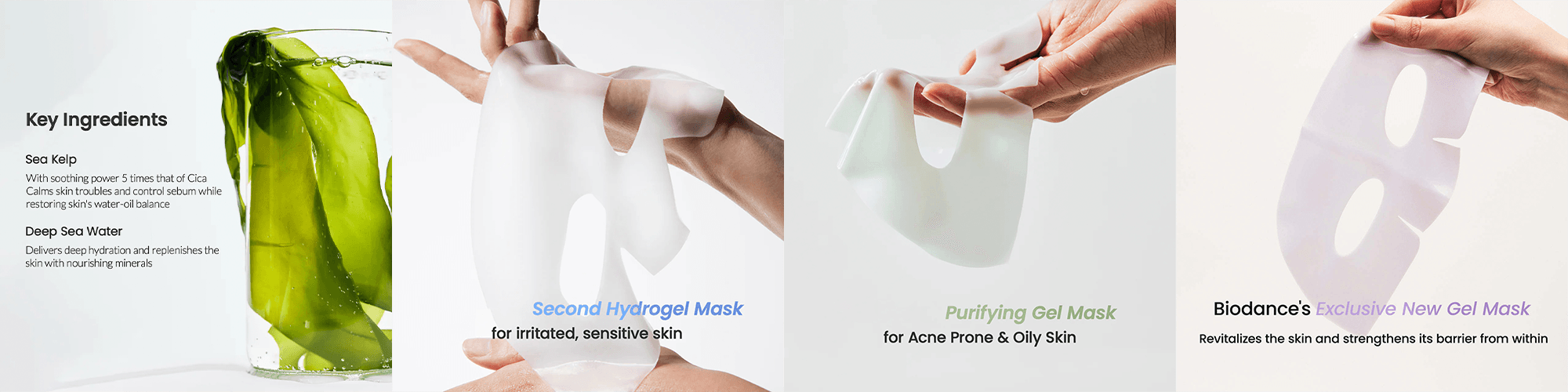
Different substrates age differently:
Hydrogel:
- Gradual moisture loss
- Network shrinkage
- Increased free liquid
Bio-cellulose:
- Fiber relaxation
- Reduced liquid retention
- Texture softening
These changes directly affect:
- leakage risk
- skin feel consistency
- perceived product quality at end of shelf life
Failure Category 4: Packaging Material Degradation
What OEMs Often Miss
Packaging films also age.
Over shelf life:
- Laminate adhesion weakens
- Inner PE layers lose elasticity
- Barrier performance degrades under heat cycling
Packaging that performs well at month 1
may fail at month 18 — without visible warning.
Failure Category 5: Temperature Cycling Stress
Real Export Conditions
- Warehouse storage
- Sea freight container temperature swings
- Distributor stock rotation delays
Temperature cycling accelerates:
- seal fatigue
- essence migration
- substrate deformation
Many failures only appear after repeated cycles, not during static tests.
Failure Category 6: Headspace Evolution Over Time
Headspace inside a pouch is not static.
Over time:
- gas permeability changes
- internal pressure fluctuates
- pouch deformation increases
This leads to:
- seal edge stress
- micro-leakage risk
- late-stage shelf failure
Shelf life is often limited by gas behavior, not formula expiration.
Limitations of Accelerated Tests
- Short-term heat stress ≠ long-term fatigue
- Linear extrapolation ignores compounding effects
- Some failures require time, not temperature
Accelerated testing should be used to:
- identify failure direction
- not to define absolute shelf life without real-time validation
VEILTA Stability Testing Framework
Our facial mask OEM stability testing focuses on:
- failure sequence mapping
- multi-factor interaction analysis
- packaging–formula–substrate balance
We evaluate:
- real-time stability
- accelerated stress behavior
- transport-related degradation risks
The goal is not to “pass tests”,
but to predict when and how failure will occur.
Shelf Life Is Market-Specific
A 36-month shelf life may be realistic for:
- controlled climates
- fast-moving distribution
The same product may fail earlier in:
- tropical regions
- long sea freight routes
- slow retail turnover markets
Shelf-life decisions must align with actual market behavior, not generic assumptions.
OEM Guidance: Reducing Shelf-Life Failure Risk
Effective shelf-life control requires:
- balancing formulation stability and functionality
- matching substrate aging behavior to essence mobility
- selecting packaging for long-term fatigue resistance
- validating under realistic logistics conditions
Shelf life is engineered — not declared.
Start a Stability-Controlled Facial Mask OEM Project
If your brand needs:
- long export shelf life
- reduced post-market complaints
- predictable product performance
VEILTA supports facial mask OEM projects with:
- stability risk assessment
- shelf-life modeling
- compliance-aligned testing documentation
Contact VEILTA to build facial mask products designed to remain stable — not just compliant.