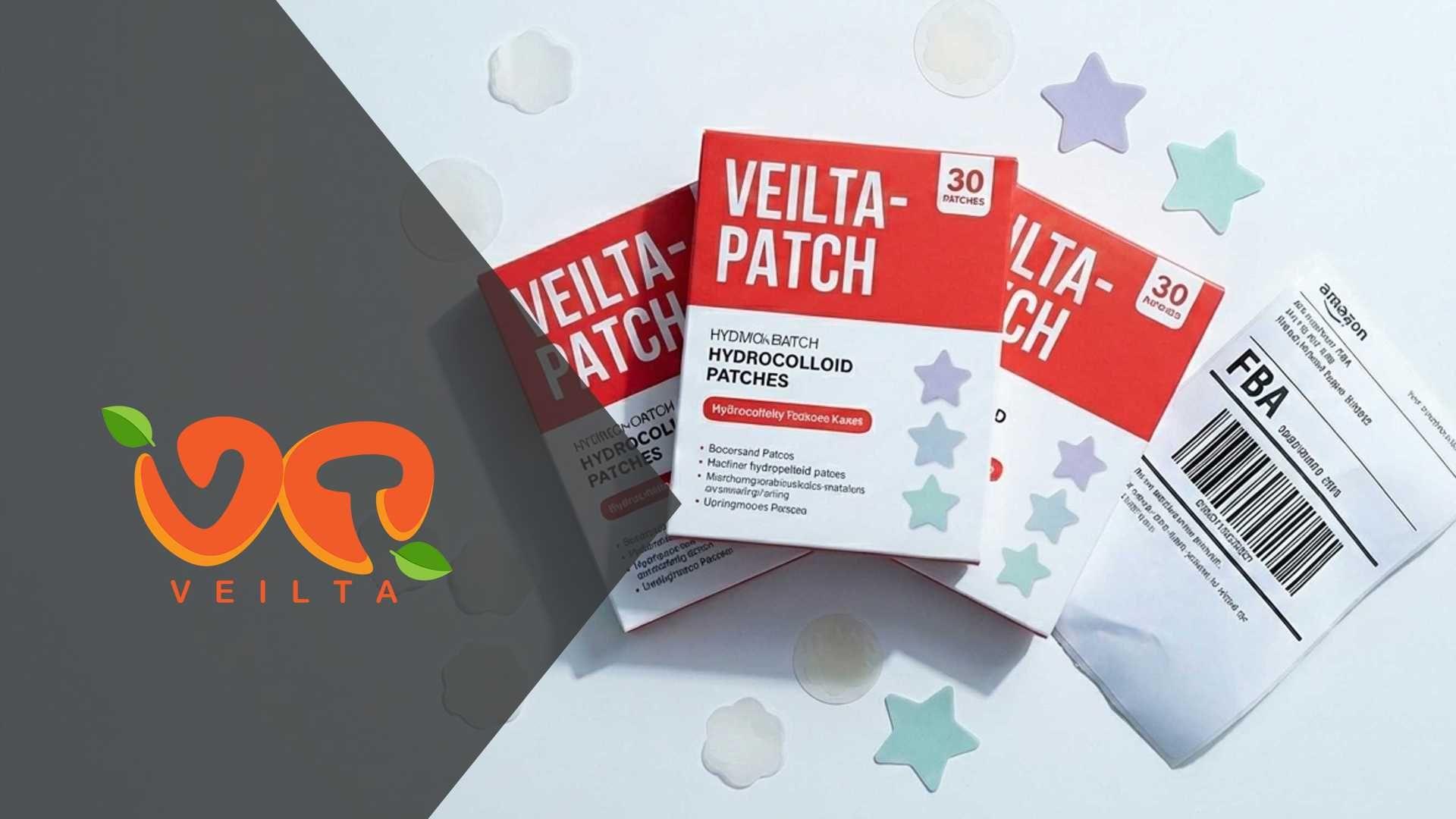
How to Sell Private Label Acne Patches on Amazon in 2026
VEILTA
05/29/2026
Selling private label acne patches on Amazon in 2026 is viable for products positioned as cosmetics—no FDA pre-market approval required. The complications arise in three specific places: how the listing is written, what the physical label says, and what the manufacturer can document before the first shipment enters a fulfillment center. This guide covers all three.
Selling on Amazon in 2026
Yes, you can sell private label acne patches on Amazon. Hydrocolloid patches are a mature, well-defined category on the platform with consistent demand from US consumers. The more useful question is not whether Amazon accepts them, but whether your listing, packaging, and documentation hold up to scrutiny.
Amazon's enforcement on health and beauty products has tightened over the past two years. Listings are reviewed by automated systems trained to detect specific language patterns, and sellers in the skincare space face documentation requests more often than most other categories. Getting this right before the first shipment costs far less—in time and money—than recovering from a listing suspension after products are already in a warehouse.
How Amazon categorizes your product
Acne patches typically fall under Beauty & Personal Care, subcategory Skin Care. Products in this category are treated as cosmetics unless they make drug claims—at which point Amazon may request additional documentation or remove the listing entirely.
This distinction matters practically, not just on paper. Amazon's content classifiers are trained to detect language associated with OTC drugs. A single phrase in a title or bullet point can shift your product from cosmetic to drug territory in Amazon's system, regardless of what the physical label says.
Cosmetic or OTC drug?
This is the decision that shapes everything downstream: label copy, listing content, manufacturer requirements, and regulatory exposure. Make it early and make it clearly.
Plain hydrocolloid patches
A standard hydrocolloid acne patch with no active pharmaceutical ingredient sits comfortably in the cosmetic category. These patches work by absorbing fluid from a blemish and creating a moist, occlusive environment that protects the skin from external contact. That mechanism does not involve drug action as defined by the FDA. You can position the product around absorption, protection, and visible skin appearance without triggering OTC drug review.
Patches with salicylic acid
If the formula contains salicylic acid, classification depends on the claims. Salicylic acid is a recognized active ingredient in the FDA's OTC acne monograph. Products containing it at 0.5% to 2% concentration and making acne treatment claims are regulated as OTC drugs under that monograph. OTC drug requirements include the Drug Facts label format, specific active ingredient concentration declarations, and warning copy that differs from standard cosmetic labels.
The practical decision: if your formula includes salicylic acid, choose either cosmetic positioning—no treatment claims, conservative language—or OTC drug positioning, which requires Drug Facts labeling and monograph compliance. Straddling both is the position that creates the most risk on Amazon and with the FDA.
"We manufacture patches with salicylic acid regularly. The formulation itself is not the difficult part—the labeling decision is. Clients who come to us already knowing whether they want cosmetic or OTC drug positioning save two to three weeks on packaging development alone."
— Veilta Bio Technology, formulation team
MoCRA in 2026
Under the Modernization of Cosmetics Regulation Act (MoCRA), all cosmetic product manufacturing facilities and products sold in the US must now be registered with the FDA. This applies to the manufacturer's facility and to your finished product. MoCRA registration does not determine whether a product is a cosmetic or a drug—it is a separate documentation layer that the FDA has been enforcing since 2024. Your manufacturer should be able to supply their MoCRA facility registration number before you place a production order.
Label requirements for FBA
Amazon does not print your labels. Whatever appears on the physical packaging is your responsibility, and it must meet both FDA cosmetic labeling rules and Amazon's inbound shipment requirements before the product can go live.
Required elements for US cosmetic acne patches
Every unit sold in the US market needs the following on the outer packaging:
- Product identity — What the product is (e.g., "Hydrocolloid Acne Patches")
- Net contents — Quantity by count (e.g., "24 patches")
- Responsible party — Your brand name and US business address (the brand owner's address, not the manufacturer's)
- Country of origin — "Made in China" or equivalent, placed visibly
- Ingredient list — Full INCI names in descending order of concentration
- Directions for use — Specific and brief (e.g., "Apply to clean, dry skin over blemish. Remove after 6–8 hours.")
- Warnings — At minimum: "For external use only. Avoid contact with eyes. Discontinue use if irritation occurs."
- Lot/batch number — Required under MoCRA for product traceability
One element causes recurring problems: the responsible party address. Amazon requires that the address on the label belongs to the brand owner, not the manufacturer. If current packaging artwork shows the factory's address, that needs to change before print.
FNSKU and barcode placement
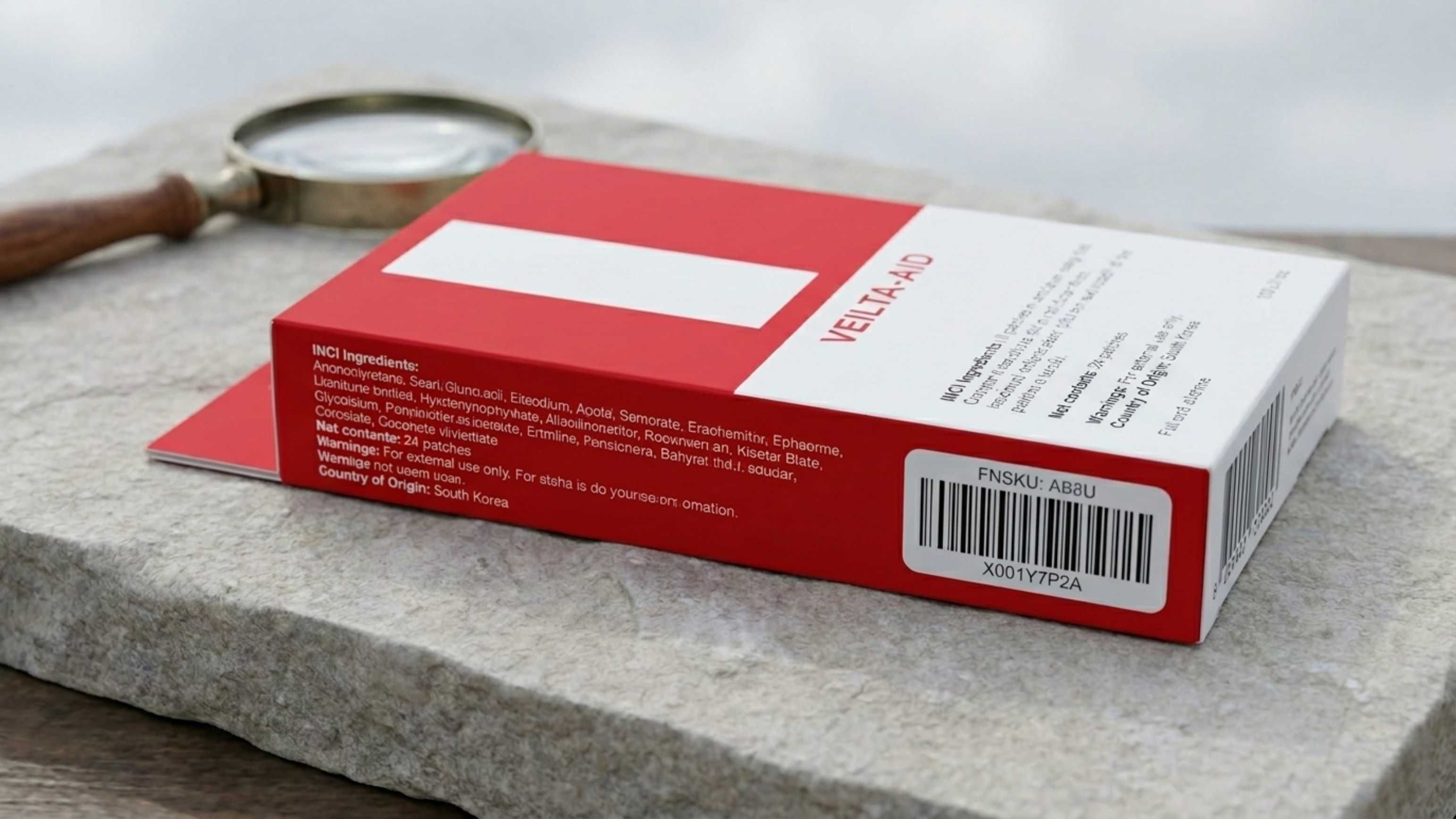
Every Amazon FBA unit needs an FNSKU barcode applied before it enters the fulfillment center. You can apply these at the factory—recommended—or pay Amazon to do it at the warehouse. Factory application is cheaper and gives you direct control over placement.
The barcode must be scannable with no competing barcodes on the same surface within 1.5 inches. This detail frequently causes problems when manufacturers place FNSKU stickers over the panel that carries the existing EAN or UPC code. Confirm placement during the dieline review stage, not after production runs.
"We include a dieline review and FNSKU placement confirmation in every order. About one in four clients initially submits artwork where the FNSKU position conflicts with existing barcodes or required label text. Finding that before print saves a full packaging cycle."
— Veilta Bio Technology, packaging team
Amazon listing claims
Your product listing is the second place where cosmetic-to-drug drift happens—and unlike packaging, it is easier for Amazon to suppress or remove. The platform's content policies for health and beauty explicitly prohibit claims that imply drug action.
Phrases that get listings pulled
These have triggered removal in the acne patch category. Avoid them in the title, bullet points, product description, and A+ content:
- "Treats acne" / "treats pimples"
- "Kills acne-causing bacteria"
- "Clinically proven to cure breakouts"
- "Heals pimples overnight"
- "Reduces inflammation"
- "Antibiotic" / "antimicrobial"
- "Medicated"
Even hedged constructions—"helps treat acne," "works like a medication"—can flag a listing. Amazon's classifier is not nuanced.
Language that works
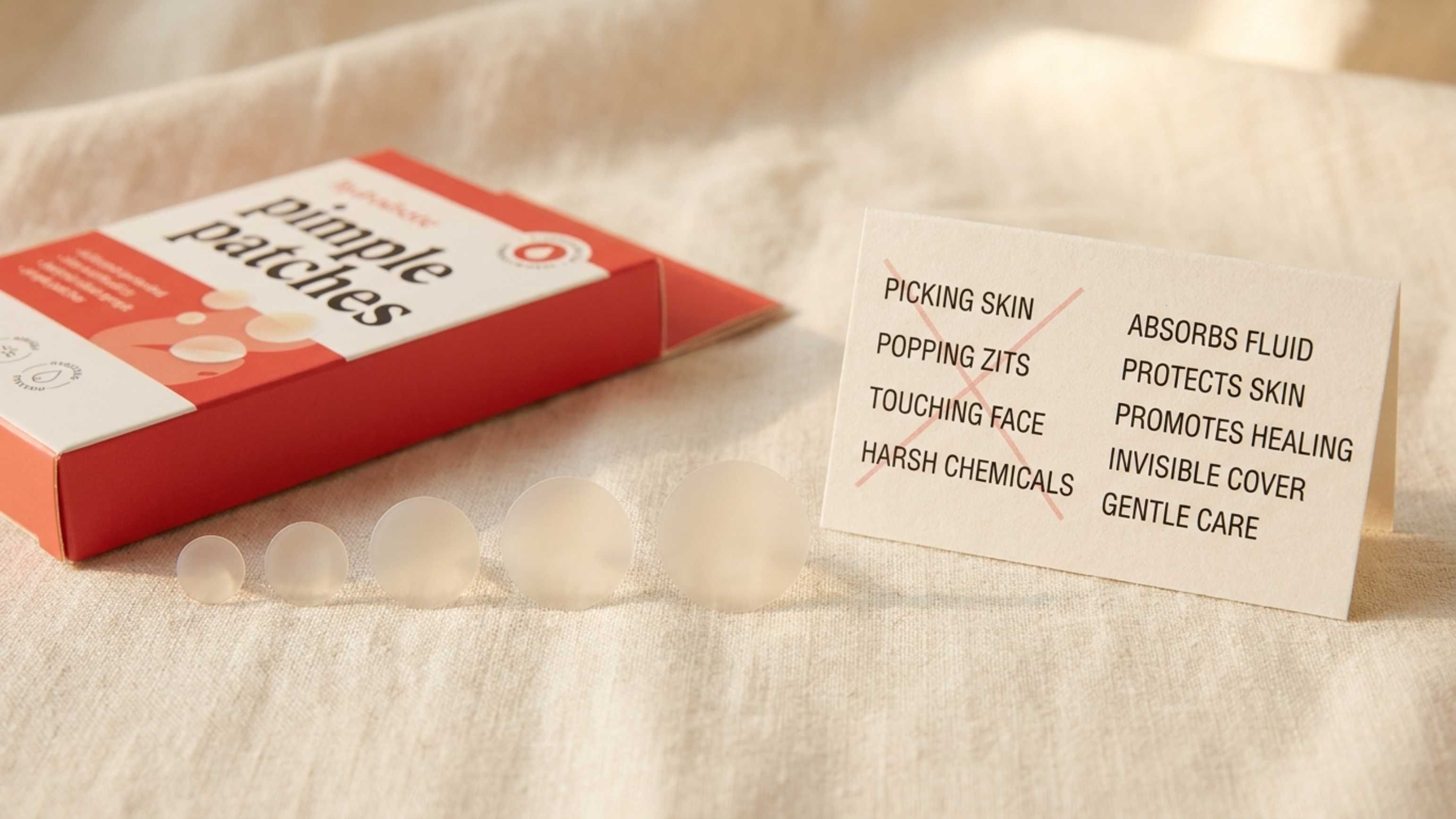
These phrases stay on the cosmetic side without sacrificing conversion:
- "Absorbs fluid from blemishes overnight"
- "Hydrocolloid technology draws out impurities"
- "Protects skin from picking and touching"
- "Reduces the visible size of blemishes"
- "Creates a moist environment over blemishes"
- "Invisible on skin for daytime wear"
- "Dermatologist tested" (only if supporting test documentation exists)
The pattern: describe what the patch physically does rather than what condition it treats. Functional description versus therapeutic claim.
Listing images and infographics
Amazon's image review catches claim violations in graphics too. A cross-section diagram showing bacteria being killed, text reading "FDA Approved" (which is not accurate for cosmetics), or outcome-oriented medical language in an infographic will trigger review. Stick to mechanism-of-action diagrams—fluid absorption, occlusion—and material callouts such as hydrocolloid composition and medical-grade adhesive.
Packaging for FBA
Beyond label content, the physical packaging must pass Amazon's inbound prep requirements.
Poly bags and suffocation warnings
If patches are packaged in a poly bag with an opening of 5 inches or more, Amazon requires a suffocation warning printed on or applied to the bag. The required text: "WARNING: To avoid danger of suffocation, keep this bag away from babies and children. Do not use this bag in cribs, beds, carriages, or playpens."
Manufacturers who produce for other markets often miss this. Confirm that the warning is either pre-printed on the bag or added as a label before the production run.
Master carton labeling
Master cartons must carry the ASIN or FNSKU, item description, and quantity per carton, placed on two sides of the outer carton. Amazon's warehouse staff scan incoming cartons; if labels are missing or on the wrong face, shipments can be flagged or refused at the dock.
Hazmat review
Standard hydrocolloid patches are not hazmat. Patches containing active ingredients—salicylic acid or certain botanical extracts—may require you to submit a Safety Data Sheet through Amazon's hazmat review process before the listing goes live. Your manufacturer's MSDS covers this. Request it before assuming your product is clear.
Supplier documents
Before the first FBA shipment, your manufacturer should be able to provide all of the following. If they cannot, that is information worth having about their suitability as a long-term partner.
Manufacturing credentials
- ISO 22716 certificate (GMP for cosmetics) or equivalent GMP certification
- FDA MoCRA facility registration number
- Third-party audit report (optional but useful if Amazon requests documentation)
Product documentation
- Certificate of Analysis (COA) for the finished product, batch-specific
- Material Safety Data Sheet (MSDS/SDS) for each formulation
- Full INCI ingredient list with concentration ranges
- Allergen declaration (relevant if you plan EU expansion under CPNP; ask now rather than later)
- Stability test report—12-month accelerated aging is the standard
Packaging and logistics support
- Finished packaging dieline in editable format (AI or PDF)
- Pantone color references for all branded colors
- Confirmation that FNSKU barcode application is available at the factory
- Carton specification sheet: dimensions, gross weight, units per carton
Some manufacturers also offer third-party dermatology or patch test reports. These are not required for Amazon, but they support A+ content claims and strengthen your position if Amazon sends a product compliance request.
"When a client asks for all these documents and we have gaps, that tells us something about our own processes. At Veilta, we maintain these records as live documents—clients can request the latest batch COA for any active SKU within 48 hours."
— Veilta Bio Technology, quality team
From supplier to FBA
This timeline assumes samples are approved and the formulation is finalized. The clock starts at packaging design sign-off.
| Stage | Duration | Notes |
|---|---|---|
| Packaging design + factory dieline review | 1–2 weeks | Factory checks artwork against production specs; confirm FNSKU placement |
| Pre-production sample approval | 1 week | Final review with packaging applied |
| Production run | 3–4 weeks | Standard for 3,000–10,000 unit orders |
| Quality inspection | 3–5 days | Third-party inspection recommended for first orders |
| Sea freight to US port | 25–35 days | Port-to-port; allow buffer for customs clearance |
| Amazon inbound processing | 7–14 days | Varies by fulfillment center |
| Total | 10–14 weeks | From packaging sign-off to FBA live |
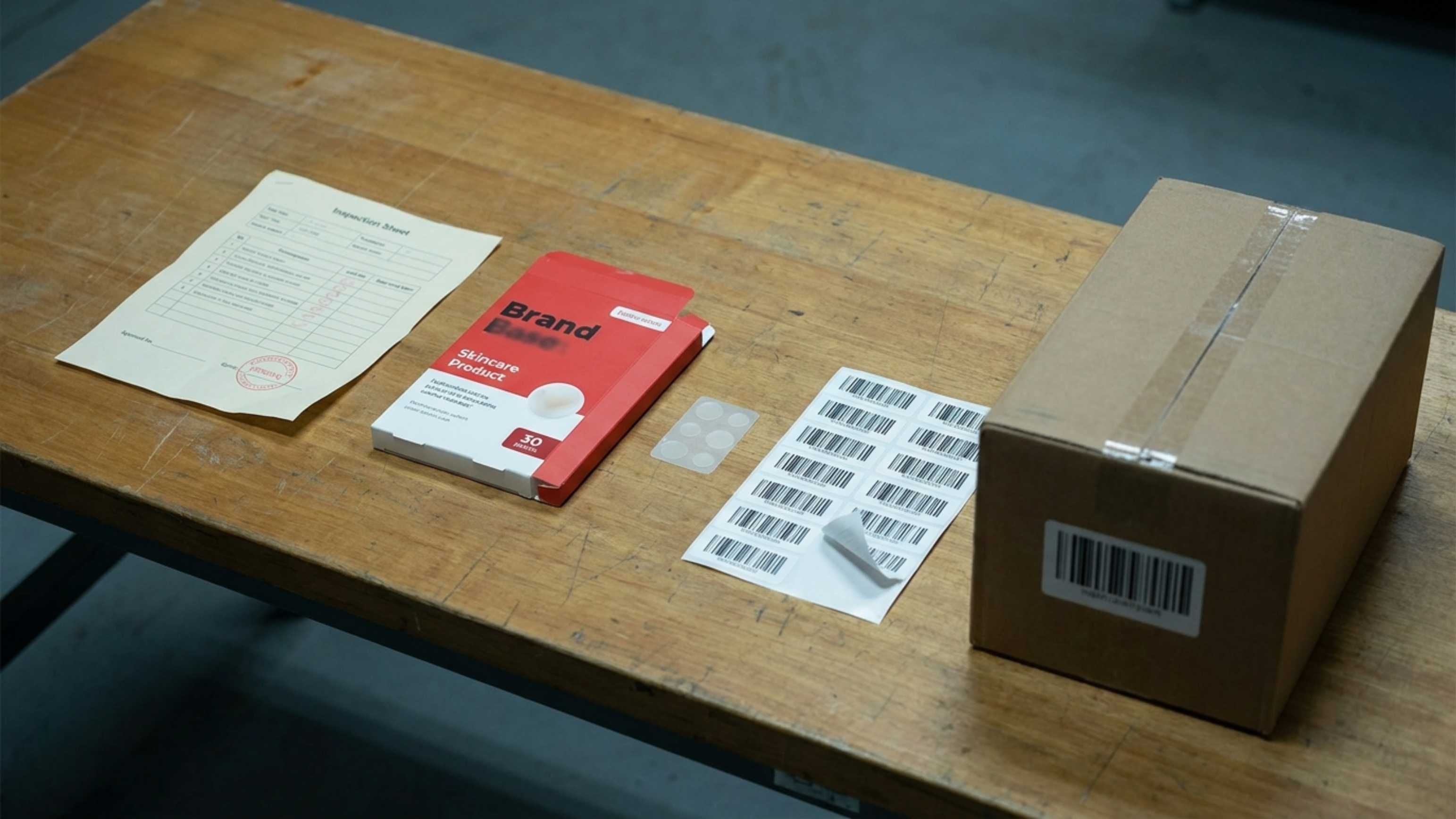
Air freight compresses the shipping stage to 7–10 days but adds roughly $3–$5 per kilogram over sea freight. On a first order of 5,000 units, that cost difference is significant enough that most brands run the initial shipment by sea and use air only for urgent replenishment when inventory runs low.
One step most brands sequence wrong
Create your Amazon listing before the shipment leaves the factory—ideally before production starts. You need the ASIN to generate the FNSKU, and the FNSKU needs to be confirmed before the factory applies barcodes. Running this in parallel with production, rather than after it, can save two weeks on the overall timeline. If you wait until the goods are finished before setting up the listing, you will be applying FNSKUs at the warehouse—at additional cost—or delaying the shipment.
For a detailed look at the private label launch process that precedes this Amazon-specific phase, see our private label acne patch MOQ, cost, and launch guide.
Pre-shipment checklist
Run through this before confirming the shipment:
Packaging and labeling
- Product identity present (product name and type)
- Net contents stated by count
- Responsible party: brand owner name and US address (not the manufacturer's)
- Country of origin visible on outer packaging
- Full INCI list in correct format, descending concentration order
- Lot/batch number printed or applied
- Directions for use included
- Required warnings present ("For external use only," etc.)
- FNSKU barcode applied; no competing barcode within 1.5 inches
- Suffocation warning on any poly bag with opening ≥5 inches
Listing and content
- Title contains no drug claims
- Bullet points use functional, not therapeutic, language
- Images contain no "FDA Approved" text, bacteria-kill graphics, or drug-outcome claims
- Listing is live and ASIN confirmed before factory applies FNSKUs
Documents in hand
- COA for the current production batch
- MSDS/SDS on file
- INCI list confirmed against the finished product formula
- ISO 22716 or GMP certificate current and dated
- FDA MoCRA facility registration number received from manufacturer
- Carton spec sheet confirmed (dimensions, weight, units per carton)
- Master carton labels prepared with ASIN/FNSKU, quantity, two-sided placement
If the product contains salicylic acid
- Decision made: cosmetic positioning or OTC drug positioning
- If OTC drug: Drug Facts label reviewed against FDA monograph requirements
- If cosmetic: no drug-action language anywhere on listing or packaging
FAQ
Do acne patches need FDA approval to sell on Amazon?
Standard hydrocolloid acne patches positioned as cosmetics do not require FDA pre-market approval. Under MoCRA, the manufacturing facility and the finished product must be registered with the FDA—but registration is not the same as approval. It is a documentation requirement that took effect in 2024. If patches contain salicylic acid and carry acne treatment claims, they may fall under the FDA's OTC drug monograph, which has stricter labeling requirements and a different regulatory path.
What claims will get my listing removed?
Amazon removes listings that use drug-action language on cosmetic products. The most common triggers in the acne patch category: "treats acne," "kills bacteria," "heals pimples," "reduces inflammation," "clinically proven to cure," and any reference to being "medicated." Describing what the patch physically does—what it absorbs, how it protects the skin, what it does to the visible appearance of a blemish—stays on safe ground.
What documents should I request from my manufacturer?
Before shipping to FBA, collect: Certificate of Analysis (COA), MSDS/SDS, full INCI ingredient list, ISO 22716 or GMP certificate, FDA MoCRA facility registration number, editable packaging dieline, and written confirmation that FNSKU barcodes can be applied at the factory. For first orders, also ask for a carton spec sheet and a stability test report.
How long does it take to go from manufacturer to FBA?
Plan for 10 to 14 weeks from packaging design approval to FBA live status. Broken down: 1–2 weeks for dieline review and packaging approval, 1 week for pre-production sample, 3–4 weeks of production, 3–5 days quality inspection, 25–35 days sea freight, 7–14 days Amazon inbound processing. Creating your Amazon listing early to generate the FNSKU runs in parallel—it does not need to add time to this schedule.
Does Amazon enforce MoCRA registration?
Amazon does not check MoCRA registration status when a listing is created. But MoCRA is a US federal requirement, and Amazon reserves the right to request compliance documentation at any time. Brands who cannot produce it face both regulatory risk and platform suspension if Amazon conducts a category documentation audit. Being registered and documented means you are in a defensible position if that request comes.
Ready to ship Amazon-ready units? Veilta produces GMP-certified private label acne patches with full documentation support—COA, INCI, MoCRA facility registration, and FNSKU application at the factory. Request samples to start your Amazon launch.