Hydrogel vs Bio-Cellulose Facial Masks: B2B Sourcing Guide
VEILTA
01/22/2026
This guide focuses specifically on facial sheet masks. For a comparison of hydrogel and bio-cellulose materials in under-eye patches, see our Hydrogel vs Bio-Cellulose Eye Patches guide →
The choice between hydrogel and bio-cellulose facial masks is one most B2B buyers make without enough information. Both are positioned as premium alternatives to standard non-woven sheet masks. Both are widely used in professional skincare. The problem is that "both are premium" is where the similarity ends — their cost structures, production requirements, sensory profiles, and market fits are different enough that choosing the wrong one for your brand's positioning can be an expensive mistake.
This guide compares the two formats from a sourcing and brand strategy perspective. Not marketing copy — actual numbers and practical decisions.
Quick summary
- Hydrogel masks cost $0.80–$2.50 per unit at OEM. Bio-cellulose runs $2.50–$6.00. The gap is real and affects your retail pricing ceiling.
- Hydrogel suits mass-premium retail ($15–$35 per mask) and K-beauty-influenced markets. Bio-cellulose belongs at $30+ per mask, in clinical or professional channels.
- Bio-cellulose requires a different production line from hydrogel — confirm your OEM factory handles both before assuming they do.
- MOQs are lower for hydrogel (3,000–10,000 units) vs bio-cellulose (5,000–15,000 units).
- Neither format is inherently superior. The right choice depends on your retail price point, channel, and what you're asking the packaging to communicate.
What each material actually is
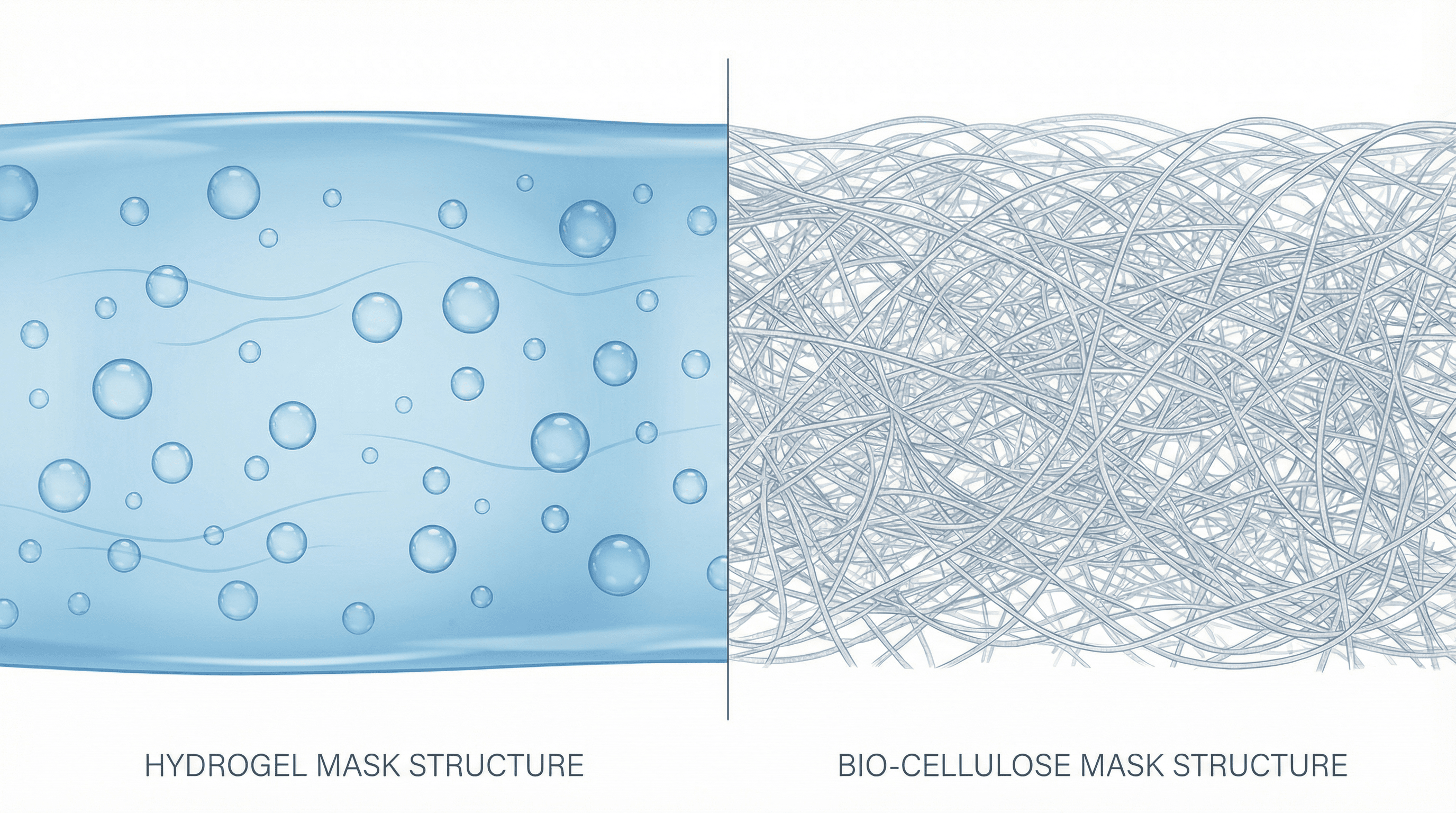 Hydrogel polymer matrix (left) vs bio-cellulose fiber network (right). The structural difference drives the sensory and performance gap between formats.
Hydrogel masks use a gel-based polymer matrix — typically a combination of water, crosslinked polymers (carrageenan, sodium alginate, or synthetic alternatives), and active ingredients. The gel is cast into a mold, cut to shape, and sealed in a sachet. Production is largely automated and high-throughput.
Bio-cellulose masks are made from bacterial cellulose — a material produced by fermenting specific bacteria (commonly Acetobacter xylinum) in a nutrient medium, usually coconut water. The fermentation produces ultra-fine cellulose fibers that form a dense, skin-conforming sheet. The process takes days, not hours, and requires controlled fermentation environments. The resulting material is thinner, more flexible, and has a significantly different skin feel from hydrogel.
Both are considered premium alternatives to standard non-woven masks. But they got there by different routes — and those routes have direct implications for cost, scalability, and the claims you can make.
Performance and skin experience: what B2B buyers need to know
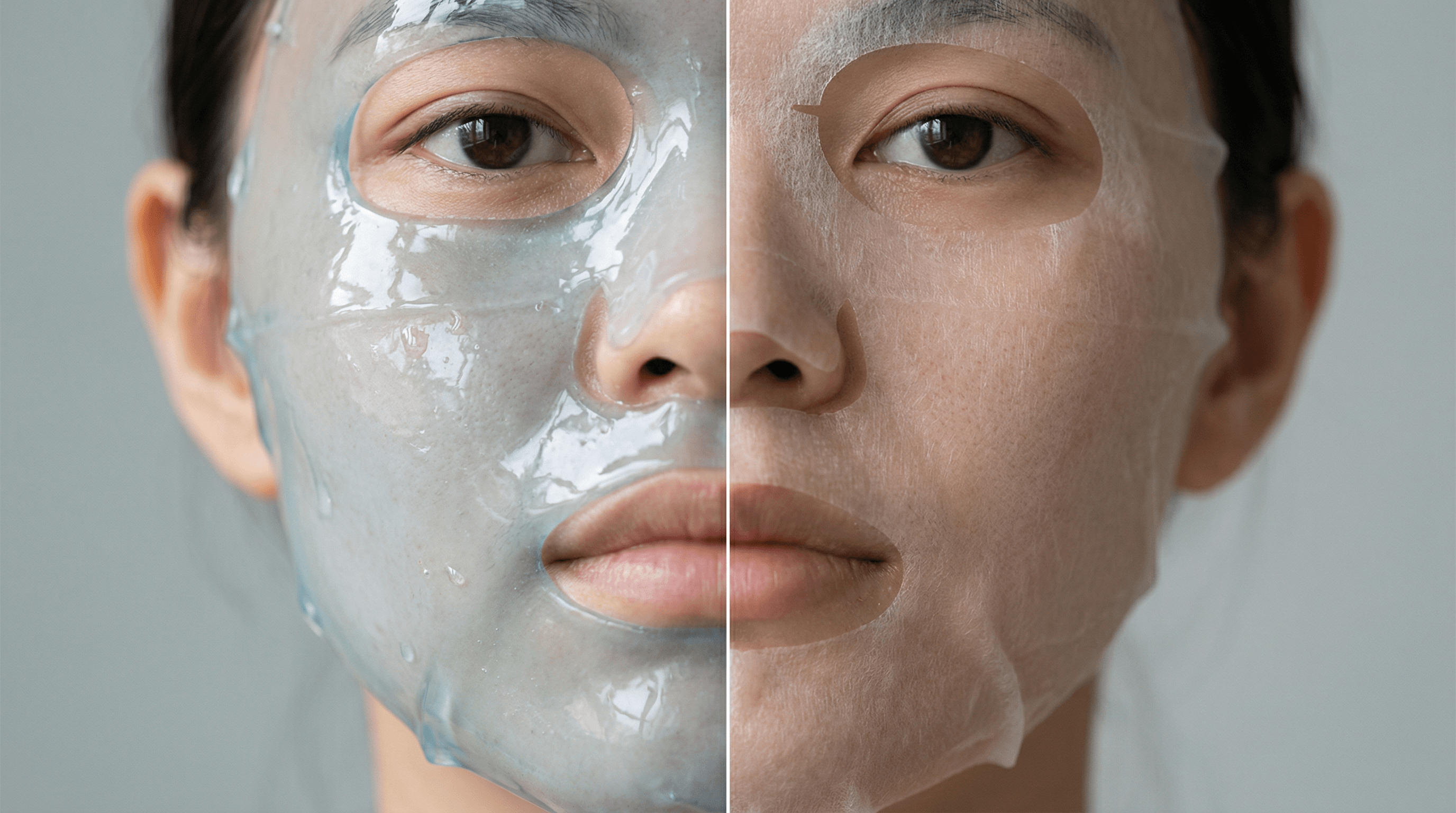 Skin contact and adhesion comparison. Bio-cellulose's second-skin fit makes it the preferred format for clinical and post-procedure applications.
The sensory difference between the two formats is significant and directly affects how you position and price them.
Hydrogel delivers a cooling, gel-like application experience. The weight of the mask and its gel texture signal hydration and luxury to most consumers. It's visually striking — translucent, thick, photographable. Adhesion is good on flat skin but can shift on curved areas (jaw, forehead) during extended wear. Typical wear time is 15–20 minutes.
Bio-cellulose has a thinner, more papery texture that adheres closely to the skin contour — what manufacturers call "second-skin fit." It doesn't deliver the same immediate cooling sensation but stays in place more consistently during movement. Because it was originally developed for wound dressing applications, it has a clinical credibility that hydrogel doesn't carry natively.
For retail brands, the practical implication is straightforward: hydrogel masks photograph better and deliver a more consumer-gratifying first use experience. Bio-cellulose masks get better results in professional or clinical settings where fit precision and skin contact duration matter more than first-impression texture.
Cost structure and MOQ: the numbers that drive the decision
This is where most B2B decisions actually get made — and where a lot of brands go wrong by comparing retail positioning without comparing production economics first.
| Factor | Hydrogel | Bio-cellulose |
|---|---|---|
| OEM unit cost (stock formula) | $0.80–$2.50 | $2.50–$6.00 |
| Raw material cost driver | Polymer + actives | Fermentation substrate + processing |
| Production cycle | 2–4 days per batch | 7–14 days per batch (fermentation) |
| Typical first-order MOQ | 3,000–10,000 units | 5,000–15,000 units |
| Customization lead time | 3–5 weeks | 5–8 weeks |
| Viable retail price floor | $12–$15 per mask | $28–$35 per mask |
From VEILTA's production data: Bio-cellulose raw material costs 3–4x more per unit area than standard hydrogel polymer. That gap doesn't compress significantly at higher volumes — the fermentation process has an inherent time cost that hydrogel casting doesn't. We typically advise brands to position bio-cellulose products at a minimum retail price of $30 per single mask to maintain workable margins. Below that, the economics are very difficult unless you're selling at significant volume into a low-cost channel. As of 2026, this cost differential has remained stable.
The MOQ difference matters most for brands testing new markets. At 3,000 units, you can validate a hydrogel SKU with reasonable inventory risk. Bio-cellulose at 10,000+ units means a larger initial commitment before you have any sell-through data.
Market suitability by region
The right format also depends on where you're selling.
North America: Hydrogel masks dominate mass-premium retail and DTC. The gel texture and photogenic format translate well to Amazon and social commerce. Bio-cellulose is mostly confined to dermatology clinics, medical spas, and post-procedure skincare lines. The consumer awareness gap between the two materials is wide — most US retail buyers don't know what bio-cellulose is without explanation.
Europe: European buyers emphasize ingredient transparency and natural origin. Bio-cellulose's fermentation provenance gives it a genuine clean beauty story — but only if the sourcing and production process is documented and communicable. Hydrogel works in European mass-premium retail when formulated with simplified, transparent ingredient lists. The EU Cosmetics Regulation requirements for CPNP notification apply equally to both formats.
Asia-Pacific: Hydrogel dominates retail in Korea, Japan, and Southeast Asia, driven by K-beauty aesthetics and the association of gel texture with luxury skincare. Bio-cellulose retains a presence in professional and aesthetic clinic settings. In China specifically, bio-cellulose masks command premium positioning in tier-1 city specialty retail.
Middle East and Southeast Asia: Both formats perform well in premium gifting contexts. The visual impact of hydrogel makes it more suitable for gift sets and retail display. Bio-cellulose is used primarily in spa and hotel amenity contexts.
How to choose: four decision criteria
There's no universally correct answer between hydrogel and bio-cellulose. The right choice follows from four questions:
1. What is your target retail price? If your retail price is under $25 per mask, hydrogel almost always makes more commercial sense. Bio-cellulose's cost structure requires a retail price above $30 to deliver workable brand margins.
2. What channel are you selling in? Retail, DTC, and social commerce → hydrogel. Clinical, post-procedure, or medical spa → bio-cellulose. Professional channel with premium positioning → bio-cellulose, if budget allows.
3. What do you need the packaging to communicate? "Luxury, hydration, indulgence" → hydrogel photographs better and delivers the expected luxury cues. "Clinical efficacy, second-skin precision, natural origin" → bio-cellulose, with appropriate formulation documentation.
4. What is your inventory tolerance for a first SKU? Testing a new market or launching a new product line → hydrogel's lower MOQ reduces risk. Established brand with known channel and sell-through history → bio-cellulose's higher MOQ is manageable.
From VEILTA's client work: The most common misalignment we see is brands choosing bio-cellulose for its premium perception without confirming the retail price point supports it. A bio-cellulose mask priced at $18 retail with a $4.50 unit cost leaves almost no margin after channel fees, shipping, and packaging. We raise this in the briefing process — sometimes it leads to a formula rethink, sometimes to a channel rethink. Either is better than finding out after the first production run.
Can the same OEM produce both?
Not always — and this matters if you're planning a product line that includes both formats.
Hydrogel mask production uses polymer casting equipment and cutting lines. Bio-cellulose production requires fermentation tanks, controlled bacterial culture environments, and specialized washing and processing for the bacterial cellulose material. These are fundamentally different production infrastructures.
Some larger OEM facilities operate both lines. Most factories specialize in one. If you're sourcing both formats from what you assume is a single manufacturer, confirm whether they handle bio-cellulose in-house or subcontract it. Subcontracted production introduces an additional quality control gap and typically a longer lead time.
VEILTA produces both hydrogel and bio-cellulose facial masks in-house under the same ISO 22716 GMP certification. Combined orders with unified compliance documentation are available for brands running both formats under the same brand umbrella.
FAQs
What is the cost difference between hydrogel and bio-cellulose facial masks?
Hydrogel masks cost $0.80–$2.50 per unit at OEM. Bio-cellulose runs $2.50–$6.00 per unit. The bio-cellulose raw material alone costs 3–4x more than hydrogel polymer per unit area. For retail price points below $25 per mask, hydrogel is almost always the commercially viable choice.
What is the MOQ difference between hydrogel and bio-cellulose masks?
Hydrogel masks typically start at 3,000–10,000 units for private label orders. Bio-cellulose generally starts at 5,000–15,000 units due to the longer production cycle and higher raw material cost per batch.
Which is better for retail — hydrogel or bio-cellulose?
Hydrogel dominates mass-premium retail in North America and Asia-Pacific. Bio-cellulose performs better in clinical, post-procedure, and high-end spa retail where the second-skin fit and medical-grade positioning justify the higher price. The retail channel and price point, not the material itself, should drive the choice.
Can the same OEM factory produce both hydrogel and bio-cellulose masks?
Not always. The two materials require different production infrastructure — polymer casting for hydrogel, fermentation tanks for bio-cellulose. Some large OEM facilities run both lines in-house. Most specialize in one. Always confirm before assuming your factory handles both.
Is bio-cellulose more sustainable than hydrogel?
Bio-cellulose is naturally derived and biodegradable, giving it a genuine sustainability story. Standard hydrogel uses synthetic polymers that are not biodegradable. Eco-friendly hydrogel formulations using plant-derived polymers are available but cost more. For brands making explicit sustainability claims, bio-cellulose is more defensible — provided formulation documentation is in order.
For material comparisons specific to under-eye patches, see: Hydrogel vs Bio-Cellulose Eye Patches: OEM Guide →
Source your facial masks from VEILTA
VEILTA produces both hydrogel and bio-cellulose facial masks in-house under ISO 22716 GMP certification, with compliance documentation for the US, EU, UK, and Southeast Asian markets. Combined format orders with unified CPNP or FDA documentation are supported for brands running both mask types.