Hydrogel vs Bio-Cellulose Eye Patches: OEM Guide
VEILTA
03/20/2026
Two materials dominate the under-eye patch category. From a distance, both look like a small crescent-shaped pad sitting under someone's eye. Both deliver active ingredients to the periorbital area. Both have clinical backing and loyal brand advocates.
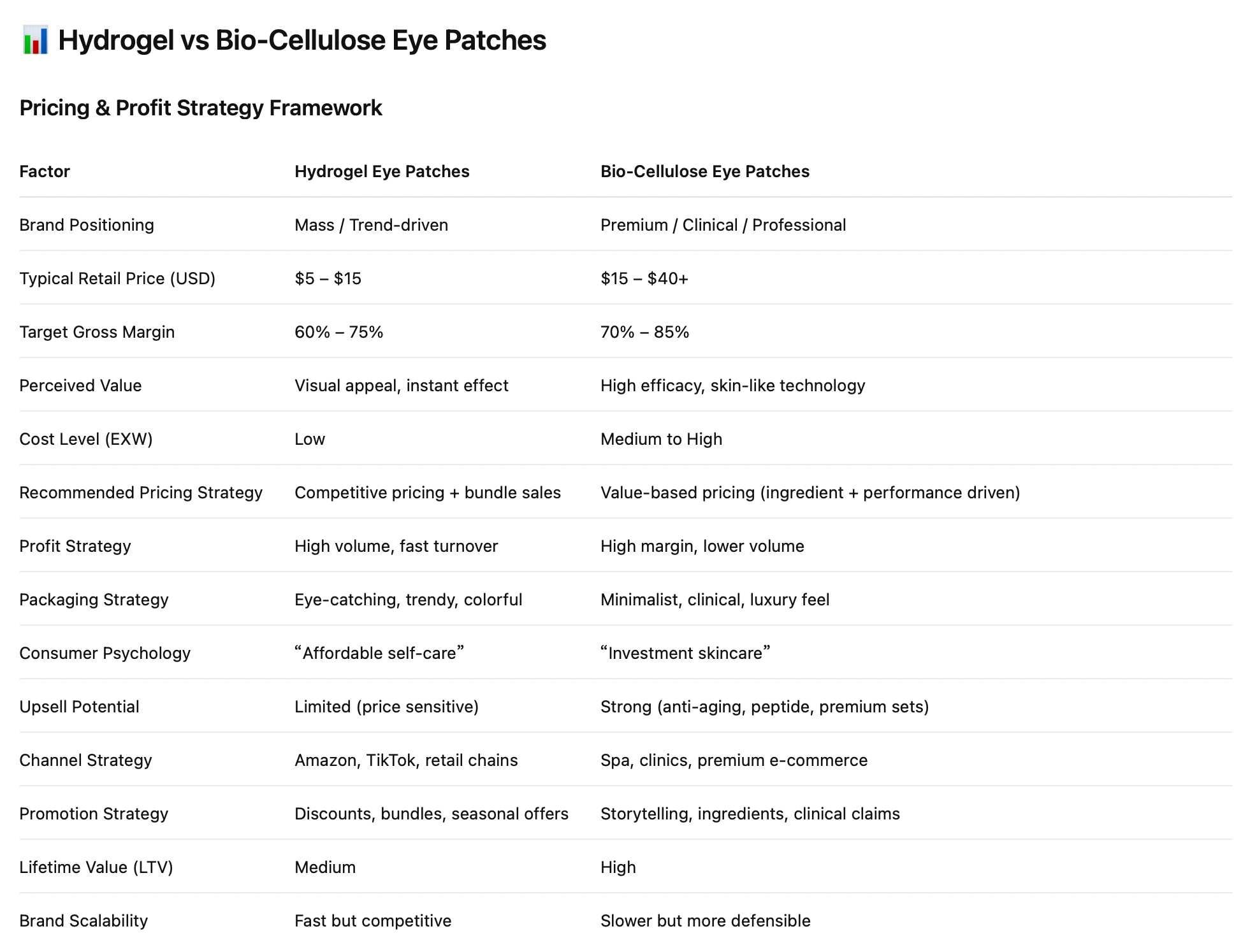
But hydrogel and bio-cellulose are fundamentally different materials — different origin, different feel, different price architecture, and different brand story. The choice between them isn't a formulation detail. It's a positioning decision that shapes everything downstream: your retail price, your supplier options, your MOQ, and what you can credibly say about your product.
TL;DR
- Hydrogel patches are mid-range, sensory-strong, and dominate mass and mid-market retail. The right choice for first-time launches and high-volume programs.
- Bio-cellulose patches are premium, biodegradable, and offer superior adhesion and ingredient delivery. They only make commercial sense at retail prices of $15+ per pair.
- The materials differ fundamentally in origin: hydrogel is a cast polymer network; bio-cellulose is grown through bacterial fermentation.
- Neither is objectively better — the right choice depends entirely on where your brand is positioned.
- A third option — hybrid formats — offers a middle ground worth knowing about before you brief any manufacturer.
What They Actually Are
Hydrogel
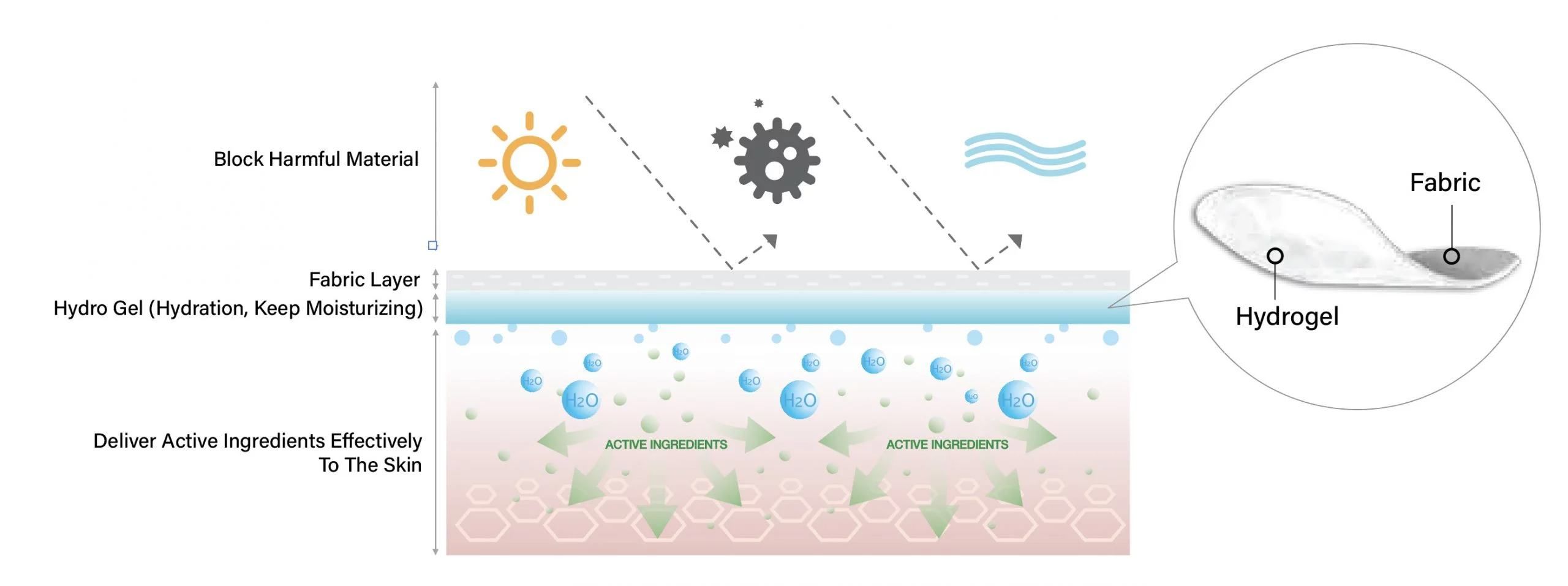
Hydrogel is a three-dimensional polymer network — typically built from natural polysaccharides such as carrageenan (derived from red algae) or agar, sometimes combined with synthetic polymers — that holds a large volume of water within its structure. The gel is cast into the under-eye crescent shape, loaded with active ingredients, and packaged in individual foil sachets or jars.
There are two main hydrogel constructions in commercial use:
Soluble hydrogel dissolves slowly on contact with skin temperature and moisture, releasing actives progressively as it melts. No residue removal after wear — the patch essentially disappears into the skin over 15–20 minutes.
Insoluble (dry type) hydrogel consists of a dry hydrogel layer bonded to a non-woven backing. It doesn't dissolve — it delivers actives through contact transfer and is peeled off after use. More stable shelf life, easier to handle, preferred for longer wear times of 30–60 minutes.
The defining characteristic of hydrogel is its water content — typically 80–95% by weight. That's what creates the immediate cooling sensation on application, the visible surface plumping, and the efficient osmosis-driven ingredient delivery.
Bio-Cellulose
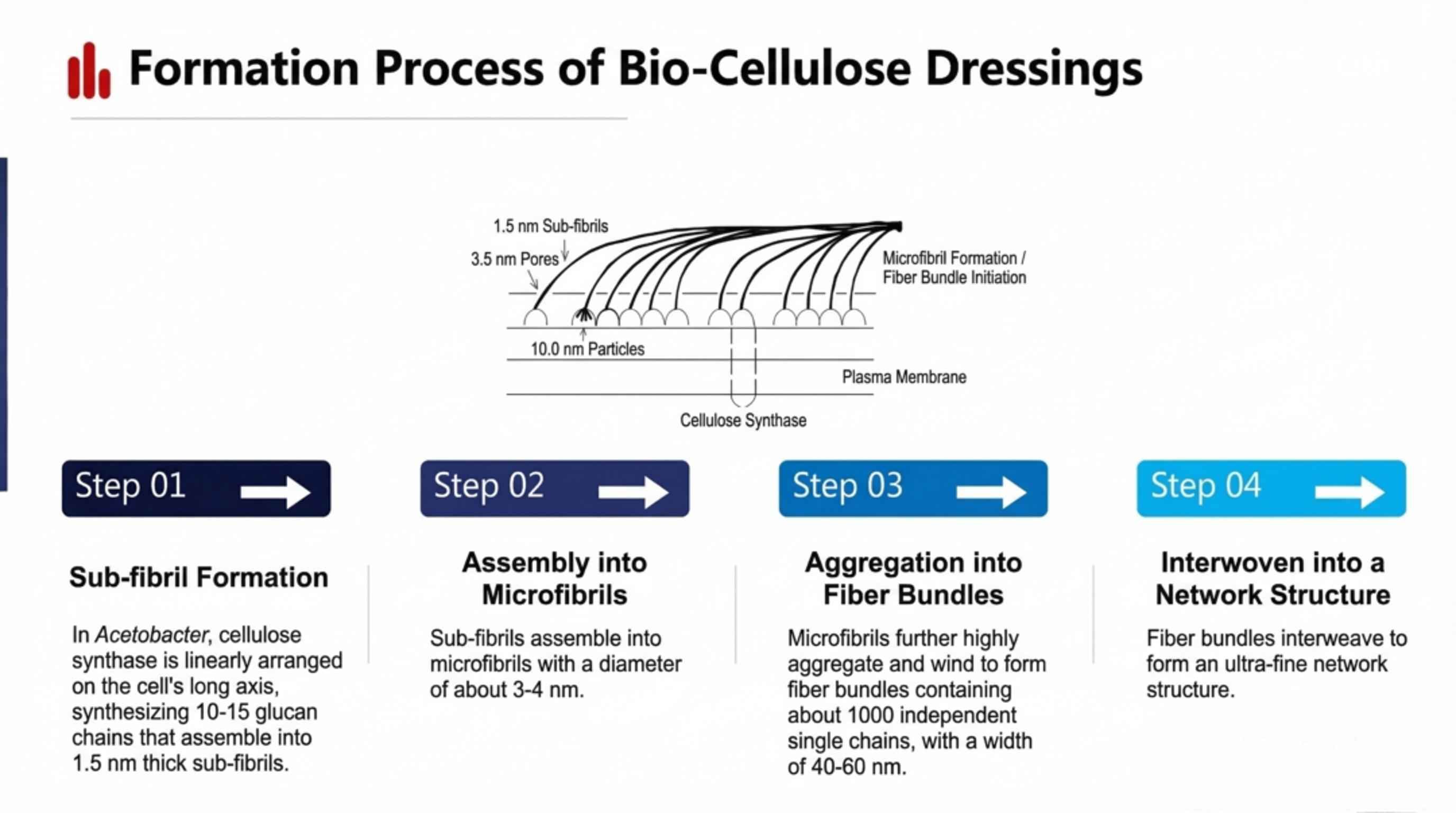
Bio-cellulose is produced through bacterial fermentation. The bacterium most commonly used is Komagataeibacter xylinus, which secretes cellulose nanofibers as it ferments a sugar-rich medium — typically coconut water or other carbohydrate sources. These nanofibers self-assemble into a dense, three-dimensional matrix that is then shaped into patch form, loaded with active serum, and packaged.
Research published in PMC confirms that bio-cellulose fiber diameter is approximately 1,000 times finer than plant-derived cellulose — which is precisely what gives it the "second skin" feel and its exceptional adhesion to skin contours.
Unlike hydrogel, which is manufactured through a casting process, bio-cellulose is literally grown. The fermentation process takes several days under controlled conditions — which is part of why it costs more and is harder to scale than hydrogel.
The Key Differences at a Glance
| Factor | Hydrogel | Bio-Cellulose |
|---|---|---|
| Material origin | Polymer network (algae-derived or synthetic) | Bacterial fermentation (natural nanofibers) |
| Water content | 80–95% | 90–99% |
| Skin adhesion | Good | Excellent ("second skin" fit) |
| Ingredient delivery | Good (osmotic diffusion) | Superior (nanofiber contact delivery) |
| Skin feel | Cool, gel-like, slightly weighted | Ultra-thin, barely perceptible |
| Contour conformity | Good | Excellent — follows every curve |
| Transparency on skin | Semi-transparent | Nearly invisible |
| Biodegradability | Varies by polymer type | Yes — naturally biodegradable |
| Manufacturing complexity | Medium | High (fermentation process) |
| Per-unit cost | Lower | Significantly higher |
| MOQ accessibility | Higher | Lower (production constraints) |
| Retail price positioning | Mid-range ($8–18/pair) | Premium ($15–35+/pair) |
Performance: Where the Real Differences Show Up
Ingredient Delivery
Both materials deliver actives through contact transfer — the serum-loaded patch releases its payload as it sits against skin. But the mechanisms differ in ways that matter.
Hydrogel delivers actives primarily through osmotic pressure and diffusion. The high water content creates a concentration gradient that drives ingredient movement from patch to skin. This is well-understood, reliable, and works consistently across most active ingredient types.
Bio-cellulose's nanofiber structure creates a different delivery environment. The ultra-fine fibers maintain close, uniform contact with even irregular skin surfaces — around the tear trough, for instance, where a hydrogel patch may lift slightly. According to a systematic review in PMC, bio-cellulose showed a 76% improvement in skin hydration in a clinical application study, partly attributed to this consistent skin contact. Fewer gaps, more active surface area at any moment means ingredients are delivered more evenly and with less waste.
For brands building clinical efficacy claims, bio-cellulose's delivery consistency is worth the premium. For brands where ingredient delivery is one benefit among several, hydrogel performs well at substantially lower cost.
Skin Feel and Consumer Experience
This is where the two materials diverge most clearly — and where consumer preference data is most consistent.
Hydrogel patches have a distinctive, immediately noticeable feel: cool, slightly weighted, visibly present on skin. Most consumers associate the weight with saturation and efficacy. The cooling sensation is strong on application and dissipates as the gel warms over 15–20 minutes. Comfortable for standard wear; extended use beyond 30–45 minutes with insoluble formats is possible but the experience changes significantly.
Bio-cellulose patches feel almost like nothing. The ultra-thin, skin-hugging material sits so flush against the face that many wearers forget they have patches on. This makes bio-cellulose the obvious choice for longer wear times and for use during activities where a gel pad sitting under the eye would be impractical — working, traveling, appearing on camera.
The "invisible wear" experience is a genuine product differentiator that bio-cellulose brands can build entire campaigns around. It's not a claim that needs substantiation — it's something any user notices immediately.
Adhesion Stability
Hydrogel patches rely on the gel itself for adhesion — moisture creates a mild suction effect. They work well on clean, dry skin but can shift with facial expressions, in humid conditions, or if skin is oily.
Bio-cellulose adhesion comes from the nanofiber matrix conforming to skin texture at a microscopic level. The result is noticeably more stable adhesion, particularly around the curved orbital area where expression movement is constant. For "wear it during your morning routine" or "sleep in it overnight" positioning, this isn't just a claim — it's a functional requirement, and bio-cellulose delivers it.
Active Ingredients: What Works in Each Format
Both formats carry a broad range of skincare actives. But there are compatibility considerations worth knowing before you brief a manufacturer.
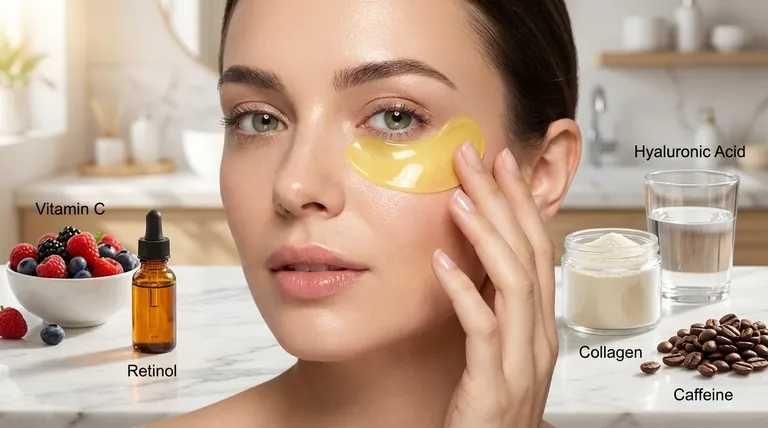
Works well in both: Hyaluronic acid / sodium hyaluronate, niacinamide, caffeine (particularly effective for de-puffing via vasoconstriction), hydrolyzed collagen, and peptides such as Palmitoyl Tripeptide-1.
Works particularly well in bio-cellulose: PDRN (polydeoxyribonucleotide), EGF (epidermal growth factor), and retinol derivatives. These larger or more unstable active molecules benefit from bio-cellulose's consistent skin contact and sealed nanofiber structure — the former improves penetration, the latter provides better protection against oxidation.
Hydrogel-specific formulation note: Hydrogel's polymer network is pH-sensitive and ionically reactive, which affects active ingredient compatibility. Vitamin C (ascorbic acid) is a known challenge — its instability in aqueous environments requires either stabilized derivatives (ascorbyl glucoside, sodium ascorbyl phosphate) or specialized encapsulation. Always ask your manufacturer which vitamin C derivative they use and request stability data before approving a formula.
Brand Positioning: How to Choose
This is the decision that actually matters. The right material is the one that fits your brand story, your target consumer, and your price architecture — not the one with the most impressive technical specifications.
Choose Hydrogel If:
Your brand competes on accessibility and value. Hydrogel dominates pharmacy shelves, mass beauty retail, and accessible DTC. If your retail price target is under $15 per pair, hydrogel is the correct format — bio-cellulose economics simply don't work at that price point.
Your marketing is sensory-first. The visible gel, the cooling sensation, the puffiness reduction within 15 minutes — these are highly demonstrable in content. Hydrogel photographs well, films well, and the transformation is immediate enough to drive compelling before/after content.
You're launching for the first time or at high volume. Hydrogel's lower per-unit cost and more accessible MOQ make it the practical starting point for market validation, high-volume retail programs, and subscription models where unit economics are critical.
You're targeting the spa and salon channel. Hydrogel eye patches are the industry standard for professional facial treatments. In that channel, bio-cellulose is the exception, not the rule.
Choose Bio-Cellulose If:
Your brand competes at $15+ per pair and has the margin to support premium positioning. Bio-cellulose's production complexity and raw material cost require a premium retail price. The economics work at $20+ and are most comfortable above $25. This format is also compatible with Leaping Bunny cruelty-free certification — increasingly required by prestige retailers as a listing condition.
Your brand story is built on sustainability credentials. Research confirms that bio-cellulose is naturally biodegradable, produced from renewable fermentation substrates, and compatible with COSMOS-certified and 100% natural formulations. If your brand architecture includes clean beauty or sustainability claims, bio-cellulose has a more credible story than hydrogel.
You're targeting the prestige or K-beauty segment. Many of the category-defining bio-cellulose eye patches originated in South Korea, and the material carries strong K-beauty associations in US and European prestige markets.
Your product needs to be worn for extended periods. "Apply before your morning skincare," "wear it on the flight," "overnight eye treatment" — these narratives require the adhesion stability and comfort that bio-cellulose delivers. Hydrogel's gel weight makes these use cases impractical.
You want shelf differentiation. In a category saturated with hydrogel options, bio-cellulose creates instant differentiation. "Bacterial fermentation," "nanofiber technology," "second-skin adhesion" — it's a story hydrogel can't replicate.
Not sure which format fits your brand? Our team has helped brands at every price point and positioning make this decision — and we carry both formats. Talk to us before you brief a manufacturer →
A Third Option: Hybrid Formats
Worth knowing before you commit to either material: a growing number of manufacturers now offer hybrid formats that combine a bio-cellulose or natural fiber backing with a hydrogel or serum contact layer.
These hybrids offer better adhesion than pure hydrogel, lower cost than pure bio-cellulose, and a "natural fiber" story that supports cleaner positioning. For brands that want to move beyond standard hydrogel without the full bio-cellulose cost structure, hybrid formats are worth sampling. Ask your manufacturer explicitly what substrate options they offer — the range varies considerably between factories.
Cost and MOQ: What to Expect
The cost difference is significant enough to affect your entire pricing architecture.
Hydrogel: MOQ typically starts at 3,000–10,000 pairs for stock formulas. Per-unit cost supports mid-market retail pricing ($8–18 per pair) with reasonable margin.
Bio-cellulose: MOQ tends to be higher — typically 5,000–20,000 pairs depending on customization. Per-unit cost requires premium retail pricing ($15–35+ per pair) to maintain margin. If your retail price is under $12, stop considering bio-cellulose. The unit economics don't work.
Hybrid formats: Typically sit between the two on both MOQ and per-unit cost. Worth getting a quote for direct comparison.
What to Ask Your Manufacturer
For hydrogel:
- What polymer base do you use — natural (carrageenan, agar) or synthetic? Can you provide documentation?
- What is the water content percentage of the finished patch?
- Do you offer both soluble and insoluble (dry type) formats?
- What is the pH range of your gel matrix, and which actives have you tested for compatibility?
- Can you provide stability data for vitamin C derivatives in your hydrogel?
For bio-cellulose:
- What is your fermentation substrate — coconut water, other? Can you provide origin documentation?
- What is your monthly production capacity, and how does this affect lead times during peak periods?
- Can your formula accommodate COSMOS-certified or 100% natural active ingredients?
- What preservation system do you use, and what shelf life testing protocol do you follow?
- Do you have existing bio-cellulose SKUs currently selling in my target markets?
For both:
- What is your MOQ for stock formula versus custom formula?
- Can you provide stability data for the active ingredient combinations I'm considering?
- Can I request third-party lab testing on my sample before approving bulk production?
- What packaging formats are available, and what's the additional cost for custom packaging?
- Is your facility certified to ISO 22716 GMP standard?
Frequently Asked Questions
What is the main difference between hydrogel and bio-cellulose eye patches?
The fundamental difference is the material and how it's made. Hydrogel is a water-saturated polymer network cast into patch form. Bio-cellulose is a nanofiber matrix grown through bacterial fermentation. In practice, this translates to different skin feel (gel-heavy vs. nearly invisible), different adhesion (good vs. excellent), different sustainability credentials, and a significant difference in per-unit cost and retail price positioning.
Which is better for under-eye puffiness: hydrogel or bio-cellulose?
Both can effectively deliver caffeine, peptides, and other de-puffing actives. Hydrogel's immediate cooling effect provides faster visible relief, which consumers often interpret as stronger efficacy. Bio-cellulose's consistent adhesion means actives are delivered more uniformly over the full wear period. For a "quick fix before an event" positioning, hydrogel wins on consumer perception. For a "sustained daily treatment" positioning, bio-cellulose's delivery consistency is the stronger story.
Is bio-cellulose more sustainable than hydrogel?
Generally, yes. Bio-cellulose is naturally biodegradable and produced from bacterial fermentation of renewable substrates. Hydrogel sustainability depends on the polymer type used — natural polymer bases (carrageenan, agar) are more biodegradable than synthetic options. If sustainability claims matter for your brand, confirm your manufacturer's polymer source and request documentation before making any claims on packaging.
What retail price does bio-cellulose require?
Bio-cellulose eye patches need to retail at $15+ per pair to support a viable margin structure. The economics are most comfortable at $20–25+. If your target retail price is under $12–15, bio-cellulose isn't the right material — the per-unit manufacturing cost makes margin compression unavoidable at lower price points.
Can I launch with hydrogel first and switch to bio-cellulose later?
Yes — and it's a common brand evolution path. Many brands validate the market with hydrogel at a mid-market price point, establish distribution and brand recognition, then introduce a bio-cellulose premium SKU as a line extension. This approach spreads commercial risk and lets you build toward bio-cellulose with customer data rather than assumptions.
What active ingredients work best in bio-cellulose eye patches?
PDRN, EGF, and retinol derivatives perform particularly well in bio-cellulose due to consistent skin contact and the sealed nanofiber structure's protection against active degradation. Hyaluronic acid, niacinamide, and caffeine work well in both formats. Always ask your manufacturer for stability data on any active combination you're considering.
What is the MOQ for bio-cellulose eye patches?
MOQ for bio-cellulose eye patches typically starts at 5,000–20,000 pairs, depending on the manufacturer and whether you're using a stock formula or custom development. This is generally higher than hydrogel MOQ (3,000–10,000 pairs for stock formulas) due to the more complex fermentation production process. Ask specifically about pilot run options if you want to validate before committing to full production.
Do bio-cellulose eye patches need special packaging?
Both formats require sealed individual packaging — typically foil sachets — to maintain moisture content and prevent contamination. Bio-cellulose's higher water content (up to 99%) makes packaging integrity especially important. Ask your manufacturer about their packaging specifications and shelf life testing protocol, particularly if you're planning extended retail distribution.
Source Your Eye Patches with VEILTA
VEILTA manufactures both hydrogel and bio-cellulose under-eye patches for private label brands worldwide. We offer stock formulas and full custom ODM development across both formats, with ISO 22716, FDA, and CPNP certification.
Our team works with you from material selection through formulation, sampling, and production — so you're not choosing between formats in the dark.