
Is Microneedle Acne Patch OEM Worth It? Cost, Margin, and Brand Fit
VEILTA
09/10/2025
Microneedle acne patches attract attention for one obvious reason: they usually sell at a much higher price than standard hydrocolloid patches.
For skincare brands, that makes the category appealing. A stronger premium story can support better shelf positioning, a more differentiated SKU, and potentially better gross margin. But a higher retail price does not automatically mean an easier or more profitable product.
A microneedle acne patch OEM project usually comes with higher development complexity, more testing pressure, and stricter execution requirements than a standard acne patch launch. The right question is not simply whether the product is expensive. It is whether the economics fit your brand model.
This guide explains how microneedle acne patch cost structure usually works, how the category compares with hydrocolloid patches, what kind of retail margin brands often aim for, and when this format makes commercial sense.
Quick Takeaways
- Microneedle acne patches usually cost more to develop and produce than standard hydrocolloid patches.
- The premium price is supported by structure, formulation, testing, packaging, and positioning.
- Higher retail price can improve margin potential, but only if the brand can support premium messaging and sell-through.
- Microneedle patches are usually a better fit for brands with stronger positioning, not purely price-led brands.
- Launching one well-positioned hero SKU is often smarter than launching multiple variants too early.
- The category is most attractive when the brand can convert technical complexity into stronger perceived value.
Why Microneedle Acne Patches Cost More Than Hydrocolloid Patches
A standard hydrocolloid patch is usually simpler to develop, simpler to package, and easier to position.
A microneedle patch adds more technical and commercial layers:
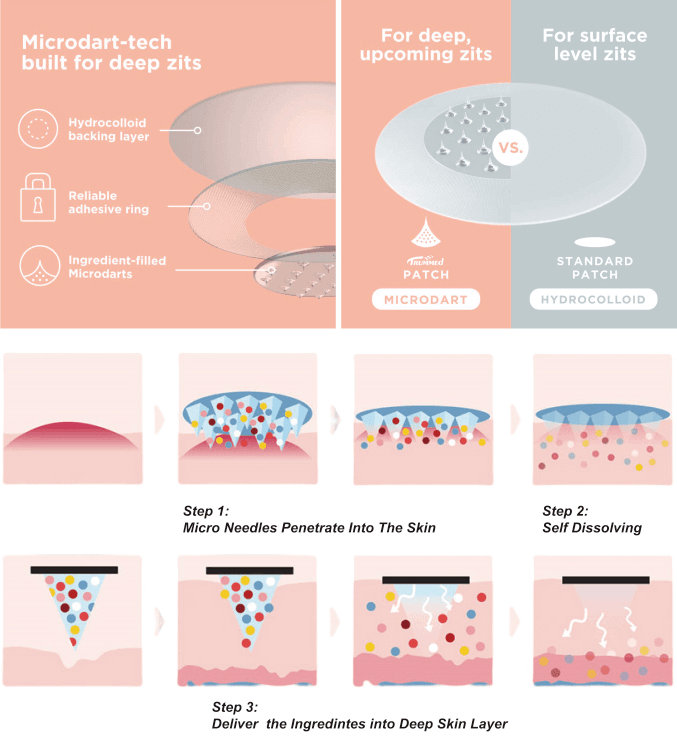
- a dissolvable microneedle structure
- ingredient compatibility and loading considerations
- more detailed sampling and revision work
- more demanding QC and documentation
- a premium packaging and user-education requirement
This is why microneedle acne patch OEM is not just a more expensive version of the same SKU. It is a different product model with a different cost logic.
Hydrocolloid vs Microneedle Patch Cost Logic
The table below shows why the two formats behave differently from a commercial perspective.
| Area | Standard Hydrocolloid Patch | Microneedle Acne Patch |
|---|---|---|
| Product structure | Simpler | More complex |
| Formula challenge | Lower | Higher |
| Sample cycle | Usually shorter | Usually longer |
| Packaging pressure | Moderate | Higher |
| QC and testing | More straightforward | More detailed |
| Positioning | Broad-market | Premium or innovation-led |
| Retail price ceiling | Lower | Higher |
The key point is not only that microneedle patches cost more. It is that they need a stronger commercial story to justify that cost.
| Factor | Hydrocolloid | Microneedle | Real Business Meaning |
|---|---|---|---|
| Cost | $ | $$$$$ | Microneedle ≈ 5–15× cost |
| Risk | Low | High | More failure risk |
| MOQ | Low | High | Setup cost drives MOQ |
| Margin | Medium | Very High | Profit driver SKU |
| Difficulty | Easy | Hard | Technology barrier |
Hydrocolloid vs microneedle acne patch cost logic for OEM brands
What Makes Up Microneedle Acne Patch OEM Cost
A private label microneedle acne patch usually carries cost across four major areas.
1. Patch Structure
The dissolvable microneedle system itself adds production complexity. Structure quality affects product feel, perceived efficacy, and consistency.
2. Formula System
Active ingredient choice affects cost, stability, sample revision time, and market positioning. A simpler formula may cost less and move faster, while a more ambitious ingredient system can raise both development time and commercial expectations.
3. Testing and Documentation
As product complexity rises, the need for internal checks, stability review, documentation support, and quality control usually rises with it.
4. Packaging and Sellable Unit Design
Premium SKUs often need better packaging, clearer instructions, and more polished presentation. That influences both direct packaging cost and launch execution cost.
In many projects, brands focus too much on factory price per unit and not enough on the total launch cost around it.
Typical OEM Cost Stack
The exact cost mix depends on formula complexity, packaging structure, and order size, but the most common cost layers in a microneedle acne patch manufacturer project look like this:
| Cost Area | Typical Commercial Impact |
|---|---|
| Patch structure | Core driver of format complexity |
| Active ingredient system | Can raise both unit cost and development risk |
| Sampling and revisions | Often underestimated in early planning |
| Testing and documentation | Important for export readiness and consistency |
| Sachet and carton packaging | Can materially affect first-order economics |
| Low-volume customization | Often raises cost faster than brands expect |
This is why the most useful pricing discussion is rarely about one single unit number. It is about the full launch structure around that unit.
Typical OEM Cost Pressure Points
The most common drivers that increase cost in a microneedle acne patch manufacturer project are:
- more complex active ingredient systems
- repeated sample revisions
- premium carton or sachet design
- low-volume custom packaging
- multiple SKU variations at launch
- market-specific packaging changes
- tighter documentation requirements
A product can look commercially attractive at first glance and still become inefficient if the launch structure is too complicated.
Retail Pricing: Why the Category Can Still Be Attractive
Even though the OEM side is more expensive, microneedle acne patches can still make sense because the category usually supports a higher retail position than standard acne patches.
In many markets, the consumer is not comparing the product only as a patch. They are comparing it as an advanced acne-care treatment or premium skincare solution.
That changes willingness to pay.
Typical Retail Logic
| Format | Typical Retail Position |
|---|---|
| Standard hydrocolloid patch | Entry to mid-range |
| Premium hydrocolloid patch | Mid-range |
| Microneedle acne patch | Mid to premium |
| Premium microneedle concept | Premium to specialty |
In many markets, standard hydrocolloid patches are often sold as accessible daily-use products, while microneedle acne patches are more often positioned as a targeted premium-treatment-style SKU.
Margin Potential Depends on Brand Fit
A high retail price does not guarantee a strong business case.
Margin potential depends on whether the brand can support:
- premium positioning
- clear product education
- good conversion messaging
- realistic CAC or retail sell-through
- packaging that feels worth the price
For some brands, a microneedle patch becomes a high-margin hero SKU. For others, it becomes a high-effort product with weak sell-through.
That is why brand fit matters as much as cost structure.
Margin Logic by Positioning
| Brand Positioning | Margin Potential | Main Condition |
|---|---|---|
| Clinical premium | Strong | Product story and efficacy positioning are clear |
| Premium beauty | Strong | Packaging and branding support price acceptance |
| Trend-led social | Medium to Strong | Conversion depends on launch momentum and storytelling |
| Mid-market acne care | Medium | Needs careful pricing and SKU focus |
| Budget-led brand | Weak to Medium | Harder to sustain premium conversion |
For many brands, the margin question is less about factory cost alone and more about whether the final product can sustain premium conversion.
What Kind of Brand Usually Fits Best?
Microneedle acne patches usually fit best with brands that already have at least one of these advantages:
- a premium skincare identity
- a customer base that understands advanced formats
- strong design and packaging execution
- good DTC storytelling or retail education capability
- willingness to invest in a differentiated hero SKU
The category is usually less suitable for brands whose main advantage is low price.
Brand Fit by Business Type
| Brand Type | Likely Fit | Why |
|---|---|---|
| Clinical skincare brand | Strong | Easier to support efficacy-led positioning |
| Premium beauty brand | Strong | Better fit for elevated packaging and price point |
| Trend-led social brand | Medium to Strong | Can work if storytelling is strong |
| Budget acne-care brand | Weak to Medium | Harder to justify premium pricing |
| Early-stage brand with limited budget | Medium | Works only if SKU focus is tight |
When Should a Brand Upgrade From Hydrocolloid to Microneedle?
Not every brand should move into microneedle patches immediately.
In many cases, the right time comes when:
- the brand already has traction in acne care
- the customer base is ready for a more advanced SKU
- packaging and positioning have become more premium
- the brand wants a hero product with stronger perceived value
- repeat demand gives more confidence for a higher-complexity launch
If the brand is still proving basic demand, a standard hydrocolloid product is often the safer first step.
Signs the Timing May Be Right
A move into microneedle patch OEM often makes more sense when:
- your current acne patch line already sells steadily
- your audience responds to ingredient-led or premium-care messaging
- your brand wants more pricing power
- you need a more differentiated lead SKU
- your team can support stronger education and launch execution
The timing is usually wrong when the brand still needs the simplest possible product to enter the category.
Common Commercial Mistakes
Brands often make the economics worse by:
- overbuilding the first formula
- launching too many variants
- using premium packaging before validating demand
- relying on retail price assumptions without testing positioning
- choosing a format that does not match the customer base
In many cases, the most profitable launch is not the most complex one. It is the one with the clearest commercial logic.
A Smarter First Launch Structure
For many brands, a stronger launch plan looks like this:
- start with one hero SKU
- keep the ingredient story focused
- avoid excessive packaging complexity
- validate price acceptance early
- expand only after repeat demand is clearer
This often gives a better margin outcome than trying to launch a broad microneedle line too early.
How to Estimate Whether the Product Is Worth It
When reviewing a custom microneedle acne patch project, ask these questions:
- Can our brand support a premium price point?
- Will our customer understand why this product is different?
- Can we keep the first launch focused enough to control cost?
- Do we have the packaging and messaging quality this format needs?
- Is this SKU likely to become a hero product, or just a novelty addition?
If the answers are mostly yes, the category may be commercially worth exploring.
Final Thoughts
A microneedle acne patch OEM project is usually not the cheapest path into acne care. But it can be one of the most interesting if your brand can support the positioning.
The brands that benefit most are usually the ones that can turn higher product complexity into stronger perceived value, clearer messaging, and better retail pricing power.
If your brand already has traction in acne care and wants a more premium hero SKU, VEILTA can help review whether the format, packaging, and launch structure are commercially workable for your next step.
If you want to understand how project planning, MOQ, testing, and launch workflow fit into the bigger OEM picture, read our Microneedle Pimple Patch Private Label Guide.
FAQs About Microneedle Acne Patch Cost and Margin
Why do microneedle acne patches cost more than hydrocolloid patches?
Microneedle acne patches usually cost more because they involve a more complex patch structure, more formulation work, more testing, and stronger packaging requirements than standard hydrocolloid patches.
Can microneedle acne patches still offer good margin potential?
Yes. They can offer strong margin potential if the brand can support premium positioning, product education, and clear sell-through logic. The higher retail ceiling is what makes the category attractive.
What kind of brand is a good fit for microneedle patch OEM?
Clinical skincare brands, premium beauty brands, and brands with strong product storytelling are usually better fits than price-led or low-budget brands.
When should a brand move from hydrocolloid patches to microneedle patches?
Usually when the brand already has traction in acne care, stronger packaging and positioning, and a customer base ready for a more advanced and premium product.
What is the biggest cost mistake brands make in microneedle patch launches?
One of the biggest mistakes is overcomplicating the first launch with too many actives, too many SKUs, or packaging that is too ambitious before demand is validated.
Does a higher retail price always mean a better margin?
No. A higher retail price only improves margin potential if the brand can support premium conversion through positioning, packaging, customer education, and sell-through quality.